When Charles Carroll became the only Catholic to sign the Declaration of Independence in 1776, he was one of only about 30,000 Catholics in the 13 colonies. At that time, Carroll and his coreligionists endured repression under laws written to suppress the Catholic Church, a faith not shared by many of the other gentlemen who signed the declaration alongside him on August 2, 1776.
Despite his willingness to join the Revolution, Carroll was a conservative character who found democracy to be politically suspect. He was hardly alone among the nation’s founders, many of whom thought their grand adventure in self-rule a perilous political experiment. Carroll would no doubt be appalled by America’s contemporary populist slide, especially its totalitarian tendencies.
A most prominent American Catholic, perhaps the wealthiest person in the country at the time of the colonial rebellion, Carroll embodied the paradoxes of the new country and the spirit of revolution it set loose into the world. He helped design the electoral college system, in keeping with his disapproval of popular sovereignty. A man who enslaved hundreds of people, he also worked on strategies to liberate people enslaved by his family, supporting a hapless scheme to return them to Africa. He saw to it that the people enslaved by his family received instruction in the faith.
His cousin, America’s first bishop and a founder of Georgetown University, John Carroll, embraced the potential offered by the new nation’s commitment to freedom and interreligious tolerance, beginning a tradition in Catholic thought that reached its fruition with another Jesuit, John Courtney Murray, who held a formative role in promoting religious liberty at the Second Vatican Council.
Chattel slavery in America, the system that made Carroll his fortune, came to a bloody end nearly 40 years after his death. Its legacy lingers. Progress toward racial justice and intercommunal harmony has continued in fits and starts ever since. Our history has been as contradictory and problematic as Carroll’s.
If Carroll represented a kind of palatable Catholic to the powerful men of his time—well-educated, refined, aristocratic, and, of course, filthy rich—the waves of Catholics who followed him were of a different sort altogether: hungry peasants from marginal sites across Europe escaping famine and war, political repression and economic collapse, not unlike the modern Catholic migrants still yearning for these shores.
Today’s Catholic immigrants come from Africa, the Caribbean, and Latin America, and like those who preceded them, they have been rejected and deplored at times. They, too, will have to fight for a toehold in America—even against the prejudices and resentment of fellow Catholics, people who have succeeded in this land probably far beyond Carroll’s hopes. Thoroughly Americanized, many of the Catholic progeny of once despised immigrants see no irony in treating today’s immigrants with contempt and scorn.
While we pause to celebrate Carroll and the other men who signed a new nation into being 250 years ago, powerful forces in our business and political classes wish to conceal some of the nation’s unsavory history. They order the removal of markers, panels, and texts that address United States history not because they tell falsehoods, but because they tell too much about America’s bitter truths.
Carroll’s America is our America, of course, a tightrope walk teetering between magnificence and disaster—sometimes a place of discrimination and oppression, often a celebration of genius and compassion, at its worst moments the sponsor of unspeakable violence and cruelty. Leaning into its next half century, can Carroll’s experiment achieve the greatness its own obliviousness and vanity has denied it?
As has always been true, America will become what we make of it.
This article also appears in the July 2026 issue of U.S. Catholic (Vol. 91, No. 7, page 41). Click here to subscribe to the magazine.
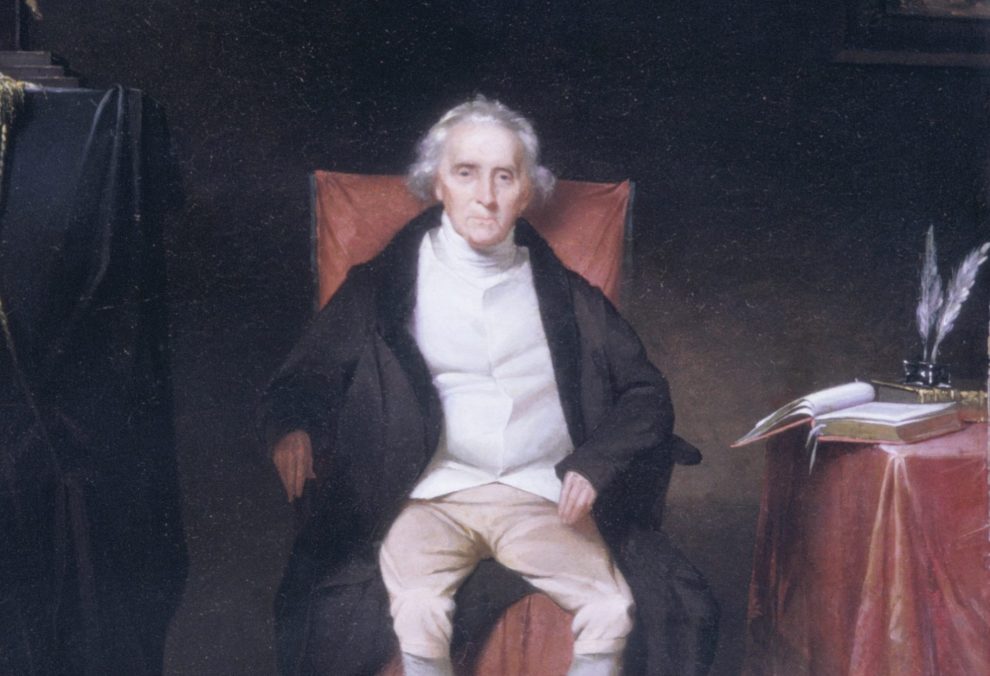
Image: William James Hubard, Charles Carroll of Carrollton, ca. 1830, Oil on wood, 18¾ x 14½ in., The Metropolitan Museum of Art, New York.