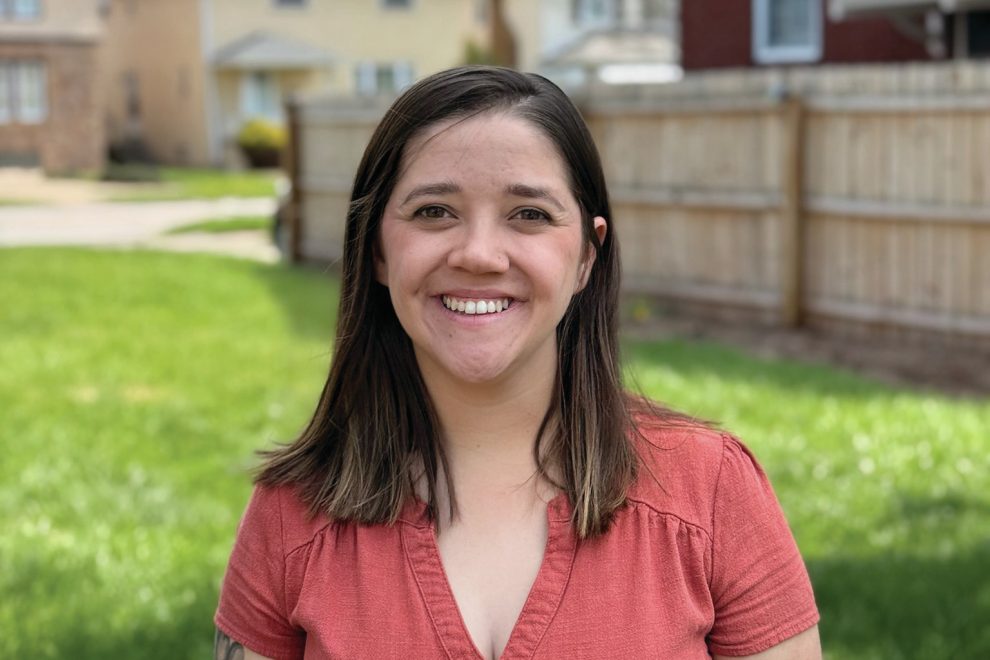
Katie Holler calls motherhood a “transformative experience.” It inspired her to found the Dorothea Project, a group of Catholic women pushing Catholic clergy and laypeople to do more to protect immigrants.
Now 28, Holler has a 3-year-old son, Teddy, and a 1-year-old daughter, Dottie. Her introduction to motherhood was far from peaceful. Her labor with Teddy lasted nearly 36 hours, involved exquisitely agonizing back pain, and the length caused a temporary separation from her firstborn, as he was whisked to intensive care for evaluation after delivery.
“My entrance into motherhood was just marked by a lot of chaos and stress and uncertainty and separation, and that just put me on a little bit of a trajectory in those early months of heightened anxiety, heightened isolation, and heightened depression,” she says. She prayed to the Blessed Mother to help her deal with these feelings. “I tried to stay close to her as best I could.”
Finding mothers online who shared her challenges balancing work and family also helped ease that sense of isolation. Holler called on this online community in 2025, when the Trump administration put in place harsh policies toward immigrants. When the administration revoked “basic care guidelines for pregnant [and] postpartum moms and their babies,” she felt called to “get our church organized in response to this, because this is not fitting with our faith,” she says.
She decided to publish a couple of Facebook posts asking other Catholic moms if they, too, were upset about what was happening to immigrants and whether they wanted to meet virtually to explore what they could do about it.
She soon discovered scores of Catholic women wanted to meet, discuss, and consider the actions they could take. These women were concerned about a variety of issues—including budget cuts harming the poor and environmental devastation—but their top issue was immigration.
It took about eight weeks for the group to form and become operational. Holler says their numbers continued growing, mostly by word of mouth. “I think that’s something that many of us can relate to, feeling alone and thinking that there’s a problem and there’s nothing you can do about it,” she says. “As soon as you see a group of women doing something, bam! You found your people, and you’re good to go.”
The name Dorothea Project honors two American women, both Catholic converts, both currently being considered for canonization: Dorothy Day, a journalist and cofounder of the Catholic Worker Movement, and Thea Bowman, a Franciscan Sister of Perpetual Adoration, granddaughter of enslaved people and advocate for racial tolerance.
Today, the intergenerational group includes more than 1,000 Catholic women—not just mothers—in chapters across the United States. Its initial action was a letter-writing campaign that reached 150 bishops, urging them to forcefully oppose the current administration’s immigration policies.
The group also organizes other actions that coincide with major feast days. The most dramatic action to date occurred January 23, marking the Conversion of St. Paul. Protesters prayed the rosary in front of detention centers, courthouses, and other government buildings. The women held up signs that repeated Christ’s words to Saul, who executed Christians: “Saul, Saul, why are you persecuting me?”
“The purpose behind it was to pray publicly for the conversion and repentance of ICE agents and the protection of immigrant brothers and sisters,” Holler says. The aim “was to get people in community with each other, get people taking action with each other, and get people saying publicly that these actions don’t align with our faith, and we have church examples of people changing their minds, converting and repenting from violence and from persecution and choosing a better way.”
But while the group’s strategy is many-pronged, its primary goal is the education of Catholics about Catholic social teaching (CST).
Holler is a devout cradle Catholic whose faith was strengthened in her teens as she participated in mission trips in the United States and Haiti. Nevertheless, she didn’t learn about CST until her junior year at the Franciscan University of Steubenville, Ohio, where she majored in social work and now is an instructor.
“Catholic social teaching compels Catholics to act and respond, to build a more just and compassionate society,” Holler says.
The United States Conference of Catholic Bishops praises CST as a “rich treasure of wisdom about building a just society and living lives of holiness amidst the challenges of modern society.” Drawing from scripture, the Catechism of the Catholic Church, and papal encyclicals, CST focuses on seven issues that describe Catholics’ responsibilities. Those priorities include: respect for human life and dignity; support for family and community; meeting the basic needs of everyone, particularly the poor and vulnerable; respecting worker rights; understanding love of neighbor in a global context; and care for creation. Faith-informed voting is one way to achieve these goals, Holler says.
To that end, the Dorothea Project has been urging Catholic bishops to revise their voter guide, “Forming Consciences for Faithful Citizenship,” issued every four years before a presidential election, the most recent version of which was approved in 2015. “It’s been given new introductions and other modifications, but the actual document itself has not been changed to meet the current moment,” Holler says.
But the group is not counting on the bishops to heed their advice: Instead, it is completing its own Catholic guide to voting. Their guide aims to help laypeople “be more intentional in their voting” by assessing candidates’ positions on all the issues Catholics should care about, she says.
The plan is for members to distribute the guide through parishes and hold their own meetings to spread the word before the midterm elections this fall. Holler calls it a “bottom-up and a top-down approach. We need the lay faithful in action. We need them educated. We need them moving. We need them in solidarity. And then we also need the bishops and the priests.”
The clergy, she says, have the moral authority to influence Catholics and to stand up to lawmakers. “If you don’t have the leaders, you’re going to be missing a lot of people,” she says, including the Catholics who “dismiss something” because they haven’t heard their pastor or bishop speak about it.
Holler believes that Catholic women’s advocacy already has made a difference. She’s seeing a faster response to the crisis from “bishops who previously would not have responded or not have acted so publicly, so boldly.”
“That gives me hope,” she says.
The Dorothea Project has also deepened and transformed her own faith. In a very short time, she’s met scores of Catholic women with varying faith experiences and backgrounds. “It’s shaped my understanding of what it means to be a Catholic and given me a community where I feel connected to the universal church in a very new and powerful way,” she says.
Empowered by her baptism to lead, she now feels a responsibility to “be more prayerful, more intentional, and more connected to the Lord,“ she says. “All the women who came together to found the Dorothea Project share the desire to be ‘Spirit-guided and Spirit-led.’ ”
While the tasks may be a bit daunting, they are not impossible. “We’re not doing it alone,” she says. “The Lord is more powerful than I am.”
This article also appears in the June 2026 issue of U.S. Catholic (Vol. 91, No. 6, pages 42-43). Click here to subscribe to the magazine.
Image: Courtesy of Katie Holler