My first encounter with the knitting Madonna (as some call her) was not in church or in a museum, but rather on the internet. I was aimlessly cycling through my preferred social media apps when I came across a post featuring a stunning image of a “wayside shrine” in Czechia. Such shrines (known as Boži muka in Czech) are shaped like a tower and provide shelter for a religious image near a road, pathway, or less-traveled area. This particular stone shrine stood amid a wooded crossroads in Travná, a town not far from the Polish border.
Two things caught my eye: First, it had been covered in colorful knit and crochet squares (known colloquially as “yarn bombing”), and visiting devotees had affixed rosary beads and other devotional items to the fibers. And second, it housed a small statue of Mary happily wielding needles and knitting and purling away. I was struck by the quaint, arresting beauty of this shrine and its marriage of the sartorial and the spiritual.
While I couldn’t find much on this particular shrine, I did learn that depictions of Mary and fiber arts are woven throughout medieval Christian art (pun intended). Today, the knitting Madonnas offer us potent theological messages and inspire deeper reflection on the act of creating from earthen fibers, God’s creation. When we encounter these Marian depictions today it is in an era marked by unbridled consumption and senseless disposal, fast fashion and clothing waste, devaluations of women’s work, AI developments and the devaluation of human labor, and more. We view the knitting Madonna with sensibilities formed by consumer capitalism, sexism, and Silicon Valley.
What can the knitting Madonna say to us in the 21st century?
According to Dutch art historian Henk van Os in Studies in Early Tuscan Painting (Pindar Press), in the fifth century, Mary was depicted on a mosaic holding a strand of wool in her hands while the angel Gabriel announced Christ’s incarnation. Here, the wool strand is a symbolic representation of the virgin birth, with roots in the eighth-century apocryphal Latin text, the Gospel of Pseudo-Matthew. This text describes Mary as a Temple virgin passing her days in chastity, weaving a veil for the temple. This process of weaving a veil gestures toward the death of Christ, during which the Temple veil was rent in two.
Depictions of Mary’s active participation in weaving and seaming—doing more than just holding fiber—emerged more than 1,000 years later in northern Italy. In the 14th century, cities such as Florence, Venice, and Milan were critical centers for textile production and trade. During this time, depictions of Mary wielding a needle spread throughout the rest of Italy, reaching Siena and even south in the Abruzzo region. By the 15th century, depictions of Mary with needle and textile in hand appeared in Germany and Spain.
Italian painter Vitale de Bologna’s 1353 Madonna dell’Umiltà (Madonna of Humility) depicts Mary holding some kind of fabric while caressing baby Jesus’ cheek with her finger. Italian painter Lorenzetti of Siena depicts Mary knitting with Jesus to her left while Joseph looks at them both in The Holy Family, circa 1319–1348. Around 1345, Tommaso de Madona’s work Madonna Operosa depicts Mary knitting while gazing down at the Christ child.
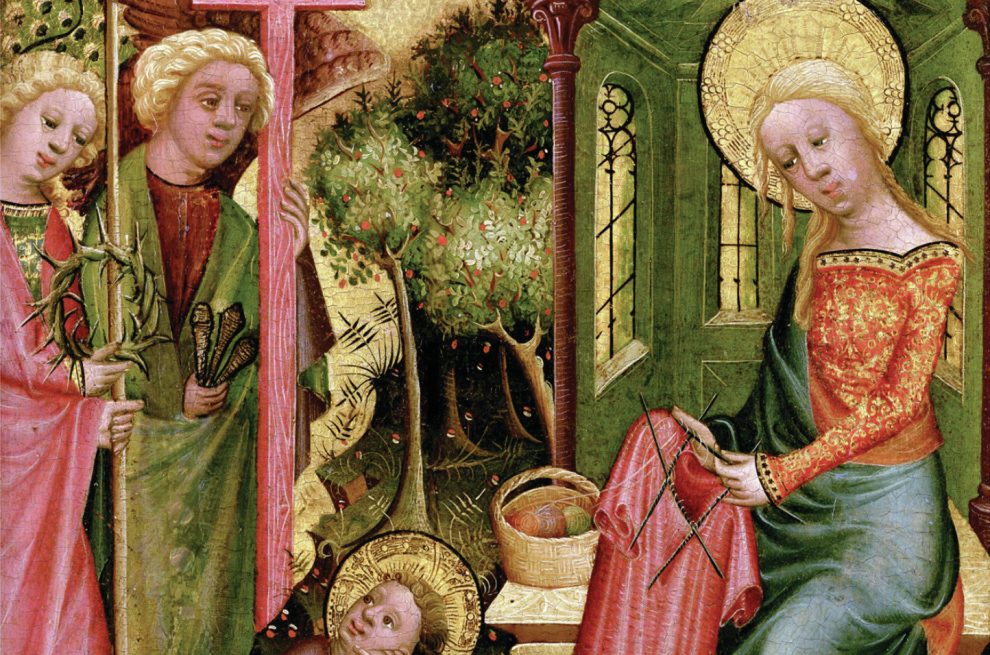
In Germany, Master Bertram of Minden depicts a knitting Madonna in his altarpiece The Buxtehude Altar. Here, Mary knits a red shirt while the Christ child peers from a book, his eyes cast upwards. The altarpiece’s recipient—the Benedictine nuns of Buxtehude—adds further significance to this piece. Women religious often pursued fiber making to sustain their convents, crafting altarpieces, textiles to cover monstrances, and garments to sell to patrons.
In several of these medieval depictions, Mary is knitting in the round, a technique that allows the artist to make things like hats, sleeves, or the bodies of shirts without a seam. In these depictions, this technique takes on theological meaning: It gestures toward the Gospel of John, where the Roman soldiers strip Christ and cast lots for his seamless garment while he is on the cross.
At first blush, depictions of Mary wielding a needle may feel a bit traditional, invoking visions of domestic ideals. But to regard the knitting Mary as a meek, passive figure is a mistake, as is underestimating this potent Marian depiction.
Fiber arts are too hastily devalued because of their association with women. They are quickly relegated to the women’s domain and devalued as such. Yet sewing, knitting, and other techniques are essential in clothing a people and constructing better futures for communities.
For example, in the work Meditations on the Life of Christ (which was traditionally attributed to St. Bonaventure but is now considered to be the work of Franciscan friar Iohannes de Caulibus of San Gimignano), during the holy family’s time in Egypt, Mary honed her sartorial skills to support her family: “She provided the necessities for herself and the Son with spindle and needle.”
Mary’s tenacity is reflected in the sartorial efforts of other women throughout history to secure better futures, such as the 19th-century Irish women who crocheted lace to lift their families out of poverty and emigrate during the British-
manufactured famine.
In addition, the techniques employed in fiber making have been adapted for other industries and in technological design. In medicine, textile techniques contribute to the fabrication of cardiac patches, vascular graft constructs, stent designs, and wearable sensors. Devices like mechanical thrombectomy retrievers, which are used to “catch clots” in the body, feature metal wires woven and braided into specific patterns that allow for expansion—patterns that originate in fiber making.
Fiber art techniques are also essential in skyward endeavors. In the 1960s, NASA developed a system called core rope memory to expand computer memory, which involved a process reminiscent of weaving. NASA enlisted women to develop core rope memory by weaving and routing copper wires to create binary computer code. This technique, later dubbed “weaving memory,” relied on techniques found in looming and weaving.
These contributions are impressive, but they do not grant fiber arts their value. Even if weaving and sewing and other techniques weren’t employed in these incredible technologies, they remain valuable because they are an avenue for emulating God. In a very literal sense, knitting and weaving and sewing are ways for fiber artists to cocreate with God. By taking God’s creation in their hands and spinning it into something new—sweaters, socks, rugs, blankets, and so much more—fiber artists embody the spirit of the divine. Intricate weaves and knits stir awe in me, not unlike the awe I feel when I view the night sky from a remote area. In both tapestries, skyward and earthside, I encounter the goodness of handiwork and I encounter God.
The knitting Madonna invites those who encounter her to experience fiber arts as a journey to cocreate with God. She encourages us, through fiber arts, to refuse the temptations of our modern age to abandon skill-building for passive consumption and to take up the needle and thread (or another tool) to join her in the pursuit of sacred work.
This article also appears in the June 2026 issue of U.S. Catholic (Vol. 91, No. 6, pages 16-17). Click here to subscribe to the magazine.
Image: Master Bertram, The Buxtehude Altar, circa 1400, painting on wood, 108.5 cm x 93 cm, Hamburger Kunsthalle, Hamburg