Nearly 20 years ago, an immigration raid sent shockwaves through our community. I was 20 when la migra (immigration authorities) swarmed into the Discount Mall, the epicenter of our community. Immigration agents, armed to the teeth with rifles and bulletproof vests, pursued my people as if we were the worst criminals. A protest broke out at the mall on the corner of 26th Street and Albany.
That raid and that protest changed me, igniting a fire of anger against injustice that still lives within me. That day, I also encountered the Aztec Dance of the Concheros. The danzantes had gathered there in prayer and protest, singing songs about God and Jesus, and praying to Mother Mary for help.
This Mexican spiritual dance tradition has survived more than 500 years of colonization, oppression, and systemic racism. It is practiced in Mexican barrios and in cities across North America, including Chicago, Illinois, where it thrives in my own neighborhood, La Villita (Little Village), a main port-of-entry for Mexican immigrants in Chicago.
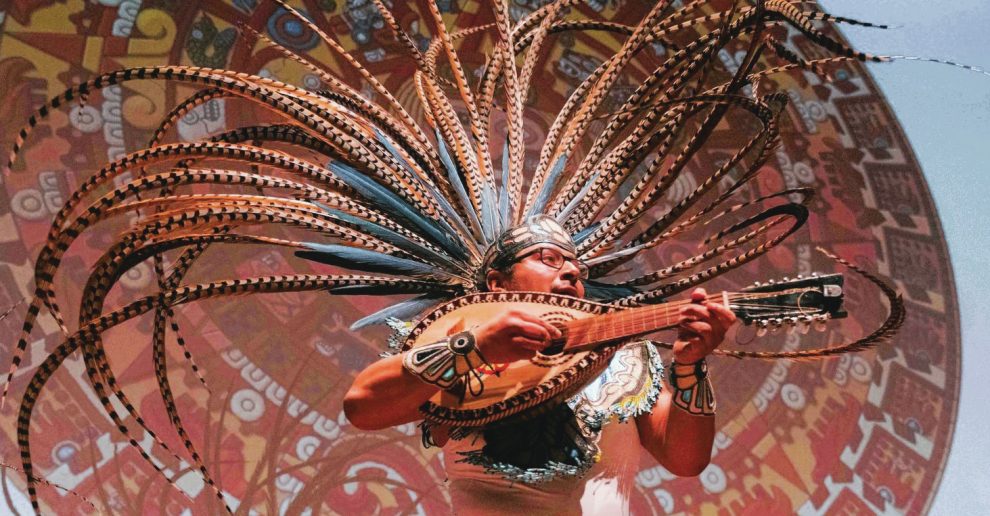
The spiritual practice of singing and dancing has a deep heritage in Indigenous traditions throughout the Americas. For the Mexican community, singing and dancing are tied to ancient prayer practices. Today, the concheros dance with guitars made from armadillo shells (conchas—hence their name, concheros), as they continue to celebrate my people’s tradition. Indigenous spiritual beliefs have merged with the Catholic faith.
Originally, though, these dances honored figures from the Aztec pantheon, including Tonatiuh (Father-Sun), Tonanzin (Mother-Earth), and Ehecatl (Lord-Wind). The Aztec Dance of the Concheros is the continuation of the Mexika-Tenochca Teo-Chichicameca dance traditions dating back to before the Conquest of the Americas.
After Cortez’s bloody conquest in 1521 of Tenochtitlan (the Aztec capital), came a spiritual conquest of souls, as European evangelists converted millions of Indigenous people to Christianity. Various apparitions at sacred sites in the Aztec Empire came next: The image of Mary (Our Lady of Guadalupe) appeared on Tepeyac Hill (1531), the image of Jesus (Our Lord of Chalma) in the caves of Chalma (1539), and the apostle James (Santiago Apóstol) on the Hill of Sangremal (1531). The apparitions at these ancient temples led to the construction of Catholic churches bearing the names of those apparitions. My people’s sacred world changed, and we changed with it. But our danza didn’t change.
After the conquest, la Danza entered a new sacred realm. Now, we dance in honor of Jesus and Mary. The Father-Sun god became the Son of God, because both sacrificed themselves for humanity and became light to the world. The Mother-Earth goddess became Mary, mother of God and Patroness of the Americas. The Aztec tradition of Day of the Dead became our vigil to the memory of our animas (ancestors), which we now celebrate as All Saints and All Souls Day. St. James (Santiago) replaced Ehecatl-Quetzacoatl (Lord of the Four Winds). The new faith became one with our tradition, and today, faith and culture still coexist. The Aztec calendar and the Catholic liturgical calendar meet and inform our days.
The four main annual ceremonies of the concheros take place at four churches in the four cardinal directions of Tenochtitlán, now known as Mexico City. On Ash Wednesday, we dance in honor of Jesus, Lord of Sacromonte, in Amecameca (east). On Pentecost, we dance in honor of Jesus, Our Lord of Chalma, in Malinalco (south). Later in the year, we honor Mary, Our Lady of Remedios, in Naucalpan (west), and finally Mary, Our Lady of Guadalupe, in Tepeyac (north). Our danza group Xochitl-Quetzal has all four sacred images, along with St. James, on our traditional danza banner.
At the time of the raid and the protest, I was a cultural Catholic. Then, as I watched the Aztec dance, I gained a deeper understanding of Jesus and his ministry. At the protest, I also met the man who would later become my closest friend, my father figure, and Aztec dance chief: Jorge Nieto, a Mexican Catholic, who taught me what it means to value our people in the community.
Nieto, a devout Catholic, reintroduced me to Jesus and the Catholic Church. He took me to Mass and the street processions of Holy Week. The Viacrucis Viviente (Living Way of the Cross) is a Good Friday tradition in Chicago’s Pilsen neighborhood that’s been held annually since 1977. It features a live, block-long reenactment of the 14 Stations of the Cross, drawing hundreds of people to watch the procession (which typically starts at 18th and Halsted Streets and ends with the crucifixion scene at Harrison Park). For decades, Nieto directed the Viacrucis Viviente, always including a message about immigrant rights.
Nieto also took me to cathedrals and churches in Mexico, many of which were built on the sites of ancient Indigenous temples. He would always tell me, “Tengo mi religión, pero también tengo mi tradición,” meaning, “I have my religion, but I also have my tradition.”
I learned from Nieto how to dance just like our ancestors did, honoring our sacred past and remembering our spiritual ancestors. When we dance, we pray—and when we pray, we heal. The history of our people lives in the Aztec Dance of the Concheros. It proclaims our identity; our mere existence is a form of resistance in a world of oppression and discrimination.
In February 2026, Pope Leo visited Mexico, where he reflected on inculturation and offered Our Lady of Guadalupe as the prime example. “The proclamation of the Good News always takes place within a concrete experience,” Leo said, so the “cultural reality of those who receive the proclamation cannot be ignored.” Leo reminded his audience that inculturation is not a secondary concession or merely a pastoral strategy but rather an intrinsic requirement of the church’s mission.
Inculturation must be front and center in bringing the Good News to the oppressed. My ancestors knew this. For survival, Indigenous leadership merged with the colonial occupation, but they found life-giving refuge when they were baptized and accepted Jesus as the new lord of their lives.
Today, I consider myself a descendant of both colonized and colonizers. Like my friend Nieto, I am a representative of my tradition and my faith. For many like me, the Catholic Church has become a place not only of refuge but of strength and spiritual renewal. Nearly 80 percent of Mexicans identify as Catholic, and our history has everything to do with that.
The very fact that these dances and songs continue is a miracle, given five centuries of conquest and imperialism. The Aztec Dance of the Concheros allows me to literally follow in the footsteps of those who came before. We are the history of the Americas and of the Catholic Church.
This is why we dance today—to proclaim both our faith and our identity. My dance group has danced in prayer at various churches across the Archdiocese of Chicago and throughout the United States and Mexico. We are intentional in remembering our culture and keeping the faith.
We are not keeping the culture alive, however—the culture has kept our community alive. We are not preserving the tradition; the tradition is preserving us. As Rev. Dr. Martin Luther King Jr. once said, “We are not makers of history, we are made by history.” We must remember the ones who left us this spiritual practice. And we must remember, as we concheros always say in our dance prayer rituals: Él es Dios! He is God.
This article also appears in the June 2026 issue of U.S. Catholic (Vol. 91, No. 6, pages 44-45). Click here to subscribe to the magazine.
Image: Henry Cervantes leads a dance for hundreds of youth in the Chicagoland area. January 2023.