I grew up bound for Colorado. We have family there, and every summer we would leave the Midwest in a van filled with siblings, cousins, and tías. Every trip began with prayer, led by my mother—an Our Father, a Hail Mary, and a Glory Be, followed by petitions for those traveling and those remaining at home.
If there were a shrine or special church along the way, we would stop there, often meeting our Sunday obligation at some random church in the Rockies. More than once, we spent time at the Mother Cabrini Shrine, nestled in the foothills. Following the winding path to the top, a Midwesterner might need to stop to catch his breath (or to gaze at a snake). Returning to the bottom, we considered filling a jug with holy water from the font to be a treat.
In those moments, the lines between the mountains and the holy were blurry, and even the flatlands of Iowa and Nebraska felt wondrous.
Much later, during graduate school, I learned this wondrous blurring was born out of my father’s love for the road, combined with my mother’s devotionalism—her invoking the holy into our everyday experiences.
Reading scholars such as historian Jay Dolan, I learned my mother’s piety was common for her generation—lighting holy candles, placing religious statues and holy water in the home, and the pervasive presence of saints’ images or holy cards randomly scattered throughout the house. Reading sociologists and theologians such as Andrew Greeley, Robert Orsi, Vincent Miller, Roberto Goizueta, and Karen Mary Davalos, I learned the power such devotionalism has when practiced outside of homes, in the streets, and on the road.
Orsi writes about a tattoo of Our Lady of Guadalupe on a prison inmate; this tattoo could be a form of devotionalism, with the power to transform the experience of incarceration by calling to mind God’s presence in all circumstances. Davalos explains how participating in a way of the cross procession in the streets of Chicago’s Pilsen neighborhood could, in a similar way, transform the experience of the streets: Imagine meditating on Jesus’ first fall while standing on a corner where your cousin was first approached to join a gang or at the entrance of a club where your loved one drank her life away.
Gradually, on road trips during graduate school, I became more conscious of the relationship between devotionalism, the holy, and the natural world. The first time this happened was on a road trip I took with Damian Costello, who has also written for U.S. Catholic.
On a crisp October morning, we headed north from Ohio, crossed into Ontario, and passed through Toronto and tribal land on our way to New England. I remember Damian’s long right arm extended as he drove, his palm pressed into the steering wheel. He looked at me and asked, “Should we pray?” He thanked God for the gray-blue autumn morning. He told Jesus, on behalf of both of us, that we loved him. He asked God—the Creator, the Son, and the Holy Spirit—to bless the road in front of us. His prayer was like a psalm, with a sort of tenderness to it.
After prayer, we picked the music we wanted to hear. We usually listened to a lot of Bob Dylan or jazz, but that day, we opted for Johnny Cash reading the book of Revelation. Cash described the natural world in metaphysical terms as the American landscape unfolded before us. Such devotionalism invited us to see everything as holy, just as it had when I was a kid.
On another road trip, a friend of ours—the hyper-rationalist Joe Weber—and I drove Damian to his wedding in Vermont. The plan was to catch a ferry for the final stretch. As we drove through the winding roads approaching the dock, the sun was setting, permeating the sky with an intense pinkish-red hue. Damian said, “Roll the windows down, boys. This is St. Thérèse showering us with roses.” To my surprise, rationalist Joe rolled his window down, stuck out his head, looked around, smiled, and said, “Thank you, St. Thérèse.”
My own children inherited devotions like this. Nearly every year on October 1, the feast day of Saint Thérèse, the South Bend sky glows a deep rose pink—and the kids notice it. In fact, I often forget some saints’ feast days, but eventually, one of the kids will see the sky and remark, “It must be St. Thérèse’s feast day.”
Another devotion our family has is to Our Lady of Guadalupe—a feast day my wife particularly helps to cultivate by helping our local parish (she and our kids make the paper roses that adorn La Virgen on her shrine). One particular December 12 in 2024, as we were driving home from school, we noticed a peculiar formation in the sky. “It looks like Mount Tepeyac!” our son exclaimed. “There are Tepeyacs all over the place!” our daughter shouted, pointing out the windshield. Indeed, the clouds all looked like the hilltop in Mexico where Our Lady appeared to Juan Diego back in 1531. The kids made me pull over to take a picture. This too was a moment of holiness.
Shortly before I got married, I found myself on a different road trip with an emerging theologian—Michael Hebbeler. Here, I learned that devotionalism also affects strangers. Our original plan was to contemplate the edge of America from the glorious vantage point of the Pacific Coast Highway, but at some point, we had another brilliant idea: We decided to drive east and experience Las Vegas at night, then keep going to behold the southern rim of the Grand Canyon with the sun coming up at dawn.
I remember riding shotgun as we headed east from Las Vegas. I remember praying for prudence, wondering if we had made a terrible and dangerous decision. I remember falling asleep. Thank God, we made it to the Grand Canyon.
We parked the car, took a quick nap, woke up, and walked out to the southern rim. We found a spot on the edge suitable for morning prayer. After finding a huge boulder we could share, we dangled our feet off the edge, and I pulled my copy of the breviary from my back pocket. We sang an opening hymn, read the psalm, the Canticle of Zechariah, and the intercessions—trading stanzas back and forth like monks.
When we completed our prayer, bowing with the “Glory Be” and overlooking the Grand Canyon, a woman in her 60s, whom we had not noticed until then, approached us.
“Good morning,” she said. “I just wanted you to know I noticed when you walked up and saw you shuffling around to find a spot. Then I noticed you two…praying? I found it captivating. Anyway, I’m not a believer, but watching you two and listening to you pray makes me wish I was.” Then she smiled at us, said, “Thank you,” and walked away.
Such is the power of devotionalism as it manifests the relationship between heaven and the seemingly ordinary world around us—the relationship between the supernatural and the natural. This manifestation is especially intense when we take it on the road, because the road emphasizes the permeability and liminality of devotionalism.
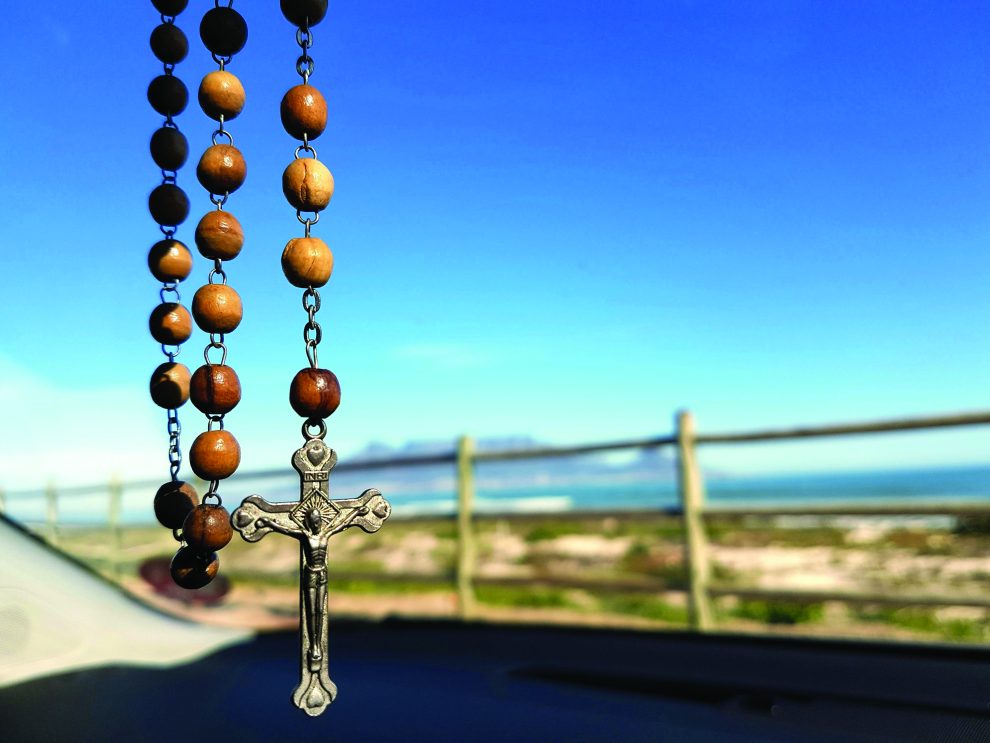
A person on the road is less able to confine the holy. Picture it: A rosary on the rearview mirror, with a dangling crucifix, makes its way past the Continental Divide, spiritually embracing anything along the way that it passes. A saint’s prayer card clipped to a visor does the same as it cuts through the Heartland and up the Atlantic Coast. In this manner, devotionalism blurs the lines between experiences of the holy and the mundane. It manifests the relationship between the supernatural and the natural, and our vision widens to include the holiness already around us.
This article also appears in the May 2026 issue of U.S. Catholic (Vol. 91, No. 5, page 44-45). Click here to subscribe to the magazine.