Pope Leo XIV’s first encyclical, Magnifica Humanitas, was released on May 25, 10 days after its signing. The date of the signing was significant, taking place exactly 135 years after Pope Leo XIII issued his groundbreaking social encyclical Rerum Novarum (On Capital and Labor). Just as Rerum Novarum responded to the challenges of the Industrial Revolution, Magnifica Humanitas responds to new technological challenges in the era of artificial intelligence, building on the church’s tradition of prioritizing human dignity as a core moral principle when addressing labor, the economy, and social issues.
A Vatican press release in advance of the new encyclical stated that it would focus on “safeguarding the human person in the time of artificial intelligence.” Magnifica Humanitas is the first encyclical to address this swiftly-accelerating new technology.
The promulgation also marked a historic first in that Pope Leo introduced the encyclical in person. The speakers at the presentation, which occurred in the Vatican’s Synod Hall, were Cardinal Víctor Manuel Fernández, Prefect of the Dicastery for the Doctrine of the Faith; Cardinal Michael Czerny, S.J., Prefect of the Dicastery for Promoting Integral Human Development; theologian Anna Rowlands of Durham University in the United Kingdom; political theologian Leocadie Lushombo, I.T., of the Jesuit School of Theology, Santa Clara University in California; and Christopher Olah, a cofounder of the AI corporation Anthropic. Cardinal Secretary of State Pietro Parolin offered concluding remarks, and the presentation ended with Pope Leo giving a blessing.
At 42,300 words, Magnifica Humanitas builds on Rerum Novarum. “While Leo XIII spoke in his time of ‘new things’ (rerum novarum), today we cannot limit ourselves simply to repeating his insightful teachings. Instead, we must ask God for the wisdom to interpret the great trends of our time, particularly technological advances,” the encyclical states. “It now falls to us to face the challenges of our time with clarity of thought and responsibility.” In the months to come, scholars, journalists, and church leaders will be unpacking its significance for aspects of human life—including here at U.S. Catholic. But for those wondering about the main points in the document, here are some key takeaways:
Pope Leo uses scripture to argue for an ethical understanding of technology
We must . . . avoid the “Babel syndrome,” namely the idolatry of profit that sacrifices the weak, a uniformity that neutralizes differences, and the pretense that a single language—even a digital one—can translate everything, including the mystery of the person, into data and performance. The risk of dehumanization—of building a future that excludes God and reduces the other to a means—is an ancient and ever-new temptation that today takes on a technical guise. Instead, let us choose the “way of Nehemiah,” which highlights the importance of working together to make the City of God a safe place for returning exiles. Rebuilding today means recognizing that, precisely from the plurality of voices and visions which, even though they sometimes remind us of the confusion caused by the diversity of spoken languages, a bright possibility emerges. Indeed, this is the possibility of building together, of transforming diversity into a resource and of making listening and dialogue the common ground upon which to cultivate justice and fraternity.
Catholic social doctrine is developed through shared discernment
What matters most is not occupying positions of power or defending cultural strongholds, but initiating good processes and enabling them to mature. In this way, the truth of the Gospel is not imposed from above, but grows over time within the concrete interweaving of lives, communities and cultures. This is not a truth that fears diversity, but instead welcomes and guides it. It does not eliminate conflicts, but transforms them, reuniting that which history tends to scatter.
Technology is dangerous in part because it consolidates power in the hands of a few people
In many cases within the digital context, control over platforms, infrastructure, data and computing power does not rest with States, but with major economic and technological actors. These entities effectively set the conditions for access, determine the rules of visibility and shape the very possibilities for participation. When such power is concentrated in the hands of a few, it tends to become opaque and evade public oversight, increasing the risk of distorted forms of development that give rise to new dependencies, exclusions, manipulations and inequalities.
AI reflects human biases
Entrusting an algorithm in practice with the power to select who is worthy or not, without anyone bearing responsibility for that judgment, is to hand over the task of redefining the boundaries of human possibilities. In this process, political responsibility is also lost, not just empathy toward those excluded, which can, after all, be simulated. The exclusion of the vulnerable becomes cloaked in a veneer of neutrality and objectivity, against which it becomes difficult to raise objections. In this way, injustice goes unnoticed, and compassion, mercy and forgiveness — understood not as mere appearances but as real political actions — gradually disappear from view.
Morality requires transparency
We cannot be satisfied with merely calling for the moralization of machines—the so-called ‘alignment’ of AI with human values—without also having the courage to insist on a further condition: the possibility of openly discussing the ethical frameworks involved and subjecting them to shared standards of social justice. Otherwise, those who control AI will impose their own moral vision, which will become the invisible infrastructure of these systems. A more moral AI is not enough if that morality is determined by a few. What is needed is a more active political involvement that is capable of slowing things down when everything is accelerating, and of protecting the opportunities for communities still to be able to participate and ask questions.
Truth is a common good
Those who command powerful technological and economic resources, along with substantial human capital for intervention, possess significant capabilities for influencing cultural change. Ultimately, they can influence a significant number of people concerning the truth about humanity, the world, the meaning of existence, the family and even God. This is pure power detached from truth, which subtly or overtly imposes what it wishes others to accept as true.
It is time for a new labor movement
The initiatives which emerged from [Catholic social teaching after Rerum Novarum], including associations, trade unions, cooperatives and welfare organizations, have contributed decisively to improving labor legislation, protecting the most vulnerable and promoting more humane conditions. Today, however, these instruments are no longer sufficient by themselves in the face of the transformations driven by AI, the new organization of markets and the competitiveness that is rarely concerned with social sustainability. New collaborative efforts are needed among political leaders, labor organizations, the business world and the scientific community in order to develop rapidly adequate shared regulations and protections, including at the international level. Labor unions, which the Church has consistently supported, are called upon to be open to new types of employment and the corresponding needs of workers, in order to represent and defend them. In this context, without bold decisions, the prospect of greater poverty and inequality looms large, which would leave many individuals marginalized, stranded and surrounded by the machines and automated systems that have replaced them.
It is time for a new economic paradigm
More than ever, in the age of AI and robotics, it is no longer possible to rely solely on the ‘invisible hand’ of the market. Politics has the task of orientating economies and technologies to the common good, promoting dignified work, social inclusion and an equitable distribution of the benefits of innovation.
Technology tells us to overcome our weaknesses, but God works through human weakness, not despite it
In the promises of transhumanism and some posthumanist currents of thought, which seek an enhanced and almost disembodied humanity, we recognize a yearning that is of concern to us, namely the need for a fuller life, less exposed to limitations and suffering. Yet the Incarnation opens a different pathway. On the one hand, old and new ideologies alike urge humanity to overcome limitations through technology, and to rise above others by asserting dominance. Contrary to this, the mystery of the Son of God entering into our human condition promises something quite different. The living God descends into our history in order to free us from all forms of slavery. He takes upon himself our weakness and transforms it into a setting for salvation.
Pope Leo ends with the words of Mary in the Magnificat
The Blessed Virgin Mary not only teaches us to recognize God’s invisible work, but also directs our gaze to “the points at which humanity is broken and the world becomes distorted: the contrast between the humble and the powerful, the poor and the rich, the satiated and the hungry,” teaching us “to look at the world from a lower position: through the eyes of those who suffer rather than the mighty; to view history through the eyes of the little ones, rather than through the perspective of the powerful; to interpret the events of history from the viewpoint of the widow, the orphan, the stranger, the wounded child, the exile and the fugitive.”
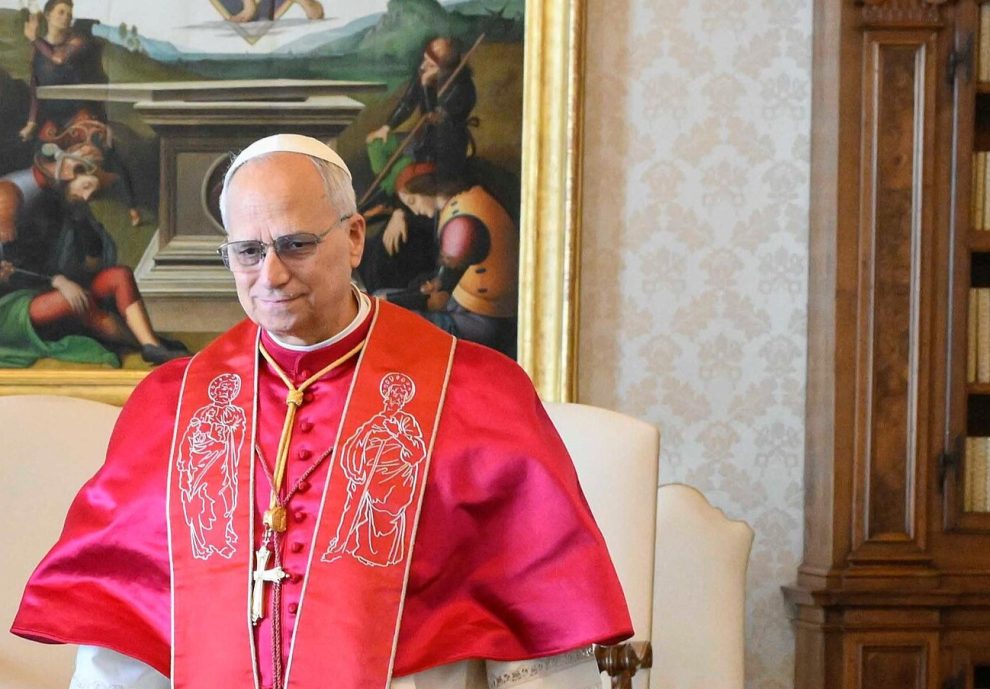
Image: Wikimedia Commons. Pope Leo XIV in meeting with President Arevalo of Guatemala, cropped.