I’ll never forget the second grader who, while preparing for first communion, asked me, “Does communion come from heaven?” Midway through my rambling and overly complicated reply, the child interrupted me to clarify, “No, I mean, does communion fall from the sky?” I breathed a sigh of relief: a much easier answer. “No,” I said. “Communion does not fall from the sky.”
When we practice communion, we remember what Jesus did with his comrades the night before the government violently detained him—and how do I explain that to a seven-year-old? Unfortunately for religious educators everywhere, communion’s origin story is not G-rated.
As a 33-year-old Palestinian Jew, Jesus was a high-priority target of the military forces occupying his neighborhood. He was an increasingly popular organizer who reminded his community that they deserved to have enough to eat, to live in peace, to be free, to have fair work in just conditions, and to be loved and welcomed by their neighbors. Not everybody was thrilled with Jesus’ message then, and not everyone is thrilled with it today.
I grew up understanding communion as something that happens in church, but lately, I’m reconsidering. After all, Jesus gave his friends the sacrament of communion to sustain them for the pending horrors of state violence and trauma. Communion, I am learning, is everywhere.
In my South Minneapolis neighborhood this past winter, where we are still recovering from Operation Metro Surge, I learned that communion is not limited to a church sanctuary. It is that which feeds us when nothing else can; that which appears when we need it most and expect it the least; that which someone else gives of themselves entirely for the good of another.
In Jesus’ day, government leaders decided they needed to put an end to his organizing. He was becoming too threatening to the status quo, even turning key government supporters (like tax collectors) against the authoritarian administration. Jesus knew his time was running out. So he did what faith leaders have always done: He turned to the ancient stories and promises of his faith. He gathered with his friends and chosen family, sharing a sacred meal and remembering when his ancestors, the Jewish people, were liberated from another crushing, violent empire.
At the end of this meal, Jesus turned to his beloveds and said, “What we’re doing is risky business. If anything happens to me, I want you to remember me like this: my body as your bread, my blood as your cup. Remember that I put my body on the line for you over and over again. Remember that I gave my blood, my sweat, my tears for your liberation. Promise me that you’ll take care of each other and be tender with each other. Promise that the good news of solidarity and freedom I shared with you does not die with me. Remember us. Remember me.”
That meal was not a vague symbol of a distant deity but rather a tangible blessing of nourishment for very real human bodies in an intensely proximate and hurting world.
Recently, I was at church with my extended family, including my young niece, who takes communion. She tugged on my arm during the offertory and loudly whispered in my ear: “I hope communion is soon. I’m HUNGRY!”
To be honest, I wish more of us hungered so concretely for communion. After all, for Catholics, communion is the “source and summit” of the Christian life. That is to say, communion reminds us where we come from and shows us where we’re going. Communion both nourishes us and orients us. Communion makes our faith possible and gives our faith purpose. We should all be hungry for it.
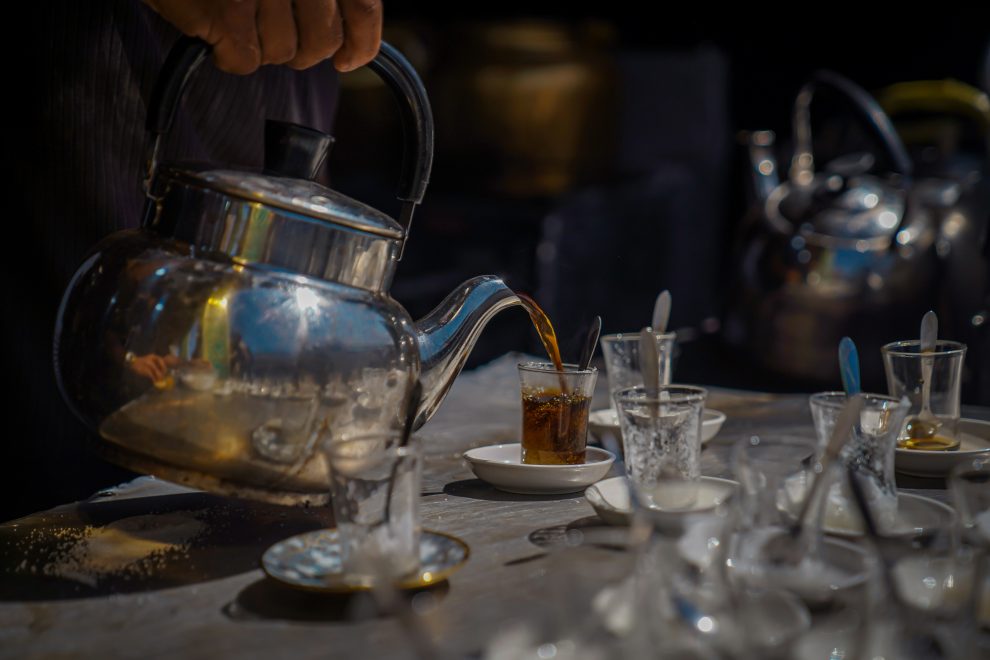
Here in South Minneapolis, during those long, cold, dark weeks of ICE occupation, communion was Somali grandmothers bringing fresh sambusas and hot spiced black tea to mourners at Renee Good’s memorial. Communion was my church handing out hot chocolate and snacks to people doing community ICE watch patrols. Communion was vats of soup batch-prepared by elders in the suburbs and dropped off on the doorsteps of families on my block. Communion was neighbors picking up and delivering groceries to households in hiding. Communion was Facebook pages flooded with reminders to order food from immigrant-owned businesses. All tangible blessings of nourishment. All for very real human bodies. All while the world, certainly, was intensely proximate and hurting.
During that same period, my wife and I were largely consumed by our fledgling vocation of keeping our new baby Frances alive and healthy. For the first two months of Frances’ life (which almost entirely overlapped with the stated duration of Operation Metro Surge), we needed help feeding her, for a whole host of reasons. We had tried several feeding strategies that were not working, leaving us crabby and frustrated parents of a crabby and frustrated baby.
A friend of a friend heard that we were struggling and dropped off 40 ounces of her own frozen breast milk in the cooler on our back deck and threw in a plastic container of homemade sweet potato soup for us, just for good measure. For weeks afterward, she pumped extra hours just to give us and our baby—whom she has still not even met—precious ounces of breast milk. It worked. Her breast milk, too, was a tangible blessing of nourishment for our very real human bodies, one extra-tiny body in particular. How is that not communion?
The thing about communion—especially for Catholics—is that we start with something ordinary and end with something divine. I remember the first time I saw a church supply catalog and realized that our precious communion elements are bulk-ordered and plastic-wrapped. I may not have explicitly believed that communion fell from the sky, but I hadn’t expected our elements to ship from a warehouse, either. In any case, that behind-the-curtain moment is exactly what communion is about: Regular people with regular bread and regular juice—mass-produced, even—come together with great faith and great need. Come to bless what is little and share it a lot. Come united in their confidence that something big is about to change: We will meet God here. We will be fed, all of us. And you know what? It’s been true every time.
Now, my baby is eating just fine on her own. We have dozens of ounces of frozen breastmilk still in our freezer, which bring us great comfort and relief in the world of ever-changing bodies and schedules. More importantly, ICE activity has shifted and slowed; most kids are back to school, and most neighbors are back to work—at least, those who were not detained or deported during the occupation. The acts of public communion so prevalent in my neighborhood over the winter have mostly melted into the gardens now preparing to bud.
As we prepare our young people to receive first communion this spring, may we tell them an age-appropriate yet honest story about hunger and risk, about possibility and promise. May we help them recognize communion in its many forms and locales: a first taste of alcohol in the sanctuary; hot soup on a front step; breastmilk in the freezer. May we bless, break, and share the miracle of divine love with all we meet. And may we know it as our calling to bring even a morsel of goodness to strangers and beloveds alike.
Communion: May we meet God here. Communion: May we be fed, all of us. May it always be so.
Image: Unsplash/Ali Fazel