
Genesis and Job are probably my two favorite books,” says Jamall Calloway. “I’m always talking about freedom and suffering.” This interest in theodicy—or how a loving God can allow evil to happen—combined with a love of literature is what led Calloway to write his book, Imagining Eden: Black Theology and the Search for Paradise (Columbia University Press). Each chapter places a well-known Black novelist in conversation with major Christian theologians such as St. Paul and St. Augustine to explore how Black writers reinterpreted and challenged common interpretations of the Garden of Eden, sin, and the fall.
“So much has been written about how 20th-century Black writers reject God,” Calloway says. “But I always thought that interpretation was very flat. I wanted to interrogate how these writers used religion and thought through the Bible in ways that were much more capacious and nuanced than previous scholars may have theorized. I realized that each of the novelists I write about in my book—James Baldwin, Toni Morrison, Richard Wright, and Alice Walker—were using different aspects of the Edenic tale to say something important about freedom, domination, imagination, sexuality, joy, and God or the lack of God.”
In the conversation that follows, Calloway revisits Genesis not as settled doctrine but as a contested and imaginative text, our interpretations of which have shaped ideas of freedom, sin, domination, and paradise in ways that still reverberate today.
What should readers know about Genesis 1–3?
Well, there are two different creation stories. Genesis 2 is actually the earlier text and portrays this sort of kingly deity who has a more corporeal relationship with creation. Genesis 1 depicts a more transcendent God who doesn’t necessarily create the cosmos out of thin air but is more or less working with the materials already present in the cosmos. In this way, this chapter is very similar to ancient Babylonian texts but also shows God defeating other gods through the act of creation.
Genesis 3 continues on with the same author as in Genesis 2 to tell the story of Adam and the other human. Eve isn’t named until she’s being punished later on in the book. And there’s no recorded conversation between Eve and the deity.
We have to understand that these are ancient mythological texts. I’m not saying they are untrue. But I also don’t take them literally. I see beauty, wonder, and magic in the imagination of the editors, writers, and scribes who put the Book of Genesis together.
I’m reading mythology and literature across each other. If someone prefers a literalist interpretation of scripture, it might throw them off to place Genesis within the ancient Near East—or the area now referred to as ancient Western Asia—literary landscape. But I see it as connected to the Enuma Elish and the Epic of Gilgamesh.
Where does original sin come into the Genesis narrative?
It doesn’t. Sin isn’t even introduced as a concept until Genesis 4. Genesis 3 is about disobedience and defiance. The idea that Adam and Eve partake of a forbidden fruit and disobey God, thereby basically inaugurating sin, is something that comes from both the Eastern and Western early church fathers. St. Augustine popularizes the idea mostly in the Latin West by systematizing it. But it’s foundation was laid much earlier by Irenaeus.
Original sin becomes Augustine’s primary way of understanding human beings and our relationship to God. There’s this idea that humans have disobeyed and disrupted our connection to God, and therefore God orchestrated a divine plan to reconcile Godself back with human beings. And all of this begins with what Augustine sees as this ultimate split in both the biblical texts and church fathers.
Over time, theologians, mostly from the West and all the way to the European Reformations, map this idea onto the biblical text. And that’s how we get our current ideas about original sin.
How have Augustine’s ideas about original sin been used between then and now?
What was meant to be theological exploration of the ways we need to seriously understand how our fraught natures and ways of being selfish or self-interested may be the result of some damaged and distorted will got warped over time to justify all sorts of domination. People need to be dominated because of sin.
Original sin is sort of the undercurrent of the transatlantic slave trade. I teach my students and church how Nicholas V and Alexander VI issued papal bulls that called people from the global South—Africa, South America, the Caribbean, even North America—infidels, sinful people who deserved to be dominated. They saw it as what Rudyard Kipling called their “white man’s burden” to bring them salvation. They understood slavery as the repercussion and correction for original sin.
In your book, you engage Black novelists as theologians. Why did you make this choice? What do we lose when we confine theology to academics or the formal reading of church documents?
Sometimes music, poetry, painting, and art in general can say things in ways that humans are incapable of. When we limit ourselves to simply relying on language, we miss out on the ineffable. Art gives us the ineffable, and if we lose that, then we lose the awe. And if we lose the awe, then religion becomes a set of rules. There’s no wonder, no imagination, no understanding that God’s glory cannot be something that can be put into our own words.
We sometimes see theology as a dead subject, as a sort of rule book, instead of as a living discourse that is still being worked out, negotiated, and reimagined. If we view it as the latter, the concept of original sin is something that is still up for debate. If we stick to the Eastern Christian tradition, the concept of inherited sin is something that is still being debated, contested, and theorized about. But when we see these things as foregone conclusions, we lose any new interpretations—whether from clergy, or other sources, like art.
We do ourselves a disservice when we don’t take into account the cultural artistic products that people have always produced in response to these doctrines, these theological ideas. In the first five to six centuries of Christianity, art—and by that I mean visual art, catacomb paintings, hymns, and chants—were already very much a part of the way people understood and thought through doctrines.
How do you engage art as theology in your book? For example, why did you choose to bring Alice Walker’s The Color Purple and liberation theologian Ivone Gebara into conversation with each other?
Each chapter brings a significant Black novelist into conversation with a theologian to talk about how ideas about Eden show up in their work. For me, Alice Walker, specifically The Color Purple, was an obvious choice to end the book on. I didn’t have to argue for ways to read the novel through an Edenic motif, so I had the least amount of legwork to do. It’s also the least theoretical chapter. All I had to do was get out of the way and highlight some of the parts in the novel that weren’t in Spielberg’s film and that were often understudied when it comes to the Garden of Eden.
Ivone Gebara, meanwhile, was one of the first scholars I read who reinterpreted the depiction of the serpent in the Genesis story. And I also wanted to highlight her because Black theology doesn’t often engage with her work. I was trying to be really careful to avoid this easy dichotomy of saying that Black novelists are right and the classic theologians and philosophers are wrong, and this chapter made it easy to show how they are in partnership in ways that might be more difficult to see in the other chapters.
What did that conversation reveal about Eden, the fall, or sin that formal theology has often missed?
Nothing that Latin American feminists and womanist theologians haven’t already written. I don’t want to jump to the front of the line, as if people such as Emilie Townes or Monica Coleman haven’t already written about them. But the idea is basically that the Genesis narrative has been used to justify the domination of animals and the planet. And the way we treat the Earth, other living beings and nonliving beings, reveals something off, something tilted about our moral imaginations that we have refused to accept because we’ve given our moral compass to these traditional ways of reading Genesis 3.
How do the novelists you write about suggest we might correct our reading of Eden?
They all disagree with one another. Baldwin believes that everyone on the planet, and the planet itself, deserves to feel paradise. Everyone has a God-given right to love and safety, which will eventually lead to radical self-acceptance. We all deserve our Edens without being intruded upon by deities or serpents. Meanwhile, what St. Paul believes is kind of the opposite; our flesh stands in the way of a relationship with God that would engender the feeling of paradise. Our flesh compels us to self-destruct, and therefore we are tethered to this eon that will not last; we need to get rid of our enslavement to the flesh and accept the spiritual selves that God has called us to. Baldwin, meanwhile, sees our flesh as inherently part of us. It’s only once we get over seeing it as a stumbling block that we experience Eden.
For Morrison, the notion of paradise is based upon exclusion. Eden is inherently a gated community. And if we get rid of the idea of paradise, we get rid of the idea that we need to be separated from one another. So it’s not that everyone needs their own private Eden, but Eden itself causes divisions and separations in ways that are unnecessary and unhelpful; it is the very cause of some of our most violent and terrible interactions.
Wright, in The Outsider, is focused on freedom. Not necessarily freedom related to race, but the idea that even if we got rid of our religions and our gods, then our ideologies would still have replaced our deities. All these ideologies are functioning as gods, enslaving people to rules and rubrics in the same way that theologies and religions do. He uses Kierkegaard’s reading of Adam in The Concept of Anxiety, where Kierkegaard makes the claim that original sin did not commence with Adam partaking of the fruit. Instead, Adam learned he had freedom when God started prohibiting him from doing things. The very act of prohibition is also a concession to the fact that Adam has freedom and can do something the deity doesn’t want him to do. The temptation comes from God’s mouth, not the serpent’s.
And, finally, Walker is trying to get rid of any interpretation or idea around Eden that can be corrupted and turned to something that creates distance and unsafety for people, especially Black women and girls. She shows that sometimes the most radical idea is what gets portrayed as something evil. The serpent offers the most radical idea in Genesis 3, but there’s also freedom and safety in this idea, as portrayed by both Walker and Gebara.
These ideas are radically different. There are some connections, but none of the authors read the Garden of Eden the same way in their novels.
What are those areas of overlap?
What ties them all together is something called heretical hermeneutics. In other words, they all have the desire to still see the text as significant and worthy of investigation, but they have no fidelity to any orthodox reading. They all ask: How can I read this text that is important to my community in ways that are freeing for them and get them out of this ritual of sacrifice and enslavement? So what ties them together is more or less their agendas, their desired outcomes for engaging the biblical texts, not necessarily their interpretations or conclusions.
What is the significance of holding on to all this diversity in theological belief, even when ideas conflict?
Sometimes we get caught up on the word theology; it sounds so academic and seminary-oriented rather than ecclesiological. I want to switch terms when it comes to the writers in my book, because what they’re really dealing with is the sacred. All of us think about what’s sacred and what’s not, what’s transcendental and universal, and when we start using these particular terms, we realize that a lot of us are on equal footing. Everyone’s an armchair theologian.
As for the diversity of their theologies, I could say the same about the Bible. Think of Matthew, Mark, Luke, and John: They’re all telling the same story, but they’re different. They disagree with one another. You can do the same with Paul and James.
Sometimes people look for univocality in areas where the truth actually comes from the disagreement, distinctions, alternatives, and variations. The value is in understanding what each distinction individually offers.
For many Christians, Eden is lost forever, and we’re always kind of mourning that loss, while the writers in your book challenge that understanding a bit. Where do you fall?
I’m OK with recognizing that living comes with loss. We lose relationships, we lose people. We move from places we don’t want to or move to places we hate. I don’t want to remove the idea that we have to come to terms with constant loss.
I’m OK with recognizing Eden as a place of loss, of grief, of thinking back to a time before I messed up and lost what I had. What that teaches us is that we have to come to terms with losing, with letting go or being let go, and moving on, while also being gracious and compassionate with ourselves and others.
Your version of mourning Eden is different than I think many Christians’ is, which is more like “Eden is gone forever and all of humanity is horrible because we lost it.”
Oh absolutely. There are things I’ve lost because of me, but there are things I’ve lost because of time or because of someone else. If I use Baldwin’s language, we lose Edens all the time in the traffic of constant collisions and messy existence of life. And I think that reading Eden poetically as something attached to existence is helpful in contextualizing us within time and space.
So, if you start to reimagine Eden in the way these writers do, what happens to sin?
For me, sin is a helpful theological concept because it contextualizes us in a world of constant mistakes, missed opportunities, and shortcomings. It tells someone that they are always off the target of perfection that they want others to live up to. If I remember to ground myself in that level of humility, then I should have the same kindness and compassion for everyone else.
Sin is not meant to be about self-loathing, although if we look at Kierkegaard or even Augustine, it can result in that if we aren’t careful. Which is why—again, coming back to Augustine—it’s also helpful to talk about grace. The grace we should give ourselves, which is the same grace we should give our neighbors.
Where does structural sin play into this?
Reinhold Niebuhr believed that humans seem to be cursed with this desire to misuse power in ways that are harmful to people they can’t see or refuse to care about. Sin is always present in the world. So, to me, structural sin means always being aware of social injustice; it beckons us to confront ourselves and the structural sins that dominate over others, not just ourselves.
Sometimes within liberal theology we don’t want people to feel personally guilty. We’re very clear on the structural argument of who and what we want to feel bad. But we often need to collapse that; the people who are maintaining the structure also have to deal with the personal. And so maybe sometimes talking about or focusing on the personal can be a way of addressing structural sin.
What would the Christian faith look like if we took the theological work of these writers more seriously?
We’d see certain things as up for debate rather than foregone conclusions. We’d be talking about the ways we can actually show fidelity to biblical texts, because right now we show loyalty to traditions rather than scripture, and scripture is oftentimes actually much more progressive than our traditions.
I don’t have a problem with literalist readings, it just depends on what text. I’d love a literalist reading of Luke. But we need to know to switch our techniques and hermeneutics depending on the text we’re reading.
I think our churches would look more intentional. We would stop treating religion so passively and as a corner of our lives and instead see it as more central. Theology and biblical studies are alive. There aren’t any monumental Catholic ecumenical councils right now, but Orlando Espin would say that religion is in your grandmother’s kitchen. Every kitchen is a place to talk about who God is. Every home, every church, every parish, is a council unto themselves. We can reimagine who gets to talk about the sacred without sacrificing the sustenance and integrity of the texts. We have permission from God: God isn’t offended by our re-readings, imaginations, and alternative conclusions.
This article also appears in the April 2026 issue of U.S. Catholic (Vol. 91, No. 4, pages 20-24). Click here to subscribe to the magazine.
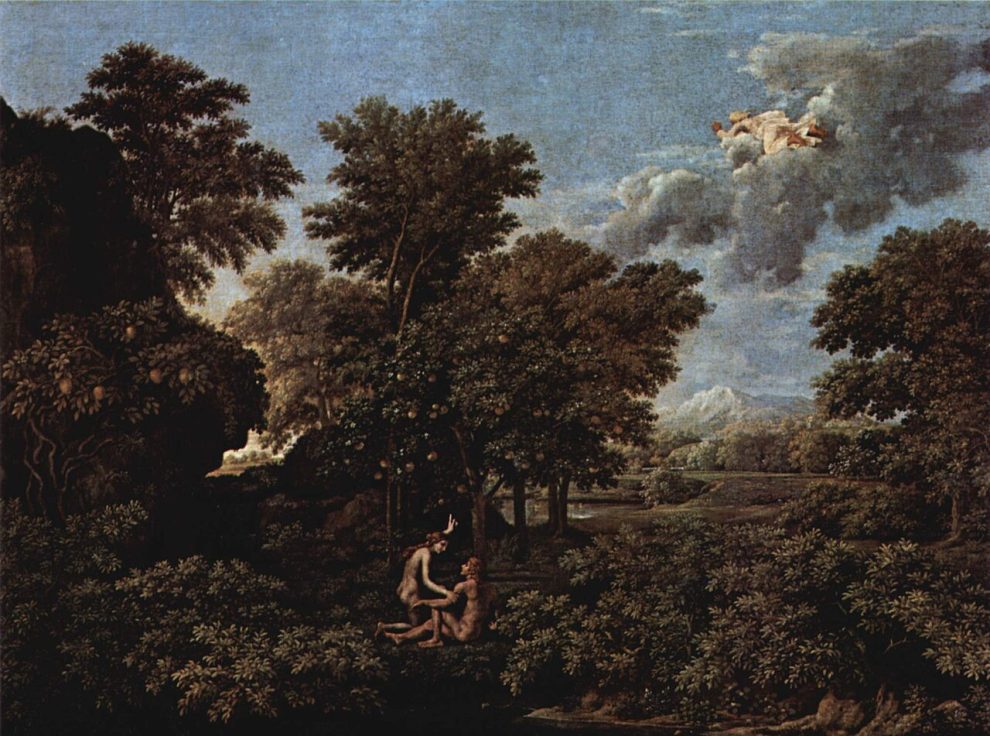
Image: Nicolas Poussin, Spring, 1660-1664