You’ve seen them before. Over-saturated, cartoony, carnival-like advertisements. Blocky letters. Inexplicably mixed fonts. Generic, clip-art flourishes. Exclamation points. Words set atop a slightly stylized but uncanny image that doesn’t quite look like art but also doesn’t look like a photo. These are the hallmarks of AI-generated advertisements.
It might not have alarmed you when you saw an AI-generated social media post advertising an ice cream shop or perhaps as an invitation to a backyard barbecue. Maybe you even joined in a silly AI social media trend. But what happens when that trademark AI “art” appears on the parish Facebook page, in the bulletin, or as a flyer in the vestibule? It feels different when generative AI is used to promote something sacred, even if it’s just the parish picnic.
As a Catholic involved in faith communities on- and offline, I have become increasingly aware of just how many parishes are turning to AI to help them with administrative, communication, and development challenges. Given priest shortages, parish mergers, digitally inexperienced personnel, and diocesan bankruptcy declarations, dwindling parish staff members must innovate to get everything done.
And yes, there is a time and a place for these tools—but in the list of daily tasks that might benefit from delegation to artificial intelligence, communication with the faithful should not be one of them.
In Pope Leo XIV’s groundbreaking encyclical Magnifica Humanitas (On Safeguarding the Human Person in the Time of Artificial Intelligence), he uses an ethos rooted in preserving human dignity and the prism of Catholic social doctrine to view several issues facing the world today, most critically, the proliferation of artificial intelligence. In the document, Leo shies away from an overly prescriptive outline of when Catholics can ethically use AI. Instead, he frames our collective understanding of artificial intelligence in a way that challenges us to answer these questions: What does it mean to be human? And how can we safeguard humanity from technological intrusions? These are the questions that will help us determine when and how to use AI in our daily lives—and potentially, for the glory of God.
“We are called to reflect on the great ‘construction sites’ of our era,” Leo says, “and ask: What are we building? As technological development rapidly transforms languages, relationships, institutions and forms of power, we believers must and can choose which projects to work on and in what manner, so as to safeguard and value the grandeur of humanity that has been given to us as a gift.”
In a poignant and prescient section of the document simply titled “What must not be lost,” Leo describes human existence as complex, warning that our intelligence is merely one aspect of what makes us human and should not dominate or overshadow “other essential dimensions of life, such as affection, the will, commitment and relationships.”
The pontiff also cautions against a culture that values expediency and efficiency above all else. “When efficiency becomes the ultimate measure of value, human beings are tempted to see themselves as a project to be optimized rather than as persons called to relationship and communion,” he writes, adding that if our technology is geared only toward increasing human capabilities and output, we can become “more isolated and more vulnerable to being dominated and excluded.”
The pope’s caution is critical for Catholics today as we grapple with AI’s immense powers. Sure, creating a flyer with a couple of keystrokes, cleaning the parish database with the help of an algorithm, or drafting a theological reflection with ChatGPT or Claude might all be more “efficient.” But the pope is asking us to pause and consider the actual human impact of those decisions.
Does using an AI-generated graphic put a human being out of a job? Does it mean that fewer people see the advertisement and thus attend the gathering? Does cleaning and organizing the database with AI mean that someone accidentally gets deleted or left behind? Does using AI to draft text for a reflection, bulletin, or social media post eliminate the personal touches that foster connection and meaning? These are all questions Leo wants us to answer when considering whether to use these tools.
While Leo leaves room for AI use on a case-by-case basis built on discernment (both individual and collective), he emphasizes the need for creativity over efficiency. The word creative appears in the document nine times, used positively in each reference and often used as a descriptor of human intelligence. “The creative intelligence of humanity is a gift that can alleviate suffering and open up new possibilities,” the pope writes, “but it must remain ordered toward the common good, justice, the care of the vulnerable and creation.” If ordered in this way, the gift of creativity will set us on the path of a progress “that serves individuals and peoples” and not “a progress that subjects them to the mentality of power.”
Some people, however, use AI to tackle tasks that challenge their natural limitations. Perhaps they aren’t artistic or digitally savvy. Perhaps it’s been a long day, and they’re tired. Or maybe a specific task will take too long, and time is ticking to get it done. Under those conditions, a tool like AI can seem like a gift—and perhaps sometimes that is the case!
But often our vulnerability is where the Holy Spirit meets us. Vulnerability and limitations are part of our human experience, and Leo argues that we must embrace them positively. “Our rule must be the acceptance of human limitations as a natural and positive reality, and should be characterized by shared responsibility and a language characterized by the Gospel,” he says.
Creativity is part of what makes us human. It inspires connection, community, enthusiasm, and sustainable progress. When we outsource the creative tasks of our job, especially the ones outside our comfort zones, we rob ourselves of the ability to grow. At its worst, delegating to a machine the work we are afraid or unwilling to do prevents the Holy Spirit from working through us to reach others. If not discerned properly, AI use could rob us of opportunities for grace and encounter.
Some people might point to the relative insignificance of a social media post, flyer, database, or reflection and ask, “What’s the big deal?” But in our digital world, content is the lifeblood of online connection. If an organization is going to succeed in the digital world, the single most important thing it can do is create sustainable, specific, and useful content for its community.
“The content that circulates within digital environments shapes how people perceive the world,” says Leo, “and introduces into the collective consciousness images and narratives that direct our desires and influence our daily choices.”
Good content fosters discussion—and discussion then fosters debate, dialogue, and community. Good content can inform us, shape our views, challenge our biases, invite us to a gathering, or open up a moment of encounter. Good content is authentic, vulnerable, human. It is not generic. AI content, on the other hand, is mediocre and repetitive. Eagle-eyed followers can spot a generated graphic or caption from a mile away. It all starts to look the same. Offering something unique is not only the best practice in marketing and communications; it’s the essence of our Catholic faith.
So it’s okay if you design your parish picnic flyer on Canva, Photoshop, or Microsoft Paint, instead of letting AI do it all for you. It’s okay if the reflection takes more time or research to write. It’s okay if there are a few outdated files in the database. The human act of creating and connecting is more important than the relentless push for efficiency.
The church is charged with offering something different, something more, than what the secular world provides. The words of the gospel are the words of everlasting life. They are not meant to be packaged by an algorithm or proclaimed in a generic template. Instead, the gospel is meant to be preached in our human vulnerability—one social media post, one parish picnic flyer, and one homily at a time.
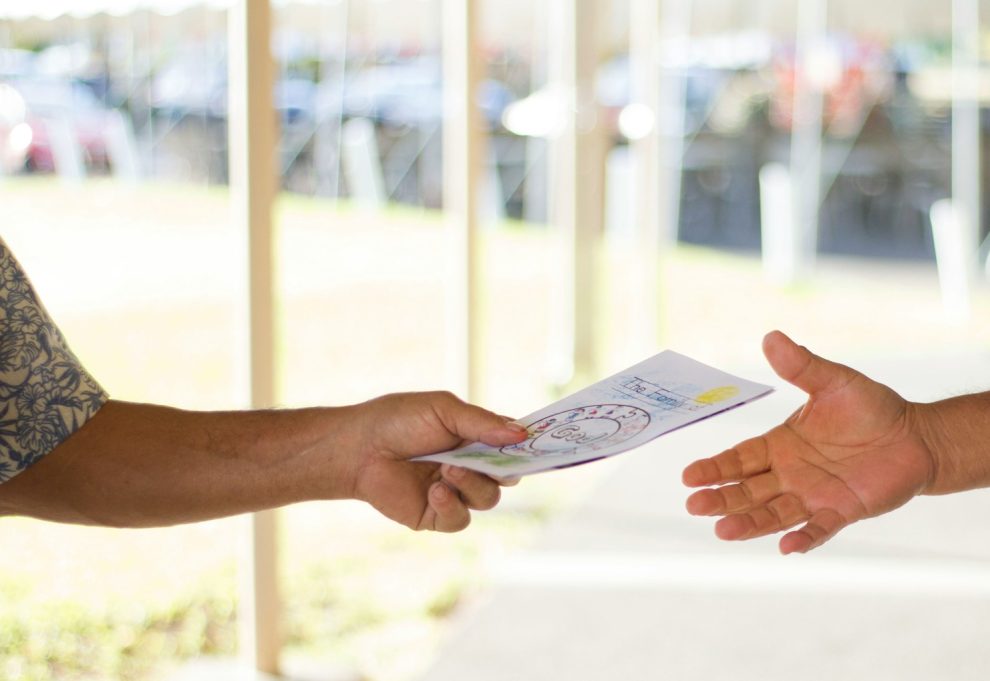
Image: Unsplash