Before it was called Trout Lake, the nearly 4,000-acre body of water in Vilas County, Wisconsin had a different name. An Ojibwe wild rice technician dug up some old files and found the name recently—Makade’ike. It literally means the “place where they make something black,” said Biskakone Greg Johnson on a webinar in November. Johnson, a member of the nearby Lac du Flambeau Band of the Lake Superior Chippewa, surmised that the black color could have had to do with mud, dye for hides, or maybe fire. “A lot of those old translations are lost to time,” he said.
The lake’s Indigenous name surfaced around the same time a small portion of the land around the lake was returned to its original caretakers. In October, the Franciscan Sisters of Perpetual Adoration handed Johnson’s tribe the keys to their just-under-two-acre Marywood Franciscan Spirituality Center along Trout Lake. This act represents the first instance of Catholics in the United States returning land to the original Indigenous tribes in the name of reparations.
Deeper histories
Before European settlers arrived, the entire area from Watersmeet, Michigan, in the north to Wausau, Wisconsin, in the south, Pelican Lake in the east to Park Falls in the west, was called Waaswaaganing (literally, “torch lake”) by the 30-plus Ojibwe tribes that made their homes there. As the white settlers claimed more and more land, these tribes were eventually all pushed into the 87,000-acre Lac du Flambeau Indian Reservation, established in 1854 by the Treaty of La Pointe.
Trout Lake, five miles outside the reservation, holds particular significance for these tribes. “Our culture is centered on water,” says Araia Breedlove, a spokesperson for the Lac du Flambeau Band. “Not only do we have ancestral bodies along that lake, it was a lake filled with our culture—fishing, spearing, canoeing, ricing, and ceremonies.”
The Franciscan Sisters of Perpetual Adoration (FSPA) came by their land around Trout Lake in 1966, after one of the sisters visited the area with her family and envisioned a place of rest and recreation for their community. The FSPA bought the property for $30,000. It served as the regional governance headquarters before transitioning to a spirituality center in the 1990s.
The FSPA, which currently numbers 123 sisters, is based out of its mother church in La Crosse, Wisconsin. They also ran the St. Mary’s Indian Boarding School in Odanah, Wisconsin, from 1883 to 1969.
In 2020, the sisters heard a story from a descendant of a St. Mary’s attendee that challenged their usual narrative that the school had been good for the students. They formed a truth-and-healing committee that brought to light more stories, painting a more honest picture of the mixed results of the sisters’ efforts. “We dived into the aspects of what has happened to the Indigenous people, all of the treaties, and our part in the boarding school that was part of their forced assimilation and losing their culture, as well as our white dominance,” says Sister Sue Ernster, FSPA president.
The sisters’ journey was supported by Land Justice Futures, a group that has walked alongside Catholic religious communities as they discern what to do with land they can no longer manage. While a conventional property divestment process involves finding an agent, listing it on the market, and selling to the highest bidder, Land Justice Futures “creates the foundation for communities to discern property planning in a really different way,” says director Brittany Koteles. “What we’re trying to do is understand the history of severed relationships, between us and people, us and the land, us and God.”
As a result of that deeper work, when the FSPA came to the point of needing to transition the Marywood property to other caretakers, they realized that “it doesn’t have to be a transactional transition where we get the market rate,” Ernster says. The sisters, who were already in relationship with some of the Lac du Flambeau tribal leaders, began a conversation. They were guided by the values in their “Position on Land Resource Decisions” paper, which affirms the order’s simple lifestyle, a perspective of plenitude, and the recognition that all is a gift. It also helped that the sisters’ retirement and care are fully funded. Eventually, they settled on selling the property, valued at $2.6 million, to the tribe for the original purchase price of $30,000.
The ceremony
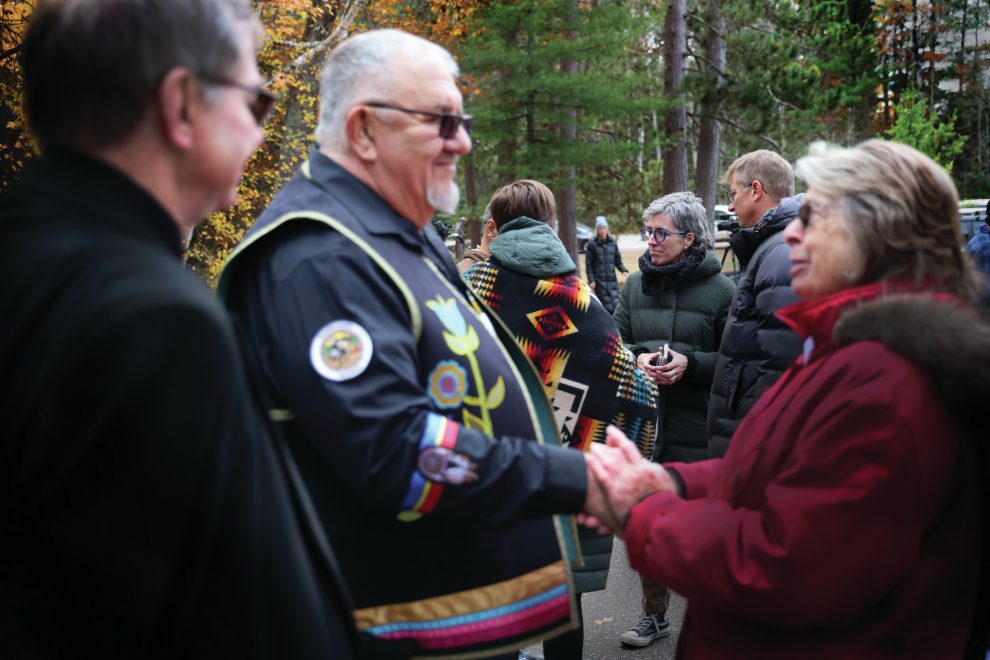
October 31, 2025 was bright and cold on Trout Lake. At the Marywood Franciscan Spirituality Center, a “beautiful, awkward, blended mix” of Catholic sisters, Lac du Flambeau members, and local officials gathered outside, Koteles says. Mildred “Tinker” Schuman, a tribal elder, presided. She sang, burned sacred plants, and blessed the water. Four young women, the water carriers, filled cups for everyone present. Together, the people faced each of the four directions and drank the water.
Drummers called the people into the celebration, a deed was signed, and food was shared. Koteles recalls the entire experience as beautiful, sacred, and even eucharistic. “You were watching in real time the shift of who’s holding this space,” she says. “Two highly unlikely groups were coming together to create this other way.”
One of Greg Johnson’s teachers, a tribal elder, was born on one of the islands in the middle of Trout Lake. While the reservation was established much earlier, Ojibwe bands continued to live nomadically on these islands, which are visible from the shoreline, until they were forcibly removed. “We talk about history. People want to think this all happened long ago,” Johnson says. “That just happened in my teacher’s lifetime.”
As this small piece of the land that was once all Ojibwe territory has returned to the people, Johnson and his friends are revisiting their shared ancestral memories from around the lake. “We have one of our traditional pieces of land back. It might be a fraction of what we originally had, but it is being returned in good faith and in a good way,” he says.
During the event, the sisters shared that it was a bittersweet moment, telling stories of their own from the land. “It’s a very calming space, with large trees, the lake, hearing and seeing different animals,” Ernster says. “When I was there, we would be having meals together, sharing time, playing cards, paddleboarding. The space allowed for us to be nourished and healed.”
Breedlove says she will be telling her grandchildren about this day. “While we have different beliefs, we stood on similar values of kindness and peace. You could feel it in the air,” she says. “Our backgrounds didn’t matter; what mattered was what was happening right at that time.”
The property, set in a resort-like area, is near a golf course, multimillion-dollar condominiums, and vacation rentals. “The land is surrounded by a white community,” Breedlove says. “We’re carving space for brown people where there was never space. That, for us, was huge.”
In fact, several neighbors around the Marywood property voiced concerns when they heard about the pending land transfer to the Lac du Flambeau Band. They said things to the sisters like, “Wait a minute, what are you doing? You can’t trust them, you need to put restrictions on this,” Ernster says. One neighbor even offered to buy the property.
Working with Land Justice Futures reminded the sisters of one of their charisms as Franciscans—to be in right relationship with all creation. The sisters addressed neighbors’ concerns but also pointed them to engage with the tribal leaders. “What are we centering in this decision?” Ernster says. “Are we centering the neighbors or are we centering the land, the land’s history, and where the land belongs?”
At the end of the ceremony, the sisters noticed that a statue of St. Francis was still left on the property. They asked tribal president John Johnson if he would like them to remove it. Ernster recounts that he said, “No, please leave it here; it’s a sign of how the land is passing along, going from one to another.”
More than a deed transfer
The Catholic Church, the largest private landowner in the world, is facing many property decisions as religious members age and numbers decline. In a 2014 study, 80 percent of Catholic sisters in the United States were over 60 years old, while those under 40 numbered around one percent.
Pope Francis’ landmark encyclical Laudato Si’ (On Care for Our Common Home) called on Catholics to heed the cry of the poor and the cry of the Earth. Koteles sees an opportunity in this call for Catholics to understand those two cries as interconnected. “What you do to the people, you do to the land; what you do to the land, you do to the people. We’re inseparable,” Koteles says. Land Justice Futures has worked with more than 100 religious communities to support them in living out this creation worldview of oneness, where humans belong to the land, rather than live separately from it.
For all the parties involved in the Marywood land transfer, this moment was part of the beginning of a larger movement of reconciliation between white settler communities and the Indigenous and Black communities they have harmed. In other parts of the country, people of faith have made similar moves.
Around New York’s Shinnecock Bay, the Sisters of St. Joseph of Brentwood have grown a relationship with the Shinnecock Indian Nation to allow them to access the bay waters for regenerative kelp farming. Beyond the Catholic Church, in 2019, the Hudson River Presbytery donated a building and the surrounding property to the Sweetwater Cultural Center, led by the Ramapough-Lenape Nation, to preserve and promote Indigenous lifeways. Not long after, a Methodist minister in Virginia donated more than half of the 134 acres of farmland she had inherited to the Central Virginia Agrarian Commons, which is working to make land available to Black farmers.
Koteles notes that while this movement includes the acknowledgment of past harm and material reparations, it signifies something far more than moving some deeds around. “It’s about building a future where we all have what we need,” she says, “where we all belong to each other and the Earth.”
Marywood’s future
The Lac du Flambeau Band is still calling the property Marywood for now. They are renovating the cabins on the property and using them to house tribal nurses and working professionals who can’t find housing on the reservation.
The tribe, which numbers more than 3,000 registered members, is in the middle of a housing crisis. Much of the reservation is protected wetland and forest, while about half of the housing is owned by non-Native residents. While tribal members received allotments when the reservation was created, many were forced to sell their properties as the state raised property taxes, and families couldn’t keep up with the fees.
At Marywood, Breedlove, Greg Johnson, and others dream of a cultural center where they hold birchbark canoe workshops, access the water, and bring Ojibwe traditions back to Trout Lake.
The Franciscan Sisters of Perpetual Adoration plan to stay in contact with the tribe. They continue to reminisce about their experiences on the Marywood property, lament, and celebrate this new phase in the land’s history. “I hope it inspires people to realize there are things we can do when it seems so overwhelming,” Ernster says. “There are opportunities for us to disrupt the current system with all the adversarial energy. Hopefully, the intergenerational trauma can start to dissipate. It’s a real opportunity for others to see there is another way.”
This article also appears in the July 2026 issue of U.S. Catholic (Vol. 91, No. 7, pages 10-14). Click here to subscribe to the magazine.
Image: