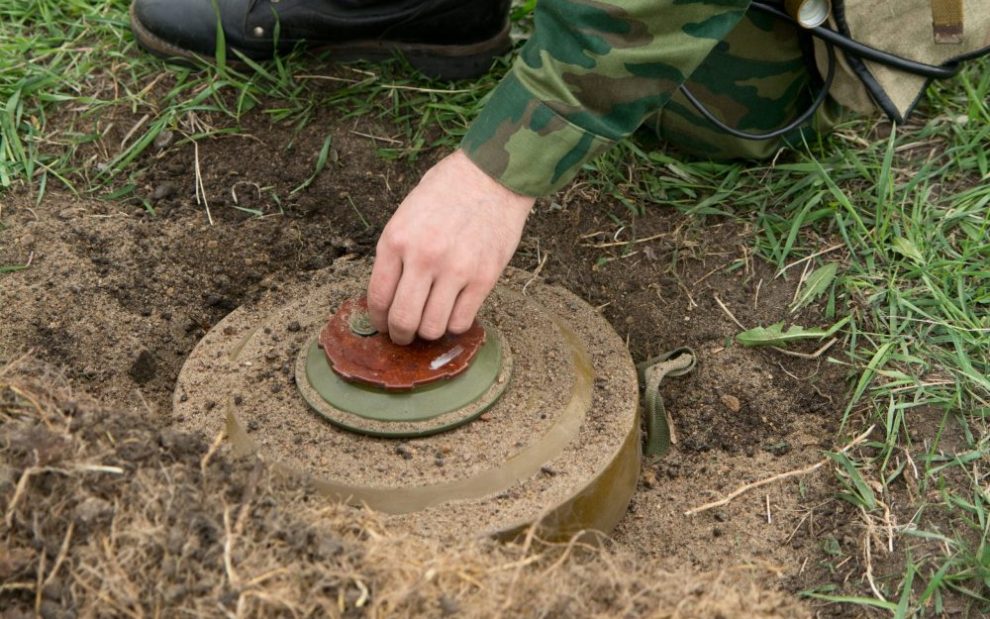
The day before the United States and Israel launched a joint military campaign over Iran, which, in its first days, reached more than 4,000 targets and killed more than 1,000 people, Davor Božinovic, Croatia’s minister of the interior and deputy prime minister, announced that his nation could finally be declared free of landmines—weapons that continue to kill and maim many years after conflict has subsided.
More than 200 people, including 41 deminers, had been killed, according to a government statement, during 31 years of “painstaking and dangerous work.” The effort cost more than 1.2 billion euros and cleared more than 100,000 mines and 407,000 pieces of unexploded ordnance scattered across Croatia during years of strife after the break up of Yugoslavia in 1992.
“This is not just a technical success,” Božinovic said, “It is the fulfillment of a moral obligation to the victims of mines and their families. A mine-free Croatia means safer families, better development of rural areas, more farmland, and stronger tourism.”
The Croatian success is a small reminder of the sorrowful, lingering costs of conflict as President Donald Trump and his counterpart in Israel, Prime Minister Benjamin Netanyahu, begin a war that has not been authorized by the United Nations or formally declared by the U.S. Congress. The administration’s justifications for initiating the conflict hopscotched around in its first days and were rarely persuasive. Some landed awkwardly on the circular proposition that the United States had no choice but to attack first, since its regional ally, Israel, was determined to go all-in and Iran was bound to strike back.
In the short term, a war of choice like this attack on Iran can prove unpredictable. The long-term ramifications of conflict are even harder to discern. If quagmires were easy to foresee, they would be easy to avoid.
The United States declared “mission accomplished” just six weeks into its invasion of Iraq in 2003, similarly justified then as an attempt to defang a foe on the verge of acquiring weapons of mass destruction. In the end, those weapons were not found, but trillions of dollars were wasted, hundreds of thousands of lives ended, and the region thrown into turmoil that persists to this day. After that catastrophic example, it is hard to understand how the United States could have contemplated such a hazardous and costly enterprise again.
Trump has not ruled out putting “boots on the ground” in Iran to press for an unconditional surrender. That land campaign will presumably include Israeli troops. It will mean establishing defensive lines and some kind of billeting for U.S. and I.D.F. troops. It will mean the deployment of thousands of anti-personnel mines laid around army, I.D.F., and Marine positions—just as mines were put to use during Croatia’s bloody conflict with its neighbors.
Neither the United States nor Israel are signatory to the UN treaty that abolished the use of landmines in 1999. Let’s hope that once this adventure without return concludes, it won’t require three decades of painstaking and dangerous work to remove them all.
This article also appears in the May 2026 issue of U.S. Catholic (Vol. 91, No. 5, page 41). Click here to subscribe to the magazine.
Image: Adobe Stock/kanzefar