My great-aunt offered me my great-grandmother’s fine china. These dishes witnessed generations of family dinners, those of celebration and of lament. I adored my grammie, so I accepted without hesitation. Back at home, I found myself asking: What does one do with 87 pieces of antique, lead-glazed china that are unsafe to eat from? And how do we make sense of the complex histories that come with them?
Mixed in the boxes of dishes and teacups are questions about memory and shared history. The personal and the social are always intertwined. In Fratelli Tutti (On Fraternity and Social Friendship), Pope Francis argues that memory and history are essential for building community and peace. He warns that we are often quick to “forget the lessons of history” in order to avoid difficult and painful memories. “Nowadays, it is easy to be tempted to turn the page, to say that all these things happened long ago and we should look to the future. For God’s sake, no!” Francis writes. “We can never move forward without remembering the past; we do not progress without an honest and unclouded memory.”
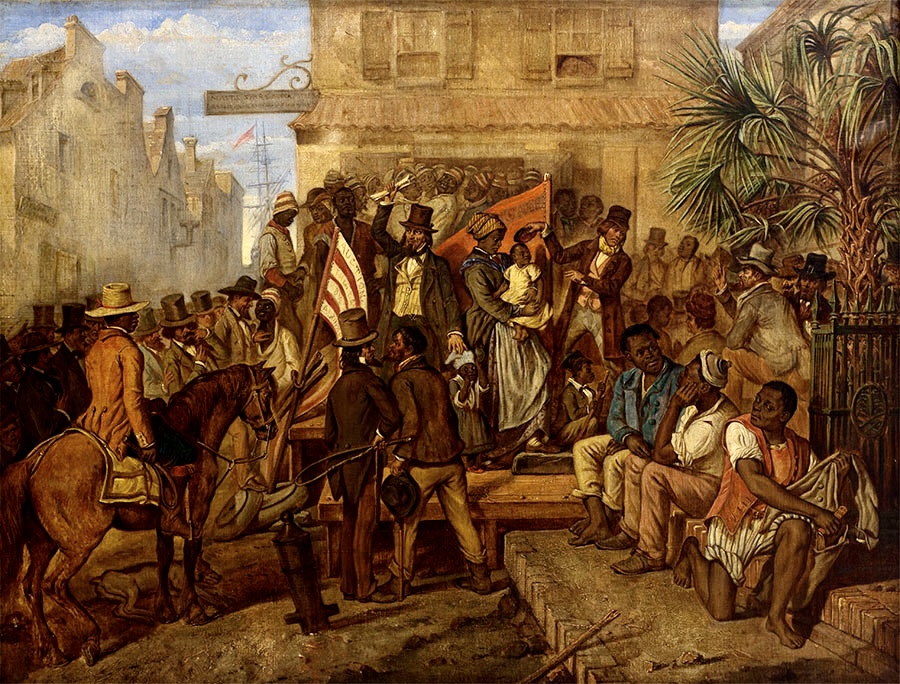
As we celebrate the 250th anniversary of the United States, Catholic social teaching invites us to remember our history with a mixture of celebration and mourning. In a July video, President Barack Obama noted that Thomas Jefferson enslaved people—“and he penned some of the most important words written.” Major Francis Boykin, my sixth-great-grandfather, fought in the 1st Virginia Militia at Yorktown, and he enslaved people. The “and” is uncomfortable but important. An honest and unclouded memory of the United States requires lamenting the horrors of slavery alongside celebrations of the Declaration of Independence. This is not the 250th anniversary of freedom in this land.
In Magnifica Humanitas (On Safeguarding the Human Person in the Time of Artificial Intelligence), Pope Leo XIV reminds us that slavery “constitutes a wound in Christian memory” and asks forgiveness in the name of the church. In recent years, Catholic institutions such as Georgetown University have sought to examine their participation in slavery more openly. In 2022, the Sisters of Charity Foundation issued an apology for St. Elizabeth Ann Seton and other early sisters’ involvement with slavery from 1809 to 1865. In their report, they identify the many ways historical communities “benefited from the labor of enslaved people.” This broader frame is uncomfortable but important if we are to have an unclouded memory of history. “The damage done by slavery is enduring,” they note, and “persistent racism, discrimination, injustice, and inequity demand continued action by all of us.”
The first pope from the United States emphasizes the ongoing need to tell the truth about slavery and seek pardon, and calls us to vigilance against new forms of slavery today. Catholic social teaching asks us to engage past, present, and future, confronting the historical narrative and legacy of injustice so that a new community of peace may be possible. “Moral progress,” Leo writes, “almost always unfolds through a long and demanding journey, often marked by setbacks.” In his encyclical, he challenges us to face “the memory of past complicity and blindness” as a call to action today.
November is a month of remembrance. Beginning with the feasts of All Saints and All Souls and ending with Thanksgiving, it is a liminal time inviting communal reflection. We gather as family and friends around tables to share stories and give thanks. Grammie’s china may no longer be part of Thanksgiving, but the long and complex history it represented remains.
History shapes our present-day world. Catholic social teaching reminds us that only with an honest and unclouded memory is moral progress possible. On this 250th anniversary, each of us must ask: How can I help the United States build on its strengths and avoid the sins of its past? What can I do to foster freedom and justice in our community?
This article also appears in the November 2026 issue of U.S. Catholic (Vol. 91, No. 11, page 40). Click here to subscribe to the magazine.
Image: Wikimedia Commons