When I was a boy in the late 1960s and early 1970s, Thanksgiving seemed like little more than a prologue to Christmas. Society teaches this. We sit down to a nice dinner and then the mayhem of consumerism consumes us.
Like many people I would watch Macy’s Thanksgiving Day Parade. Back then, as is the case today, the parade would start with a turkey, but we all know the real star appears at the end of the parade—Santa Claus. In the time between the turkey and Santa, different balloons and floats suggest items to buy or shows to watch—a marketing extravaganza of several hours. As a child, the most inspiring moment at home was when the turkey came out of the oven and we spent an hour or more eating it and various side dishes. We would then waddle from the table and find a place to nap.
Coming from a family of immigrants, the history of Thanksgiving was always a bit murky. In our Catholic school we were taught it had something to do with pilgrims and Native Americans dining together somewhere in Massachusetts. For my father, Thanksgiving was no big deal. The Americanos invented the holiday and many folks in my Cuban-American community referred to it as El Dia del Pavo [Day of the Turkey] or Sans Giving.
This began to change for me after my first great loss—the death of my mother when I was 15. Several years later I lost my grandmother. And, for a time, there really was no one to cook the turkey or celebrate the meal with. It was melancholy to think of Thanksgivings past.
As an only child, I did not have a large immediate family. For a few years, and on several occasions, friends would invite me to spend the day with them and their families. I found joy in being surrounded by large extended families. Most of those present knew each other for years, but that did not seem to matter. For a few hours I could pretend to have an extensive familial network.
On another occasion, I met a friend in Lexington, Kentucky for Thanksgiving weekend, and we had a delicious meal there. My friend and I sat at a table for two in a packed restaurant surrounded by tables with large boisterous families with parents, children, and seniors.
I was a Thanksgiving drifter. Then I met my girlfriend, Caridad, now my wife, in mid-November 1986. After just one date and a few conversations, she invited me to her home for Thanksgiving dinner with her parents and her brother. I jumped at the chance not only because I wanted to see her, but my other options were limited. It spared me a night of going to a dance club with my father and his girlfriend and sitting there like a mope chewing on white meat. The gathering was small, intimate and lovely. I forced myself to eat black beans for the first time out of politeness and found out I loved them.
After we were married, our families merged and we began to host the annual event. At first, we were the young ones hosting our older relatives; then came our children and it became a three-generation affair. Those gatherings of eight to 10 family members took away the sadness of my drifting days. I knew they were special then and know it even more now as I remember that generation that has since passed. Their passing and our daughter’s move to the West Coast led to another Thanksgiving transition.
The dinners were smaller—at most six or seven—and we briefly considered taking the show on the road to a restaurant. But year after year different people joined us for the Thanksgiving meal.
Often the folks who came had nowhere else to go. They were suffering loss of one sort or another; the loss of a long-time spouse, family far away or no family at all. My wife and I were suffering the loss of our parents as well.
But even more than the loss was a sense of gratitude. Gratitude for each other and the comfort of a shared meal.
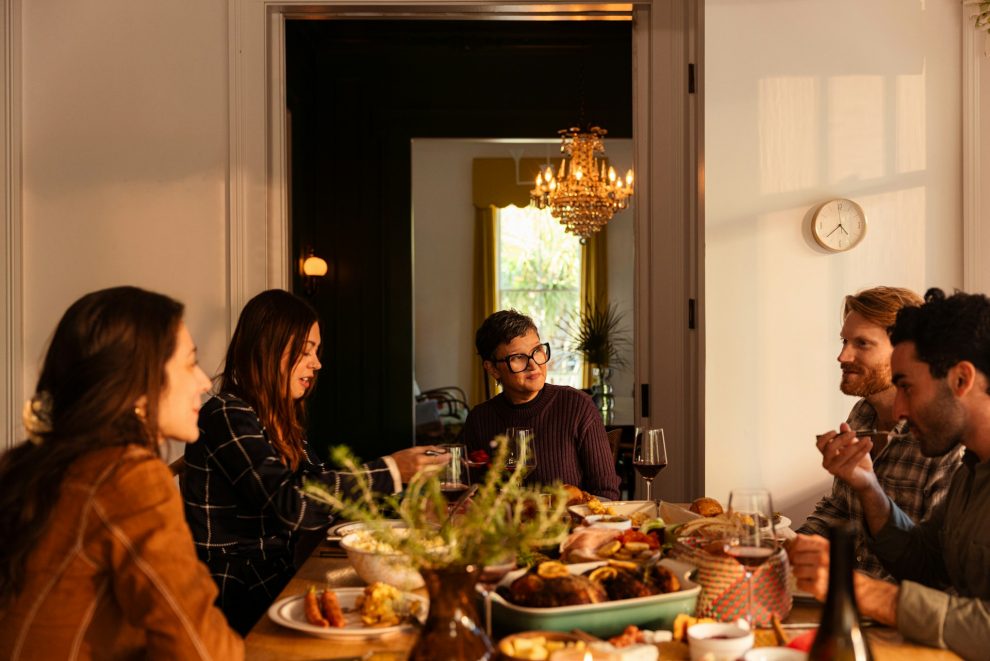
My wife and I are now the older generation, and we preside over the dinner at opposite ends of our dining room table. Before the meal we say a prayer in English and Spanish. I start things off and, in the moments before I speak, I look around the table and inhale the fellowship. My prayers are often a bit haphazard and not steeped in biblical knowledge, and not everyone at our table is of the same faith or any faith at all.
My wife insists that one year I referred to us as a “bunch of misfits,” suffering individual losses but gathering together to celebrate our mutual belonging. Whether I said it or not, I did think it. I love our Thanksgiving gatherings. In a world that can often be cruel, it is a great honor to provide comfort and refuge and be comforted in return.
Last year’s celebration was one of the most special. Two immigrant women struggling in a society ever more hostile to outsiders joined us. One woman’s husband had been recently deported, while the other lost her husband many years earlier during a border crossing that turned violent. It reminded us of the immigrant stories and sacrifices of our own parents and grandparents.
The women led us in the Spanish prayer. Like my father, they had not celebrated Thanksgiving in their country of origin. Turkey was not their meat of choice. But they certainly knew about family and fellowship, and they blessed our home and thanked us for the meal.
As is often the case in our home, the meal is a prelude to several hours of conversation, teasing, and frivolity. As Thanksgiving once again approaches, we look forward to greeting new strangers and sharing stories of loss and triumph from the year gone by.
Thanksgiving is very different from Christmas. It is more intimate. It is more reflective. It is quieter. It is the calm before the winter storm of consumerism and bright lights and never-ending carols. Christmas is everywhere all at once. In an era of social media, public discord, and lack of privacy, Thanksgiving is a holiday with little fanfare. It comes dressed in simplicity and a sprinkling of old memories and the promise of new memories to come.
Image: Unsplash