When the United States partnered with Israel and launched air strikes against Iran in February 2026, Secretary of State Marco Rubio said the strikes were necessary to obliterate Iran’s nuclear capabilities in order to preemptively thwart an imminent threat. The many explanations for these air strikes—labeled Operation Epic Fury—are complicated, confusing, and likely exaggerated. While Rubio defended the surprise attacks as a proactive and defensive measure to “prevent [Iran] from inflicting higher damage,” that argument relies on an antiquated ideology, which purports that peace can only be achieved through military strength and deterrence.
In the ensuing weeks since the first air strikes, the United States and Israel launched missiles, rocket strikes, and drone attacks at 13,000 targets across Iran. They concentrated their operations on the capital city of Tehran, devastating and collapsing the landscape and infrastructure that supports more than 9 million people. As oil refineries and storehouses exploded, sulfur dioxide, nitrogen dioxide, and other toxic chemicals were released into the atmosphere, blackening the skies and causing acidic black rain to fall.
A BBC article from June 2026 reports that the death toll across Iran and the surrounding countries is likely in the thousands, though the exact number may never be known. As of September, an estimated 1,700 to 3,700 civilians have been killed, and 18 to 20 U.S. service members never made it home.
Ten thousand additional troops were sent to the Middle East this year, and more than 20 U.S. warships now patrol the region under the direction of Secretary of War Pete Hegseth. Official rhetoric surrounding the war is punishing and exacting, positioning the nation of Iran as an enemy that deserves, as Hegseth put it, “death and destruction from the sky all day long.” On April 7, 2026, President Donald Trump warned on Truth Social that if Iran did not open the Strait of Hormuz, “A whole civilization will die tonight never to be brought back again.”
In the weeks, months, and years after September 11, 2001, similar wars were waged in retribution for those terrorist attacks and the alleged threat of stockpiled weapons of mass destruction. Like Hegseth and Trump, then-Secretary of Defense Donald Rumsfeld ordered massive obliteration, telling his aide, “Sweep it all up. Things related and things not.”
Things related and things not—vague words to obscure the inevitable erasure of cities, buildings, homes, sacred sites, and the unavoidable slaughter of human lives.
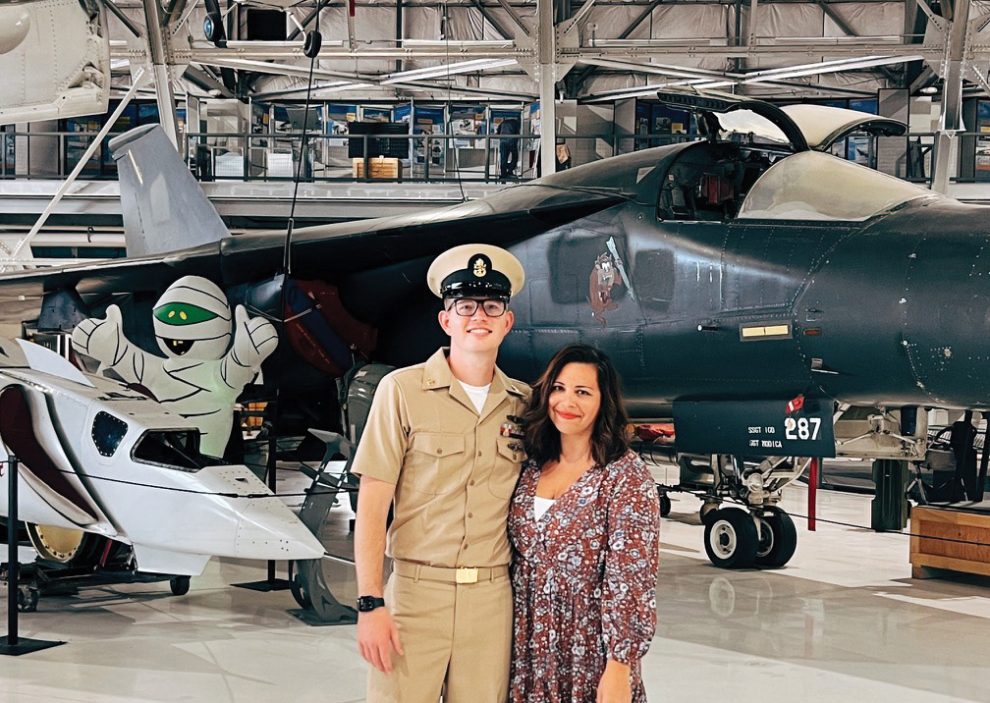
I acknowledge the complexity of international tension and unrest, especially in this era of nuclear weapons. I am a civilian and military spouse who has witnessed countless American sailors attempt to uphold the core values of honor, courage, and commitment while their government acts with little commitment to the preservation of life.
In San Diego, I hike along the cliffs overlooking the bay, watching as naval ships (including my husband’s) prepare for unexpected or accelerated deployments. My husband joined the U.S. Navy almost 11 years ago. Although the patriotic evangelical subculture of the white American South shaped us both, we did not make the decision out of patriotism but pragmatism. As newlyweds, we surveyed our small hometown, considered our meager salaries, and imagined the stable, if somewhat mundane, future awaiting us if we stayed. And we considered what military life would look like. While disruptive, it would offer a livable wage plus a basic housing allowance, early retirement, education benefits, health insurance, and opportunities to see the world.
I was naive in those early years. I had absorbed the ideology of peace through strength, which stretches back to the Roman Empire. This ideology claims peace is only possible through military readiness, and a strong military is necessary for a world without war. Ronald Reagan championed the slogan, expanding weapons development and the military, he claimed, to protect the United States against the spread of communism and the threat of nuclear war.
But the push for peace was insular. While the United States avoided a global nuclear holocaust, the Reagan administration actively funded and orchestrated conflicts abroad—from the invasion of Grenada during Operation Urgent Fury to the Iran-Contra affair, which resulted in the scandalous U.S.-backed arming of Iran. Although the United States has long positioned itself as pro-peace, what that really means is peace for ourselves; basically, we want to avoid war on our own soil.
The religious veneer of Christian nationalism puts another spin on war that might be even more insidious. During Reagan’s presidency, his rhetoric divided the globe between what he implied was a God-fearing West and a godless East. Military might was morally necessary, according to the Reagan administration, which praised soldiers as freedom fighters on God-ordained missions.
This perspective, held today by Hegseth and much of the Trump administration, fuses militaristic Christianity with fanatic patriotism. It frames the United States as a divinely appointed arbiter of justice, fueling destruction against other nations by framing it as spiritual warfare.
Hegseth demonstrated this pattern of spiritualizing and moralizing U.S. military action when he recounted the rescue of a downed U.S. airman who hid in a cave in Iran over Easter weekend. As Hegseth told the story, he drew parallels between the airman’s ordeal and Christ’s resurrection, concluding, “A pilot reborn . . . a nation rejoicing. God is good.” The terrifying irony in his narrative is his selective mercy. While practically deifying the airman, he threatened immediate death for any Iranian soldier in the vicinity.
As a child growing up in evangelicalism, I frequently heard that the world was going to become increasingly violent and cataclysmic as we neared the eventual end of days. Instead of concern for the most vulnerable or even fear of the inevitable, there was a strange sense of acceptance, an apparent apathy about human suffering. The implication was that God would eventually rescue God-fearing Christians from a damned and warring world and bring them to heaven—so who cared what happened here?
I now believe peace is a vital tenet of Christianity. In his Sermon on the Mount, Jesus blesses peacemakers—those who reject violence in the name of human dignity (Matt. 5:9). The Message translation of that passage further affirms the significance of Christ’s peacemaking message: “You’re blessed when you can show people how to cooperate instead of compete or fight. That’s when you discover who you really are, and your place in God’s family.”
On other occasions, Jesus challenges an angry mob hellbent on murdering a woman (John 8:1–11) and rebukes Peter for wielding a sword (John 18:10–11). Christian nationalists reference scripture to justify warmongering, but there is nothing righteous in the pursuit of death.
In the days after the first attacks of Operation Epic Fury, I found refuge in digital spaces with other anti-war military spouses. We voiced our anger, outrage, and grief, especially as the White House hailed the attacks as successful, as if casualties of war weren’t human lives.
A regime may have temporarily toppled, but the costs are catastrophic. Across Iran, Lebanon, Jordan, Iraq, and Syria, 4.2 million people have been displaced. Water sources in Iran are polluted, the air tainted, and more than 100,000 residential homes in Iran alone lie in ruin. The closure of the Strait of Hormuz has choked shipping routes, diminishing the energy supplies that fuel the world; as global prices have spiked, the costs of groceries and gas have risen. Meanwhile, the Department of War so far has spent approximately $38 billion on the ongoing conflict.
I am incredibly proud of my husband, a man who has served honorably, cares deeply for his sailors, and abides by his own principles of integrity and dignity. I want more for our service members: more care for their mental health and physical disabilities, more support for their families, and more protection of their lives. I want more from a government that claims peace through strength while destabilizing the world. I believe it is possible to protect ourselves without destroying others.
A few years ago, my husband was deployed to Yokosuka, Japan. There, he worked alongside military personnel from around the world, uniting in common goals for maritime peace. Toward the end of the assignment, he planned a hike to the summit of Mount Fuji with more than two dozen sailors representing Canada, Australia, New Zealand, England, South Korea, Japan, and the United States. Together, they hiked thousands of feet into thin air, pushing through exhaustion to arrive at the peak 12,388 feet above sea level.
That hike was a physical display of collaboration among dozens of countries. It demonstrated what peace could look like beyond individual nations’ own borders. It showed strength undefined by a single government or its military capabilities—and it proved that a collective commitment to protect one another is the true foundation of peace.
This article also appears in the November 2026 issue of U.S. Catholic (Vol. 91, No. 11, pages 18-19). Click here to subscribe to the magazine.
Image: Sarah Southern and her husband, courtesy of Sarah Southern