During the Second World War, Joseph Stalin is said to have asked, “How many divisions has the pope?” The answer, of course, is none; the pope has neither a brigade nor a battalion. Yet the Vatican does have soldiers, a military unit consisting of 135 Swiss Guards. In addition, a police force called the Gendarmerie Corps also serves the Vatican. Moreover, during my visits to Vatican City—in 2017 for a symposium on nuclear disarmament and earlier this summer, for the Global Nobel Laureates Assembly on artificial intelligence (AI) and nuclear weapons—I noticed that both the Guard and the Gendarmerie are armed.
For more than three decades as a Catholic moral theologian possessing professional experience in law enforcement, I have taught and written about ethics and the use of force, not only by the police but also by the military. Curiously, it never occurred to me until recently to consider the Vatican’s own police and soldiers. I am doing so now because their existence addresses two questions I think some U.S. Catholics have answered in an oversimplified way.
First, during the past several years, after the police killings of Eric Garner, George Floyd, Breonna Taylor, and many others, rather than calling for police reforms, some U.S. Catholics called for defunding and abolishing the police. Does the demand for abolition include the Vatican’s Gendarmerie, too?
Second, in the wake of the Second Vatican Council, a trajectory in Catholic teaching prioritizes and centralizes nonviolence rather than just war theory, a shift that became especially pronounced in Pope Francis’s messages. In his 2017 World Day of Peace Message, Francis advocated for “Nonviolence: A Style of Politics for Peace”, and in his 2020 encyclical Fratelli Tutti (On Fraternity and Social Friendship), he wrote, “It is very difficult nowadays to invoke the rational criteria elaborated in earlier centuries to speak of the possibility of a ‘just war.’” Similarly, in his 2026 World Day of Peace Message, Leo called for an “unarmed and disarming” approach to peace, and in his 2026 encyclical Magnifica Humanitas (On Safeguarding the Human Person in the Time of Artificial Intelligence), he noted, “It is important to reaffirm that the ‘just war’ theory, which has all too often been used to justify any kind of war, is now outdated.” Some Catholics, such as Irish theologian Brendan Butler, interpret Pope Leo’s stance to be “a return to early Christian teaching . . . when Christians generally adopted a nonviolent pacifist position.” Does the expectation of nonviolence include the Swiss Guard, too?
Although having armed police and soldiers may appear to contradict the church’s emphasis on peace and nonviolence, they are actually consistent with continued recognition in Catholic teaching of “the right to self-defense . . . in the strictest sense,” as Pope Leo also noted in Magnifica Humanitas. The primary duty of both the Swiss Guard and the Gendarmerie is precisely that: defense. A consideration of their origins—when they began and why—helps clarify this point.
In 1506, when Pope Julius II wanted a corps of soldiers who were neutral in Italy’s unstable political and military struggles at the time, he established the Pontifical Swiss Guard, relying on Swiss mercenaries who were known for their loyalty, bravery, and skill. Their reputation was confirmed during the Sack of Rome in 1527, when 147 of the 189 guards perished while defending Pope Clement VII. Four centuries later, as German forces rolled into Rome in 1943, the Swiss Guards similarly prepared to defend Pope Pius XII. (Hitler eventually decided not to attack the Vatican after all.)
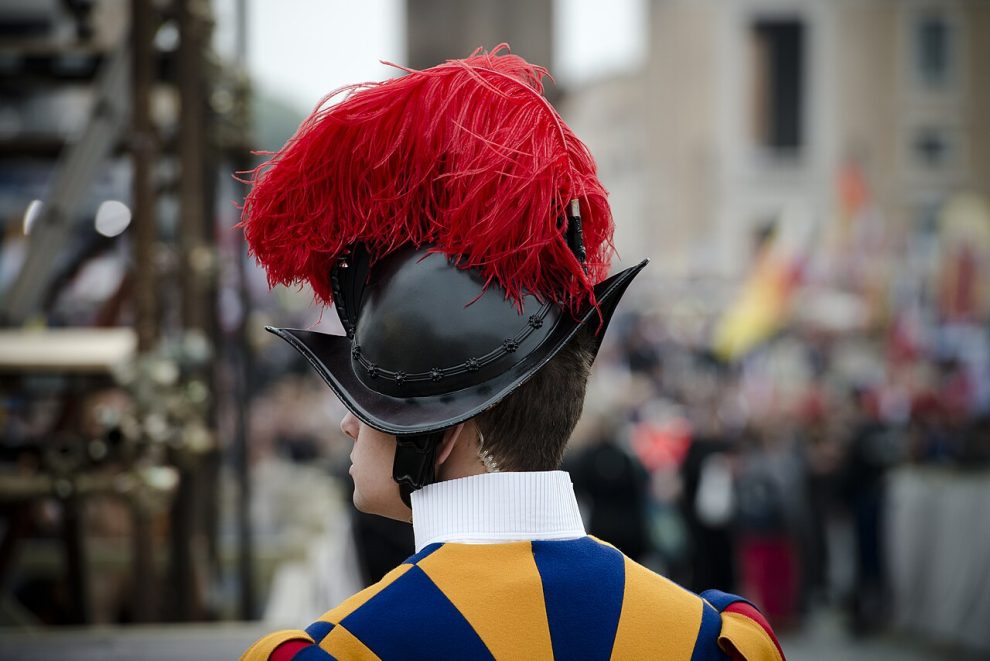
Especially noticeable in their colorful Renaissance-style uniforms, the guards must be male Swiss citizens and practicing Catholics. In addition to serving as the pope’s personal bodyguard, they stand watch at all entrances throughout the Vatican and during ceremonial occasions. Moreover, they protect the College of Cardinals when there is no pope—referred to as a “Vacant See”—such as during the Conclave and the election of a successor after a pope’s death.
In addition to their halberds—which are real and can be used as crowd control and access-denial weapons—and swords, the guards are armed with pepper spray, a Taser, and a Glock sidearm, typically concealed beneath their clothing. They also have access to assault rifles and long guns. Following basic military training in the Swiss Armed Forces, they receive subsequent extensive training in firearms, hand-to-hand combat, nonlethal munitions, and the use of the halberd.
Then there is the Gendarmerie Corps that functions as the Vatican’s police force. Established by Pope Pius VII with the restoration of the Papal States in 1816, the Gendarmerie maintains public order, provides security, and executes the judicial police functions in the Vatican City State. (The Inspectorate for Public Safety for Vatican City, which is a division of Italy’s state police, also provides armed security around St. Peter’s Square.)
In addition to guarding the entrances to Vatican City, the Gendarmerie’s approximately 150 officers, who, like the Swiss Guard, must be practicing Catholics, carry out typical law enforcement duties, including traffic control, public order, criminal investigations, detention of suspects, and evidence collection. The Gendarmerie can also provide basic medical assistance as first responders until paramedics arrive (for instance, if someone faints or injures themselves). They share intelligence with the International Police Organization (Interpol).
Known as the pope’s “Guardian Angels”, the Gendarmerie’s primary task is to protect not only the pontiff but also the Vatican’s other officials, guests, and 30 million annual visitors. In addition, the Gendarmerie Corps includes two special units: One is a rapid intervention tactical squad and the other an antisabotage team. The Gendarmerie carry pepper spray and Tasers and are armed with a Glock semi-automatic pistol; the rapid intervention unit also has assault rifles and shotguns.
Pope Leo thanked the police officers of the Inspectorate for Public Safety, saying, “I take this opportunity to express to you all my heartfelt gratitude for the valuable work you carry out in order to ensure the safety of myself, of my collaborators, and of the very many pilgrims and tourists who visit St. Peter’s Basilica and the Vatican.” In early May, Leo similarly expressed his gratitude to the Swiss Guard: “More than soldiers, you are servants who, in the image of Christ, go out to meet those in need of your help: not only members of the Curia or officials visiting the Vatican, but also pilgrims and tourists.”
Each of these armed forces is tasked with what the Catechism of the Catholic Church calls “legitimate defense”: “Those holding legitimate authority have the right to repel by armed force aggressors against the civil community entrusted to their charge.” The catechism adds the important qualification: “strict conditions for legitimate defense … requir[ing] rigorous consideration” for the use of armed force, which are “the traditional elements enumerated in what is called the ‘just war’ doctrine.” Such criteria include, for example, just cause, last resort, and proportionality. As Pope Leo put it, these armed forces are for “self-defense in the strictest sense,” a term that includes the protection of both oneself and others against unjust attack.
In my previous experience in law enforcement, these criteria were called a “use of force continuum,” in which deadly force is a last resort when there is no other way to stop someone from killing others. This is why the Swiss Guard and the Gendarmerie carry Tasers and pepper spray, as alternatives to deadly force. Even before these less-than-lethal munitions were available, we can see this “strictest sense” approach to the use of deadly force on May 13, 1982, when Mehmet Ali Agca shot Pope John Paul II as the pope rode through St. Peter’s Square; a plainclothes Swiss Guard helped subdue the shooter without shooting him.
Peace and justice activist John Noble recently acknowledged in a U.S. Catholic article that some advocates of nonviolence recognize “instances in which armed self-defense can be necessary, consistent with international law, and aligned with Christian morality.” In other words, not all who espouse nonviolence are pacifists. As David Cortright, another peace scholar and activist, notes, at the beginning of the 20th century, the word pacifism was “a general term to describe the stance of those opposed to war.” It included an “absolute pacifism” that refused to condone any war whatsoever, as well as the more widely accepted “pragmatic or conditional pacifism,” which opposed war in principle while “accepting the possibility of using force for self-defense or the protection of the vulnerable.” Instead of “pacifists,” those in the latter camp were sometimes called “pacificists.” Although the term is awkward, I think pacificism, rather than pacifism, accurately describes the current position of Pope Leo and church teaching.
While they are often called “the world’s smallest army,” the Swiss Guard are not militaristic. Likewise, unlike the United States’ militarized police, the Gendarmerie do not have a record of racial profiling, excessive force, or brutality. The Vatican’s armed security forces focus on the prevention of violent harm to the pope and others; they protect all people within the Vatican.
I believe this protection of persons remains necessary this side of the arrival of God’s kingdom—even at the Vatican. While the church now rightly emphasizes nonviolence, it neither calls for the abolition of the police nor for strict pacifism.
Image: Wikimedia Commons/Aleteia Image Department (CC BY-SA 2.0)