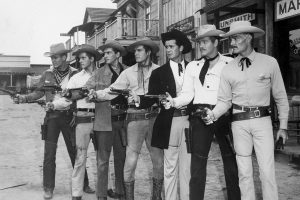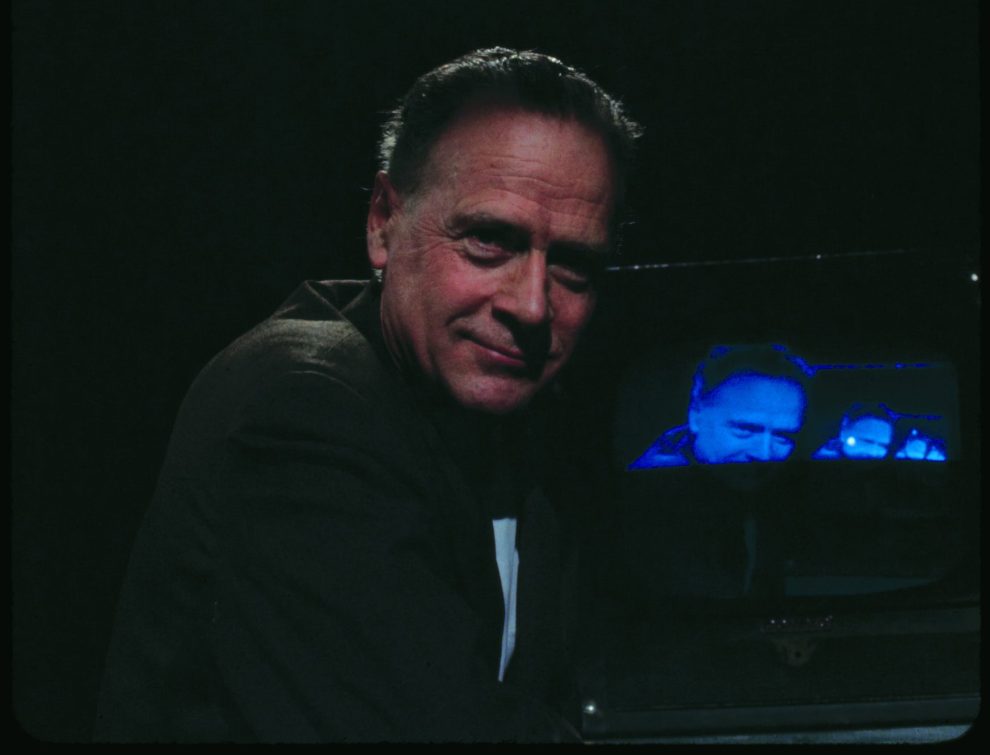
I came in on my knees,” Marshall McLuhan wrote of his conversion to Catholicism. “That is the only way in.” The celebrated 20th-century media theorist was a true public intellectual: the subject of glowing articles in magazines ranging from Vogue to Playboy to the New Yorker and featured in primetime television specials—as well as the occasional movie cameo.
In a time before the internet, McLuhan was widely recognized and just as widely debated. Some tried to debunk him; others deified him. Although he died the year before I was born, McLuhan has been a lodestar for me, an affirmation that the Catholic Church is a place of both the mind and the heart.
Born on July 21, 1911, in Edmonton, Alberta, Canada, McLuhan attended the Nassau Baptist Church growing up. He was a diligent Sunday morning Bible student, although it seemed he was more drawn to scripture as a text worthy of analysis than a source of piety. Perhaps appropriate for a budding scholar, McLuhan’s road to Catholic conversion began when he entered higher education; first, at the University of Manitoba, where he initially became acquainted with the work of G. K. Chesterton—a curiosity that deepened when McLuhan later enrolled at the University of Cambridge. “Had I not encountered Chesterton,” he reflected, “I would have remained agnostic for many years at least.”
The Protestantism of McLuhan’s youth—and of his mother—felt rather anodyne to him, in comparison to the Catholicism that he was discovering via Catholic writers such as Chesterton and Gerard Manley Hopkins, and Catholic-trained writers such as James Joyce. “Let me tell you that religion is not a nice comfortable thing that can be scouted by cultivated lectures,” he told his mother in a sweeping letter. “It is veritably something which, if it could be presented in an image, would make your hair stand on end.”
The Catholicism of Hopkins and Chesterton, as seen through their literature, made McLuhan’s hair stand on end. Hopkins, a 19th-century Jesuit priest known for vibrant prosody and deep piety, struck McLuhan as a forward thinker. “Hopkins anticipates the electronic age in perceiving nature itself as an art form,” McLuhan wrote. Hopkins juxtaposed ornate description with “bursts into colloquial phrase,” a skill that McLuhan believed was in line with modern communication.
The Jesuit-educated Joyce had lapsed from traditional Catholic practice, but McLuhan was keen enough to recognize that the Irish writer retained a religious sensibility. Joyce’s “genius and art,” McLuhan believed, was “unthinkable apart from his immersion in the traditions of Catholic theology and philosophy.” McLuhan appreciated how Joyce “took an intelligent interest in everybody and everything”: advertisements, cartoons, film, and “popular speech.” God in all things.
McLuhan was received into the Catholic Church on March 24, 1937. He appreciated the “ease with which Catholics can penetrate and dominate secular concerns—thanks to an emotional and spiritual economy denied to the confused secular mind.” Yet he did not believe in sermonizing.
The media theories that made McLuhan famous were not delivered in Catholic terms—although hindsight reveals them as patently Catholic. The fifth-century theologian Prosper of Aquitaine, best known as a disciple and defender of Augustine, wrote “legem credendi lex statuat supplicandi” (roughly, “the law of prayer is the law of belief”), a concept that has evolved into the more concise lex orandi, lex credendi: Belief is articulated through liturgy and prayer. The language of Catholicism—down to its sense and syntax—carries the faith.
In that spirit, McLuhan’s most famous dictum, that the “medium is the message,” has two levels of meaning. The most common interpretation—that the mode through which we communicate is significant to that communication—is a reasonable one. Yet McLuhan clarified that his claim also had a deeper meaning: The manner in which information is communicated creates a particular environment in which that information is imagined and received.
Telephone and television changed the way we thought and perceived information. In our day, sending a text is both a mode of communication and a way of thinking: abbreviated, idiosyncratic, steeped in memes, images, and emojis. For the Catholic McLuhan, the medium and the message were inextricable: The way we communicate is formed by our faith, and our faith is expressed in the way we communicate. One of McLuhan’s former students, Jesuit Father Walter J. Ong, believed that Christ was “both mediator and message,” because “He is what he means.”
The more technology saturates our lives, the more we conform our living to that technology. McLuhan was suspicious of how technology shapes us and our society, but he was a realist. “I see no possibility of a worldwide Luddite rebellion that will smash all machinery to bits,” he said in 1969, “so we might as well sit back and see what is happening and what will happen to us in a cybernetic world. Resenting a new technology will not halt its progress.”
I can appreciate such technological realism. I came of age in the era of dial-up internet: a now ancient means of digital access that came before broadband. I had to barter with my older sister about who could use the phone line; her, to chat with her friends, or me, to research UFOs or Bigfoot. Although I loved the slightly outdated World Book Encyclopedias in my basement, the World Wide Web offered me faster, wider access to information, however niche. I was an immediate fan.
Like other millennials, I saw our analog world become digital. In his own lifetime, McLuhan saw the print world become electronic and could even see hints of a digital future. He worried that such a “global village” of constant connection might breed antagonism. (And he was right.)
But McLuhan was guided by a higher vision: “The new matrix is acoustic, simultaneous, electric—which in one way is very friendly to the Church,” he argued. “That is, the togetherness of humanity is now total. Everybody is now simultaneously in the same place and involved in everybody.” Although Mass is celebrated worldwide in local tongues, the Catholic Church is unified through baptism and liturgy, an international family of believers. Digitally, in our best moments, we can bridge distance and circumstance to affirm McLuhan’s visions of togetherness in Christ.
I’ve found in McLuhan a spiritual and intellectual guide. I am a cradle Catholic; it is the only faith and religious culture I have known. Yet I can appreciate McLuhan’s conversion, as he traveled a route paved with intellect and the heart. Like McLuhan, I don’t think I need to choose between an academic or instinctual attraction toward Catholicism. I am drawn to the same writers as McLuhan—stylists such as Hopkins and Joyce—and think their alternating piety and skepticism arise from the same spiritual fount. The more I learn of the church, including its human imperfections, the more I believe.
“Faith is not a matter of concepts,” McLuhan said. “It’s percepts, a matter of immediate reality.” For all his erudition, McLuhan believed that faith arose in the literal world around him: to be Catholic meant to live in the physical space of daily life.
In 1968, Benedictine Father Patrick Granfield wrote that the “communications explosion” of the electronic world resulted in a shrinking globe, and therefore “isolation is unthinkable.” The Catholic Church, Granfield noted, “has been able to cope with devastating stress and still survive”; it has weathered war, population drifts, and even the apathy of modern times. While such “adaptability has perhaps been slow, disorderly, and at times carried out under weak leadership,” the “Church has endured.”
I think that we must live in the world into which we are born. I do not seek to eschew technology. Wired magazine, as secular a publication as one might imagine, named McLuhan their patron saint. McLuhan’s religious identity was no mere footnote; it was the foundation of his media vision, one that offers Catholics and other people of faith a way to encounter emerging technologies with dignity. McLuhan compels me to pay attention to and question the prosaic world around me and to be in awe of the mystical possibilities of digital innovation and connection, as well as of the Creator.
This article also appears in the July 2026 issue of U.S. Catholic (Vol. 91, No. 7, pages 42-43). Click here to subscribe to the magazine.
Image: Library of Congress, Prints & Photographs Division, photograph by Bernard Gotfryd