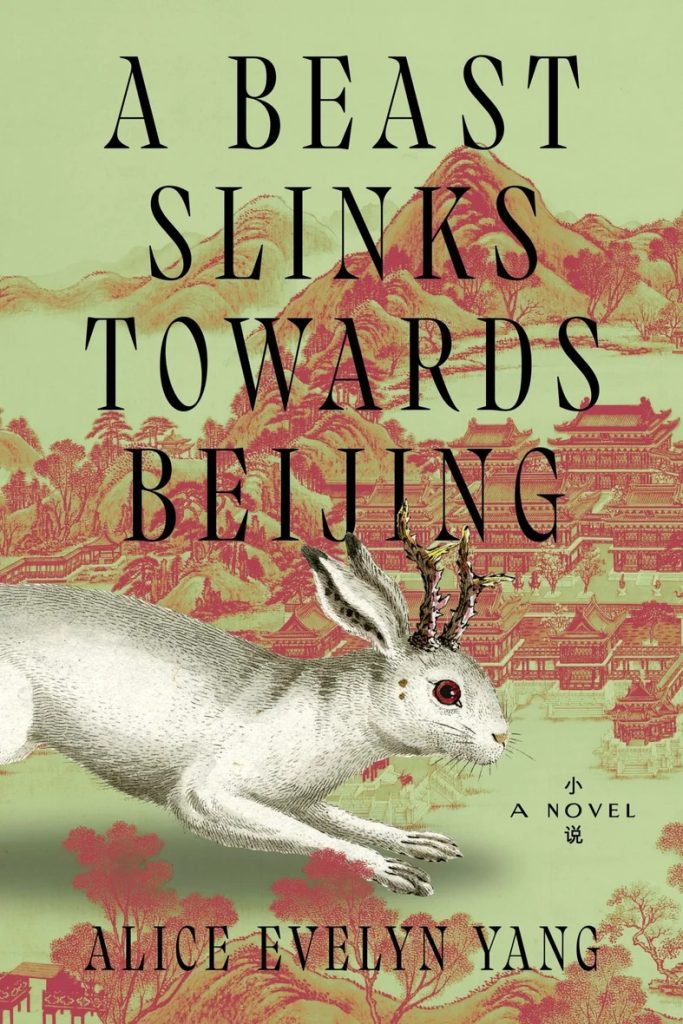
A Beast Slinks Towards Beijing
By Alice Evelyn Yang (William Morrow, 2026)
In Alice Evelyn Yang’s debut novel, the nightmares of the past keep their grip on the present. The only way to get past them is to travel through, toward the uncertain promise of reconciliation.
On Qianze’s 14th birthday, her father, Weihong, disappeared. In the years since, she’s constructed a narrow but predictable life for herself, despite the heartbreak and unanswered questions—and the occasional hauntings by mythic beasts. Now, over a decade later, her father is back, a dissipated wreck. Reluctantly, Qianze tries to make space for him in her tiny Manhattan apartment and carefully calibrated life.
As she begins to repair her connection with Weihong, the stories about his childhood in China unfurl in a montage of horrors, tracing the line of generational trauma from his experiences as a teenage soldier in Mao Zedong’s Red Guard to his mother’s desperate efforts to survive in Japanese-occupied Manchuria. The monsters that have stalked Qianze are the emissaries from the hidden world of the past that, as William Faulkner famously stated, is never really past.
A Beast Slinks Towards Beijing is a story of disruptions. Mythic creatures disrupt Qianze’s equanimity. Her returning father disrupts her domestic balance. And the story she learns is one of violent sociopolitical disruption. But disruption can be healing as well as destructive. Qianze’s father carries a secret, which he believes is connected to a curse. Confronting that secret and moving past it is essential to his becoming unstuck from the moments that have imprisoned him. The story itself disrupts our easy assumptions around what it means to be a good or bad person in a society where most of us have been insulated from the upheavals many immigrant families have endured.
To highlight the ferocity of generational trauma, Yang employs techniques from magical realism, depicting the symbolic as the factual, the emotional as the substantial, to capture the terrifying realness of the memories we carry, the monsters that slink through our minds. In an impressive feat of historical fiction, she takes the reader into the past where these traumas took place.
If you like historical fiction, have a strong stomach for the truth that history is more than a series of romantic set-pieces, and enjoy plot as elaborate tapestry, not loosely stitched backdrop, you will find much to admire in this novel. Readers of faith will appreciate the vindication of the spirit world and the emphasis on reconciliation through confession. Yang writes with a sophisticated yet limpid style that allows the story to stay front and center. The plot’s many jumps from character to character could get a little complicated, but I appreciated the intellectual exercise of keeping it all together. If I had one critique to make of this story, it was that the reconciliation felt sudden, a little formulaic and tacked on. I wonder whether our societal demand for a happy ending, and even a facile approach to redemption, sometimes pushes writers to tie up ends that might be better left trailing.
This article also appears in the August 2026 issue of U.S. Catholic (Vol. 91, No. 8, page 36). Click here to subscribe to the magazine.