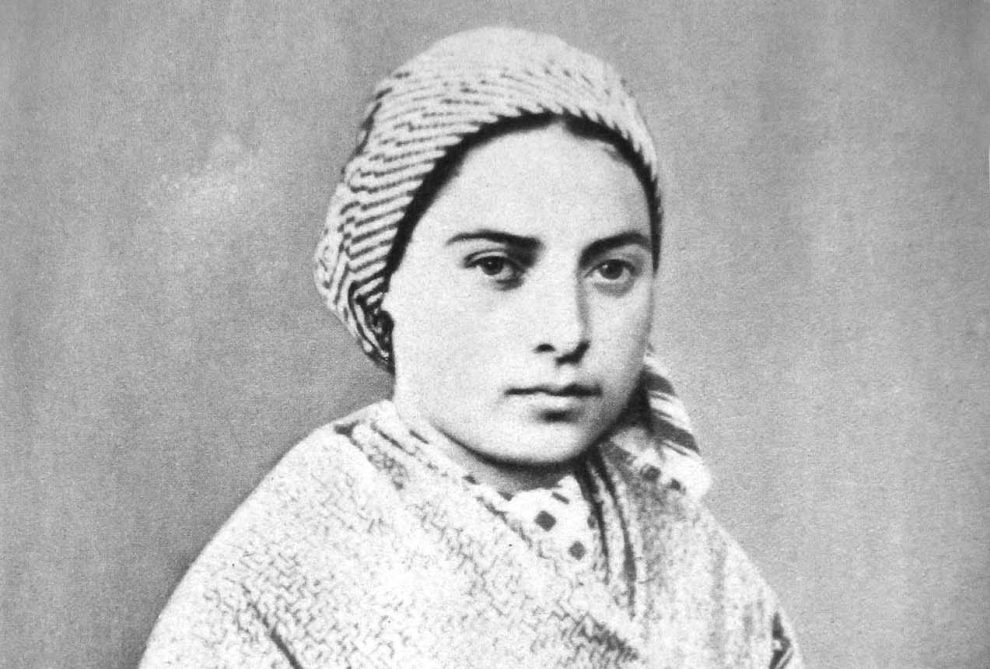
How does the world see Bernadette Soubirous, also known as St. Bernadette of Lourdes? With a new musical about her touring the United States after a successful run in France, it’s a good time to remember her—and explore some neglected details of her story. Bernadette, The Musical, named for the saint rather than her hometown, promises to center her humanity.
You may know Bernadette from prayer cards, replica Lourdes grottos, and bottles of holy water. As a teenage peasant in 1858, she witnessed apparitions of the Virgin Mary that put her village on the map. In 2026, Lourdes remains a major destination for pilgrims. In contrast to the story of Mary appearing at Guadalupe, where the apparition’s indigeneity disrupts Eurocentric Catholicism in the Americas, the story of Lourdes is more likely to evoke dusty kitsch and sentimental piety. But Bernadette’s story isn’t stale or tame. She came from a minority community in the corner of an empire and still stood up to church authorities. She dealt with child stardom. And she invites us to explore questions about storytelling and truth.
Marian apparitions typically appear to marginalized people, often young girls. In witnessing an apparition, a visionary claims authority that is not mediated by the church. When the church declares an apparition “worthy of belief,” it affirms that its witness has unique insight about the divine. This mirrors the preferential option for the poor. An illiterate girl from a destitute family in a marginal region of France certainly fits the mold. Interrogated by the police, dismissed by the Church, and derided by her community, Bernadette stood firm in her conviction about what she had seen, and circumvents avenues that were closed to a peasant girl.
Our Lady of Lourdes is usually associated with France, but Bernadette’s native language was Occitan. Occitan is a Romance language spoken in parts of France, Spain, Monaco, and Italy. UNESCO classifies it as “severely endangered,” following centuries of government suppression called vergonha. Occitan enjoys no legal recognition in France. Bernadette was from the margins of empire and spoke a marginal language.
At the beginning of the musical, authority figures repeatedly mispronounce Bernadette’s surname and she corrects them. The first act follows Bernadette’s claims to see a figure that she calls Aquero, or “that one” in the Occitan language. Villagers shun her, the police condemn her, and the priest is skeptical at first but eventually believes her. The audience sees a headstrong, self-assured Bernadette, familiar from pious literature but brought to life onstage. When Bernadette is ordered to avoid the grotto where she finds Aquero, she refuses because she promised Aquero that she would return. Her faith draws her back to the grotto again and again, heedless of threats to herself and her family.
The Lourdes story includes non-Christian folkloric elements that might unsettle some of the faithful. Bernadette’s description of Aquero evokes the white-clad fairy women who were said to roam the Pyrenees. And the area around Lourdes was rich with shrines, miraculous springs, and apparitions. Bernadette’s experience was not unheard-of; in fact, copycat visionaries popped up in Lourdes after her.
The musical’s second act shows a girl worn down by the demands of fame. Thousands of people come to believe that Bernadette has indeed seen the Virgin Mary, but their belief upends the girl’s life. The beleaguered Bernadette enters a convent with no reference to a contemplative vocation, simply longing to live in peace. The musical doesn’t fast forward, but the real Bernadette struggled with chronic illness and died at age 35.
What happens to a peasant girl after she sees the Virgin? How can she integrate that experience? Some visionaries similarly died as humble women religious. Two of the visionaries at Fatima died as children, while the third became a Discalced Carmelite and witnessed private apparitions throughout her life. Catherine Labouré, who received the Miraculous Medal, lived a life of service as a Daughter of Charity. Other visionaries led unsettled lives, much like child stars who grow into troubled adulthood. The children who received the grim prophecies of Mary at La Salette seemed permanently disturbed by what they had seen. One entered the convent, while the other lived an itinerant life before dying young.
A woman named Mariette Beco who witnessed an apparition of Mary in Banneaux, Belgium, in 1933 offered a particularly telling, if unsettling, reflection on apparitions. After her experience she lived a private life, marrying, bearing children, and dying at age ninety. On the 75th anniversary of the apparitions, she made her final public statement, writing, “I was no more than a postman who delivers the mail. Once this has been done, the postman is of no importance anymore.”
At the time of her apparitions, Bernadette was much more than a postman. Since the apparition did not leave cryptic messages or prophecies, Bernadette herself—the way she moved her body in a trance-state during the apparitions, appearing immune to all pain—was the main “text” available for interpretation. One scene in the musical shows her sitting for a now-famous photograph. When the apparition is gone, she is told, this photograph will remain as a memory. When the camera flashes, the photograph appears projected on the stage’s backdrop. The musical draws our attention toward representation and witness. How does a story get preserved and conveyed? What medium is most suitable? Which witnesses are most trustworthy?
This evokes old debates about who gets to tell the story of Lourdes. Naturally, male writers and clergy brought Bernadette’s story to the masses. Henri Lasserre’s 1869 history of the apparitions titled Notre Dame de Lourdes catapulted the story to tremendous fame. It was a best-selling book at its time, but its account raised the ire of the bishop and the order of priests who staffed the new shrine at Lourdes. Lasserre spent years asserting that his book should be elevated as the definitive account of the apparitions. When the Jesuit Père Cros wrote about the apparitions, Lasserre argued that his conflicting account would undermine the church and even the message of Lourdes. Cros countered that the four gospels by four separate evangelists hadn’t ruined Christianity. Funnily enough, Cros also offered his own jab at the accuracy of Bernadette’s famous portrait. After meeting Bernadette, he told his brother, “I’ve seen a photograph of her, but it is a very bad resemblance. If one comes to hand, do not think you have seen Bernadette.”
Perhaps we cannot trust that the photograph captures the essence of Bernadette, but she is also preserved in a literal sense. Decades after her death, Bernadette’s body was exhumed several times and found incorrupt, meaning that it showed no signs of decay. She now lies in a crystal reliquary for pilgrims to venerate. She may have gone to the convent to hide, but her earthly remains are now on permanent display.
In the musical and in most literature, Bernadette is portrayed as the archetype of a faithful woman. She is a true saint, an imitator of Mary’s “yes.” She is like the women who stayed at the foot of the cross, or a martyr who held fast to her faith. Because this archetype is so familiar, a modern reader might be tempted to overlook Bernadette. By many standards, she was a “good girl.” A modern feminist might note that she had limited agency. But Bernadette did defy authority and faced the ire of the church. She didn’t let anyone gaslight her.
Bernadette, The Musical ends with a rousing number about how “you can do anything you put your mind to.”Though the musical applauds Bernadette’s strength, this closing song doesn’t feel quite right because we’ve just seen the girl flee under duress. Bernadette convinced the church of her deepest truth—but Aquero told her that, though she’d never be happy on earth, she’d find happiness in the next life. That’s a common fate for a martyr or prophet.
This article also appears in the June 2026 issue of U.S. Catholic (Vol. 91, No. 6, page 36). Click here to subscribe to the magazine.
Image: Wikimedia Commons, photo of St. Bernadette