

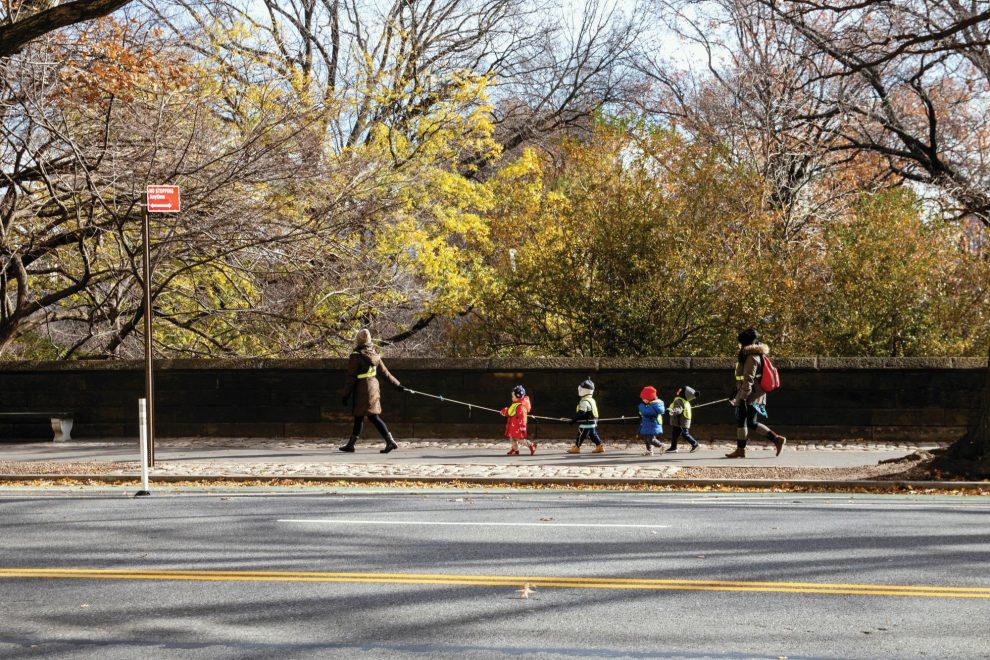
City-owned grocery stores were among the potpourri of notions that New York City’s new mayor, Zohran Mamdani, floated during a campaign that upset the city’s political establishment. Not everyone agrees it’s a good plan, but Mamdani has plenty of other ideas that quickly caught on with the voting public. His “big three commitments” include farefree buses and a rent freeze on rent-stabilized apartments. The last pillar of his big three, universal child care, especially captured the attention of the city’s beleaguered parents.
Why is Mamdani so focused on child care? Maybe because he realizes that a city without children is a city without life—or a future. New York City is hemorrhaging middle-income earners and families with children. School enrollment is dropping, and parks are becoming populated by dogs instead of small humans.
According to a recent municipal study, the average cost of child care for infants and toddlers in family-based care in 2024 was $18,200, an increase of 79 percent since 2019. Meanwhile, the average cost of center-based care was $26,000, an increase of 43 percent since 2019. During the same time frame, family income only went up 13 percent.
It’s easy to see that the math does not work out for families. Between 2020 and 2023, the population of children ages 3 and under in New York City declined by almost 20 percent.
Affordable child care has been a hope for generations of parents. The United States is one of the few industrialized nations bereft of national standards for child care or a social service infrastructure to help pay for it; at the same time, it nearly leads the world in the percentage of household income that goes for child care, landing 38th out of 41 high-income nations UNICEF surveyed.
Critics roundly mocked Mamdani, claiming that his plans for the Big Apple are too costly or doomed to Soviet-style failure. Certainly, universal child care in a city of nearly 10 million people will not be cheap. According to some estimates, the price tag may be as high as $6 billion a year.
Who can afford that? Apparently, New Mexico can, even as it regularly ranks among the poorest states in the union. In April 2022, New Mexico extended free child care to include families earning more than 400 percent above the poverty line, creating a new social benefit that served just about every working family in the state. Now, New Mexico is offering child care to all parental comers regardless of income, becoming the first state in the union to achieve this civic milestone.
Results have been promising. Public child care has lifted thousands of New Mexico’s families above the poverty line. Its mandates have also meant better compensation for child care workers. The savings have brought life-changing money to many families, allowing them to eat better, plan for the future, and do wild things like take family vacations.

But the security and stability universal child care offers poor families cannot be measured only by savings to working parents. It will also likely mean lifetime improvements in expectations, education, and earning opportunities for the children fortunate to be enrolled in improved and properly funded programs.
Critics will say that better than even the best child care outside the home is a full-time parent (usually assumed to be the mother) at home with their children. But minimum wages still can’t be translated into something that approaches a just family wage, and single mothers lead many households; these factors make universal child care a social intervention that has become essential.
When Roe v. Wade was overturned in 2022, Catholic pro-life activists got what they had long desired. Now, we need to address the responsibility that proceeds from that achievement. If we want sound and sane families in our society, we have to find a way to pay for that worthy ambition.
This article also appears in the February 2026 issue of U.S. Catholic (Vol. 91, No. 2, page 42). Click here to subscribe to the magazine.







Add comment