• Digital Edition
  • Newsletters
  • Donate
  • Renew
  • Subscribe
U.S. Catholic
  • About
    • Mission
    • Who We Are
    • Contact U.S. Catholic
    • Write for Us
    • Advertise with Us
    • FAQ
  • Sections
    • Arts & Culture
    • Catholic Voices
    • In the Pews
    • Our Faith
    • Peace & Justice
    • Poetry
    • Religion
    • Saint Calendar
    • Spanish Content
  • Podcasts
  • Magazine
    • Current Issue
    • Issue Archive
    • Digital Edition
    • Advertise
    • Subscribe
    • Renew
  • Giving
subscribe
U.S. Catholic
  • About
    • Mission
    • Who We Are
    • Contact U.S. Catholic
    • Write for Us
    • Advertise with Us
    • FAQ
  • Sections
    • Arts & Culture
    • Catholic Voices
    • In the Pews
    • Our Faith
    • Peace & Justice
    • Poetry
    • Religion
    • Saint Calendar
    • Spanish Content
  • Podcasts
  • Magazine
    • Current Issue
    • Issue Archive
    • Digital Edition
    • Advertise
    • Subscribe
    • Renew
  • Giving
subscribe
U.S. Catholic
subscribe
  • About
    • Mission
    • Who We Are
    • Contact U.S. Catholic
    • Write for Us
    • Advertise with Us
    • FAQ
  • Sections
    • Arts & Culture
    • Catholic Voices
    • In the Pews
    • Our Faith
    • Peace & Justice
    • Poetry
    • Religion
    • Saint Calendar
    • Spanish Content
  • Podcasts
  • Magazine
    • Current Issue
    • Issue Archive
    • Digital Edition
    • Advertise
    • Subscribe
    • Renew
  • Giving

SHARE

FacebookXEmail
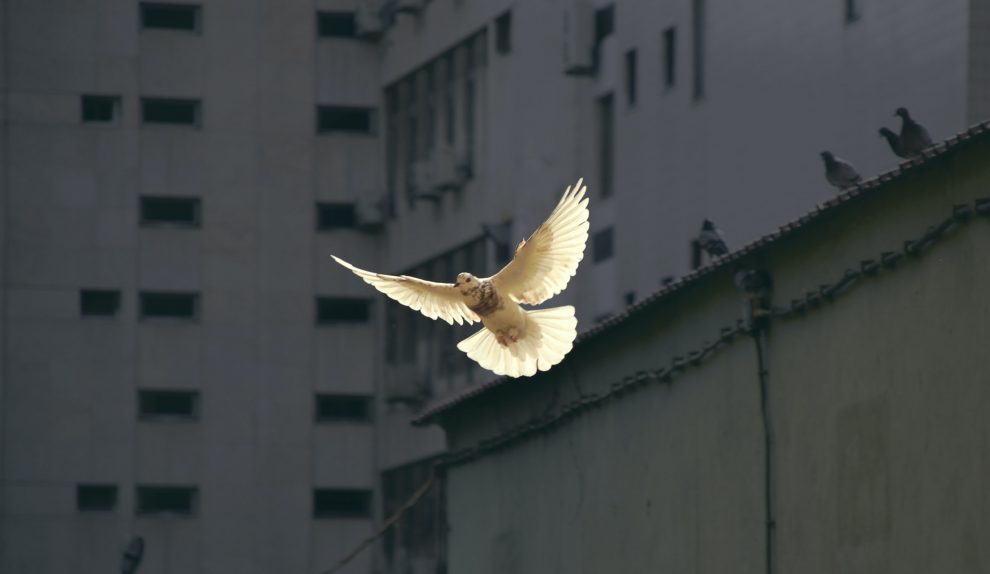
dove-flying-in-city

In a nation perpetually at war, find ways to promote peace

Christians must build a world based on love, not fear.
Peace & Justice
Meghan J. Clark
Published April 13, 2020

On September 11, 2001, I was a junior at Fordham University in the Bronx. If I close my eyes, the memories quickly flood back: My roommate banging on the bathroom door to tell me an airplane had flown into the World Trade Center; the smell a few days later when the wind shifted and the smoke from Ground Zero came north; the silence of Midtown streets as the city recovered. Terrorism became part of our daily national conversation on that day, but to what end?

“Blessed are the peacemakers, for they will be called children of God” (Matt. 5:9). This particular Beatitude seems simple enough. Christians are called to build peace. But what does it mean to be a peacemaker in a nation perpetually at war?

The first Christians understood the command to love your neighbor, including your enemies, as embracing a strong presumption against violence. The idea that violence may be permissible emerged only once Christianity became the religion of the empire. In her book Blessed Are the Peace­makers (Fortress Press), author Lisa Sowle Cahill notes that just war “developed from the perspectives and politics of elites within powerful empires or nations, who have the capacity to wield military violence.” While it is a complex set of criteria meant to restrain the use of force, just war is most often invoked in the post-9/11 period from a position of power that assumes the legitimacy of U.S. military force.

Self-defense, when framed within the context of terrorism and fear, becomes so elastic it loses its meaning. Questioning the targeted killing of Iranian General Qasem Soleimani risks seeming weak on terrorism. This applies not only to national defense but also to “stand your ground” laws, where the threshold for “perceived threats” is perpetually lowered.

Advertisement

The Gospel of Matthew’s Beatitudes and call to love your enemies invite Christians to build a world based on love, justice, and hope—not fear. Self-preservation, on its own, is somewhat suspect on the road to Calvary. For St. Augustine, this means that while violence could be permissible to defend the empire, it was not permitted for individual self-defense. Today, my students balk at Augustine’s questioning the use of violence in self-defense. How does one form one’s conscience through the Beatitudes in a nation of “stand your ground” laws?

Violence corrodes social order both when it is used and when it is simply accepted as permissible. Dorothy Day famously noted, “Nonviolence makes the world safe for conflict.” We can disagree and argue, but not to the point of violence or killing. Christian pacifism, exemplified by Day, Cesar Chavez, and Martin Luther King Jr., consistently upheld nonviolent resistance as how Christians are called to be peacemakers in the world. Within their social movements, the deep and ongoing call to form one’s conscience and resist the easy acceptance of fear and violence permeated.

The call to be peacemakers applies not only to pacifists but to all Christians. The gospel demands a strong presumption against violence—in all cases. For me, this means grappling with moral ambiguity in Christian ethics. As Cahill notes, “If killing in war can be justified at all it still presents an irreducible moral dilemma.” As American Catholics, this means critically evaluating all proposed uses of military power, valuing the lives of civilians thousands of miles away as we value our own, and recognizing that violence can never be celebrated.

This article also appears in the April 2020 issue of U.S. Catholic (Vol. 85, No. 4, page 10). Click here to subscribe to the magazine.

Advertisement

Image: Sunyu on Unsplash

TagsCatholic social teaching Pro-life The Examined Life War and peace
ad offering InterVarsity Press' book titled
ad for Catholic Relief Services - Faith in Action. Help safe lives today

About the author

Meghan J. Clark

Meghan J. Clark is a professor of theology at St. John’s University in New York. She is author of The Vision of Catholic Social Thought: The Virtue of Solidarity and the Praxis of Human Rights (Fortress).

You may also like

Wall painted with the words "leave no one behind"

When on the fence about an issue, choose solidarity

Dan Masterton
Just Politics Banner

Catholic sisters and advocates explore how we love with action

The Editors
Photo of UFW march struck through with paint

How justice movements deal with legacies of abuse

Cassidy Klein
    Share This!
    Share
    FacebookXEmail
ad for Catholic Volunteer Network -- strengthening the field of faith-inspired service

What’s trending

    The quad of Canisius University in Buffalo, N.Y.
    In the Pews

    Mission over profit is a risk some Catholic colleges will take

    Jeannine M. Pitas
    a priest with his back to a congregation - US Catholic - Images
    Religion

    What’s the point of being a Christian?

    A U.S. Catholic interview
    Anne Attea reflects on the readings for the twenty-third Sunday in Ordinary Time
    Catholic Voices

    A Sunday reflection for September 6, 2026

    Anne Attea
    u-s-catholic-jean-francois-millet-the-angelus
    Our Faith

    What the Angelus prayer can teach us about labor justice

    Rebecca Bratten Weiss
ad promoting the title Raise Kids with Faith that Lasts

SUBSCRIBE

DONATE

RENEW

SIGN UP FOR FREE NEWSLETTERS

Quick Links

  • Mission Statement
  • Who We Are
  • Reprint Policy
  • Job Opportunities
  • AI Policy
  • Advertise
  • Contact
  • Submissions
FOLLOW US
  • Facebook
  • Twitter
  • Instagram
  • Youtube
Copyright © 2026 US Catholic. All Rights Reserved | Terms of Use | Privacy Policy
a small white version of the USC logo