The common life of culture can only exist within what Pope Leo XIV in Magnifica Humanitas (On Safeguarding the Human Person in the Time of Artificial Intelligence) calls an “ecology of communication,” fostered by an education that is not an “incessant flow of information” but rather a shared “ability to grasp reality as a whole” and “ask profound questions about meaning.” Without that shared life, we cannot really know truth at all. We think, therefore we are. Truth is a common good.
There are at least three levels to what Leo is saying. Each level can guide us in our everyday seeking of truth.
First, we should not confuse having more information with having more truth. Humans evolved in settings where calories were scarce, and so we needed to load up when food was available—and today that contributes to obesity. Similarly, we are wired to live in an environment where information is scarce. In such a setting, we constantly seek more information. Our brains evolved to reward novelty and to keep loading up on it. But now we live among information overload, and the task is not to seek more to consume but to develop skills to discern quality. This is a task we do as a community; Leo points out the essential role of traditional journalists, who serve as crucial helpers in discovering truth together.
At the next level, Leo emphasizes the connection of shared truth to democratic governance. The only way to have genuine social deliberation about common problems is on the basis of shared convictions, values, and facts. Democracy not only involves hearing all voices, but more importantly, it invites those voices into conversation and deliberation about common concerns of our life together as a society. A world of pure spin, no matter which side we’re on, is a world that cannot be democratic; it’s merely a fight to get a majority on our side. Without conversation and real relationships, democracy is a civil war on the battlefield of the ballot box.
Finally, at the deepest level, Leo emphasizes that communication “is not only the transmission of information, but it is also the creation of a culture.” The Canadian neuroscientist Merlin Donald suggests that the most remarkable feature of the human brain is not some amazing, internally focused processing power but rather the human brain’s ability to generate patterns of representation that become stored in a common culture rather than in individual brains.
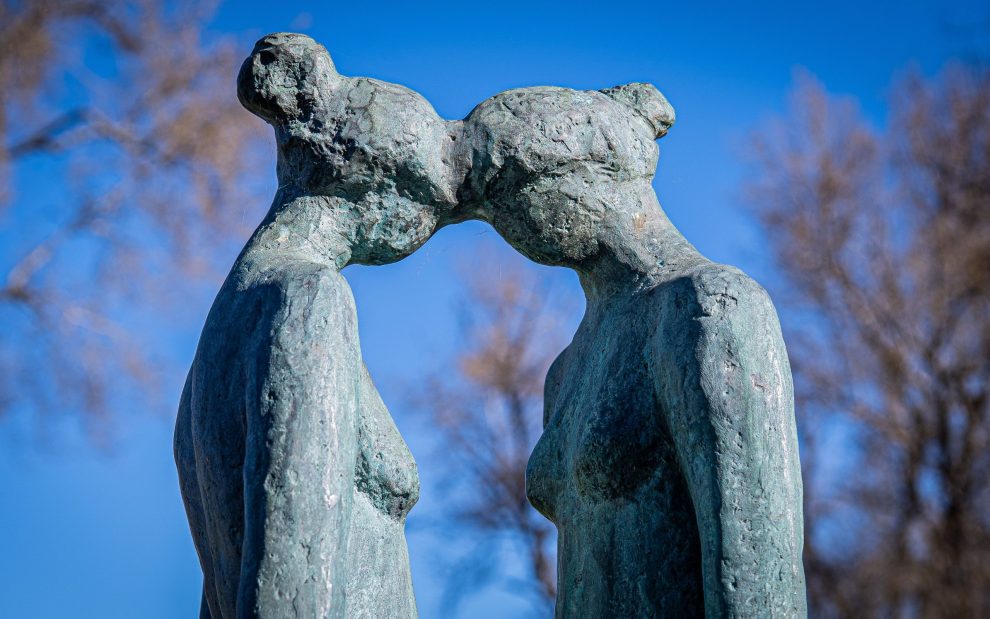
We often describe ourselves by referring to the things that set us apart from others; in fact, however, the genius of human community lies in shared understandings that enable a true melding of minds—or perhaps, better put, a shared common life that immediately marks strangers as friends. Catholicism can have this experience when we participate in the Mass in a culture and language that are completely foreign to us. In that situation, we inhabit a shared world that is not in our heads but instead lives in the life of the liturgy and the larger, worldwide community of the church.
Leo reminds us that according to our faith, we find the truth of our own being not inside ourselves but in communion with Christ. That communion is the ultimate meaning of truth as a common good.
Of course, this experience of truth generating a common culture that unites strangers can happen around evil as well as good. And so we must consider what the deepest truths and meanings of our common lives really are. When we seek truth, we should do so knowing that the truth should ultimately unite us—and that the father of lies, a name Jesus gives to the devil (John 8:44), also goes by the Greek name diabolos, the one who divides.
This article also appears in the September 2026 issue of U.S. Catholic (Vol. 91, No. 9, page 40). Click here to subscribe to the magazine.
Image: Pexels.com/maiksax