When we consider the situation of migrant children in the United States, the reality is troubling. More than 6,200 children have been detained by U.S. Immigration and Customs Enforcement (ICE) under the second term of President Donald Trump’s administration. In April 2026, the Marshall Project reported that on average, 226 children are incarcerated daily.
At the South Texas Family Residential Center (Dilley Detention Center) in Dilley, Texas, the National Center for Youth Law found that food was moldy or contained worms, and water receptables also had mold or algae. The lights were kept on all night so children could not sleep.
In a July 2026 report by the Senate’s Committee on the Judiciary, families and women detained at Dilley told Senate staffers that “cruelty was not only condoned but encouraged” by Dilley staff and medical personnel, and that “treating families and children with basic respect, dignity and kindness was discouraged.”
As a Catholic and mother of young Latino children, I have followed the stories of migrant children’s detainment in the U.S. with sorrow. Like countless others, I was horrified when I saw images and read of 5-year-old Liam Ramo’s detainment by ICE in January. Liam’s Spider-Man backpack was identical to my 5-year old’s. Liam’s story is one of thousands.
James Baldwin wrote, “The children are always ours, every single one of them, all over the globe.” As a mother, I feel this sentiment deeply in my bones. It is a clarion call. We must act.
It can be easy to feel powerless or helpless, limited by our time, responsibilities, or lack of resources, but the gospel reminds us that even small seeds can bear fruit. This year, my small act of solidarity was joining the Dorothea Project, a Catholic women’s group committed to spreading Catholic social teaching and defending vulnerable people. The Dorothea Project group meets monthly to pray, learn together, and organize virtual and in-person action in solidarity with migrants, immigrants and refugees.
As Pope St. John Paul II stated: solidarity is not “a feeling of vague compassion or shallow distress at the misfortunes of so many people…It is a firm and persevering determination to commit oneself to the common good.… Because we are all really responsible for all.”
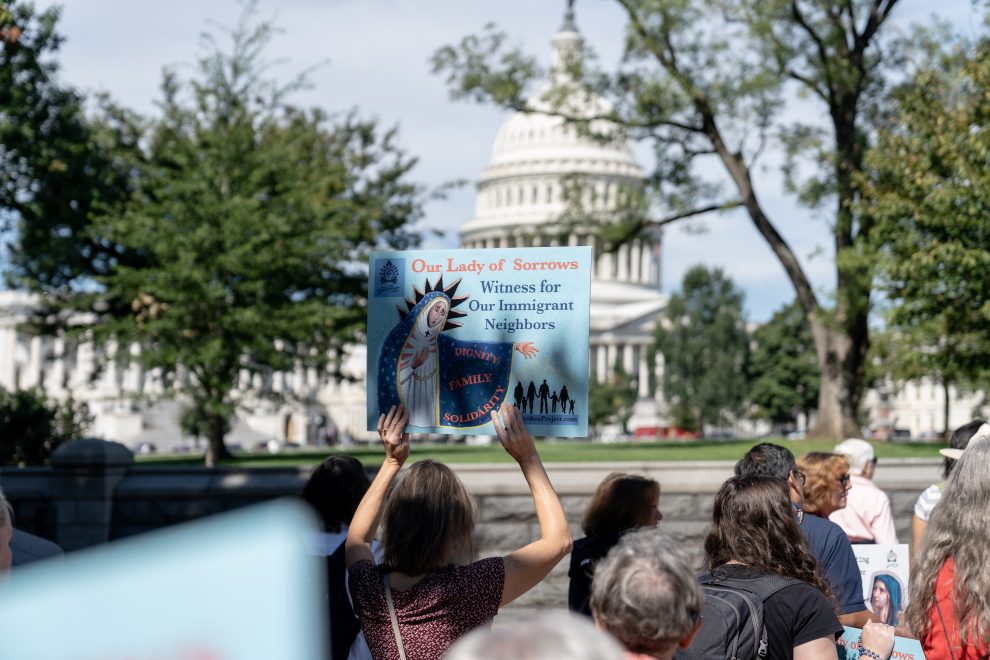
On September 15, the feast of Our Lady of Sorrows, nearly 200 Catholics attended a Mass and rally led by the Dorothea Project in the nation’s capital. This was my first in-person event with the group, and the day filled me with such renewed energy and hope.
During Mass at St. Peter’s on Capitol Hill, celebrant Bishop Gary Studniewski, auxiliary bishop of the Archdiocese of Washington, said: “These days in our own country, we are aware of so many who suffer the pains of injustice from a hostile power, just like Jesus on the cross. We gather today mindful of the many men, women and children—real families— who suffer the injustice of being mistreated as immigrants, migrants, strangers.”
“Unjust systems do not correct themselves overnight,” Bishop Studniewski said. He quoted Pope Leo XIV’s apostolic exhortation Dilexi te (On the Human and Divine Love of the Heart of Jesus Christ), emphasizing that “migrants and refugees do not only represent a problem to be solved, but are brothers and sisters to be welcomed, respected and love.”
“Congress and the administration must reform the immigrant system to defend the dignity of every person, including reforms to keep families together” Studniewski said. He called for a restoration of asylum and due process, and an end to mass detention and mass deportation. Congress, he said, must “build just pathways to citizenship.”
After Mass, the group processed to the U.S. Capitol while reciting the Seven Sorrows of Mary. Participants held signs connecting Mary’s sorrows to present-day sorrows. One sign reminded onlookers that as of August 4, 57people have died in ICE custody.
During the rally, Anna Gallagher, executive director of the Catholic Legal Immigration Network (CLINIC), said, “Solidarity does not require us to pretend that immigration law does not exist,” but “the rule of law must be worthy of the human beings whose lives it governs. It must respect due process, and it must not lose sign of the importance of family safety, and human life.”
“Our Catholic tradition asks something of us as well,” continued Gallagher. “It asks us to see the person before us. Not a case number, not an immigration status, not a political talking point—a person, a mother, a father, a child, a neighbor, a fellow politician.”
“Your dignity does not depend upon your immigration status,” she said.
Speaker Flaka Martinez, from La Colectiva North Texas and a Dorothea Project member, addressed the crowd before groups dispersed to visit their respective members of Congress. “When they tell you immigration is complicated, tell them human dignity is not complicated. When they tell you change takes time, tell them our children are waiting now,” Martinez said.
While members from Florida, Maryland, Iowa, Texas, North Carolina, and more were participating in advocacy visits in Washington, D.C., other members in states like Minnesota and New York joined the action day locally by hosting prayer vigils and petitioning their representatives through email or phone calls. The primary request was to end family detention and separation.
This week, National Migration Week (September 21-27), invites Catholics in the United States to reflect on the challenges experienced by migrants and refugees and to stand in solidarity through prayer and action. Pope Leo XIV has invited the global church to remember migrant children in particular and “the care owed to them” in his Message for the World Day of Migrants and Refugees.
I hope Catholics will take some time to read Pope Leo’s Message for the World Day of Migrants and Refugees. “We cannot remain indifferent, nor can we become accustomed to such suffering,” the pope urged. How will you respond?
Image: Windswept Photography/Megan Bethge, view from the Dorothea Project Rally in Washington D.C.