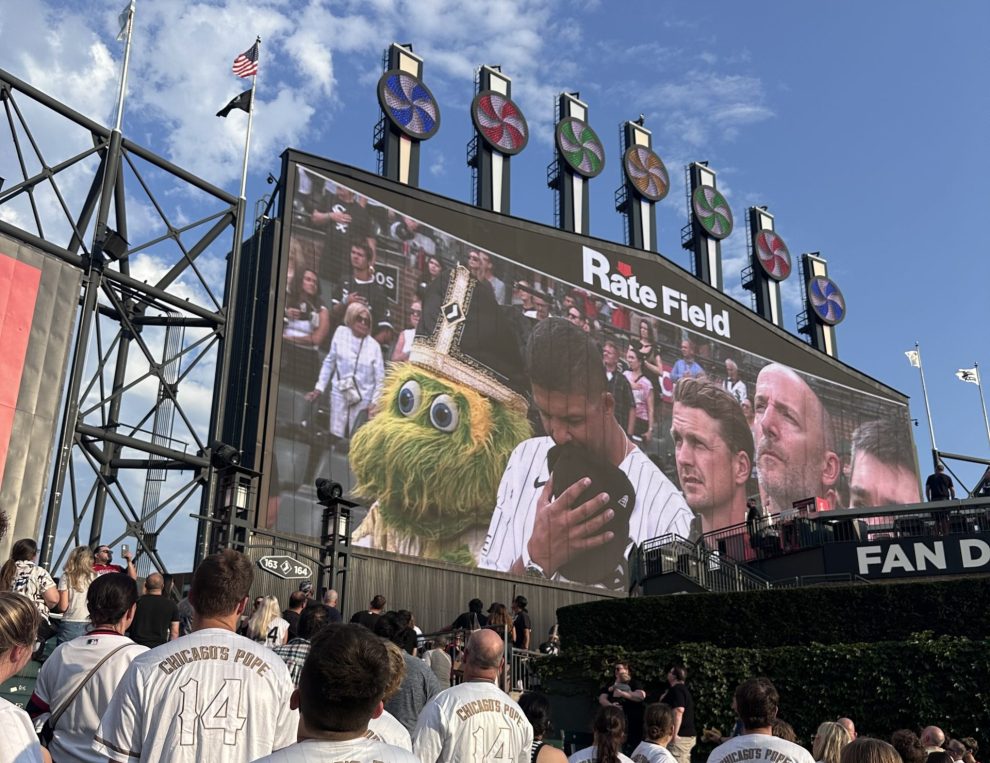
The rain stopped for no one in Chicagoland this summer, Pope Leo XIV included.
On August 11, rolling walls of dark clouds loomed from all directions under an algae-green sky. The local NBC 5 weather team reported uprooted trees in dozens of communities; tornado sirens echoed downtown. By 11 a.m., crews were already working to restore power to thousands of people, primarily in the Southland. Some of those same weary Chicagoans’ lights had only turned back on a few weeks prior, after outages from the last severe squall.
White Sox fans had waited months for Pope Hat Night against the Cincinnati Reds. After originally planning to only give away several thousand hats, the Sox’s marketing division read the room, ordering 20 times as many to try and satisfy every ticket holder who walked onto the premises that evening. The team’s stadium is technically named Rate Field, but many folks—like Leo XIV, who prerecorded a video message for a celebration Mass in his honor in the outfield last June—just call it Sox Park. (“Comiskey” and “The Cell” both work, too. Your mileage may vary.)
When I first heard about Pope Hat Night, it seemed like a scene straight out of Brian Doyle’s Chicago (St. Martin’s Press). In his roving, attentive 2016 novel, Doyle starts many a sentence on first base and ends somewhere in the bleachers. His semi-autobiographical narrator—a young transplant to the city who takes a job “with a Catholic magazine under the elevated train tracks on Madison Street”—marks the passage of time in his first year as a Chicagoan by the Sox’s up-and-down fortunes, chronicling his train rides to the South Side “to hear jazz, or savor the motley chaotic beery muddle of the White Sox and their exuberantly shaggy and inebriated fans, who were much more fun than the staid stuffy museum-goers at Cubs games.” (His words, not mine.)
In real life, Doyle worked for U.S. Catholic in Chicago after his 1978 graduation from the University of Notre Dame. He went on to serve as the editor of Portland Magazine for over two decades, discovering a deep love for the hills, creeks, and people of Oregon; write thousands of offerings blurring the lines between prose and poetry on all sorts of topics, from pick-up basketball to changing diapers to, in “Joyas Voladoras,” the beating, perishable hearts of hummingbirds, whales, and humans; and gain admirers around the world for his keen observation of the revelatory minutiae and inscrutable questions embedded in our daily lives. Doyle died in May 2017 after discovering a malignant brain tumor only six months earlier. I never met him, but after teaching his work to students around the country and traveling with dog-eared copies of his books for years, I feel like I have.
The storms rushed into Northwest Indiana by mid-afternoon. Nursing a sprained ankle from a whiffleball injury, I was still determined to be in the crowd. My eager, RBI-counting younger self demanded it. (I pictured 9-year-old me in a faded Mark Buehrle jersey on my parents’ front step in the southwest suburbs, shaking his head: Don’t you dare think about staying home, pal.)
Calamity struck upon hobbling to my local Brown Line “L” stop on the North Side. The station’s Apple Pay reader was down, and I forgot to refill my mobile Ventra card for the train fare. A Chicago Transit Authority staffer saw me glance frantically back and forth between the digital display noting the southbound train’s arrival time—two minutes away!—and the faulty card reader. “Go ahead in,” she said, holding the exit door open for me. Small mercies, I thought.
After transferring to the Red Line, I scrolled Twitter. My algorithm threw all sorts of Pope Hat content at me, nestled in between Wisconsin primary exit polls and El Niño climate coverage. I’d completed a master’s thesis exploring the polarized, worryingly-conspiratorial, often-humorous #CatholicTwitter landscape a few years ago; accordingly, amid excited Pope-themed selfies, my feed still boosted numerous argumentative users—some real, some bots—spitting vitriol about the propriety of handing out felt mitres to the masses.
I counted 14 popes decked out in various shades of red, white, and gold on my short walk to the gate. After scanning my ticket, I finally received my coveted Hat from a resolute Sox staffer. (“One per fan!”) Inside, I saw at least three people sporting T-shirts with various depictions of Our Lady of Guadalupe; countless old hats from Midwestern Catholic colleges and universities such as Loras, St. Xavier, and St. Norbert; and many vowed religious intermingled with cosplaying counterparts, like the stately contingent of Dominican friars in white habits entering ahead of a boisterous, Blues Brothers-coded man with tinted sunglasses and a black fedora, channeling a young Bob Prevost.
A familiar kaleidoscope of smells hit me as soon as I entered the lower concourse: Polish sausages and elotes, homemade quesadillas and Beggar’s Pizza. As I bought a ticket for the “50/50” Sox Charities raffle from a roaming vendor, I heard the opening notes of “Danny Boy” playing from stadium speakers. Nancy Faust, the legendary Chicago sports organist who retired from her Sox duties more than a decade ago, was back on the keys for Pope Hat Night, and the crowd knew it. “We love ya, Nancy!” someone shouted.
I bought a churro and settled into my seat in left field. The Reds went down one-two-three; not a bad start. Not two minutes later, newly arrived center fielder Brenton Doyle hit the first pitch off the Reds’ Nick Lodolo into the waiting arms of a fan three sections over from me. The stadium rejoiced. Edgar Quero matched Doyle in the bottom of the second inning on a 1-1 count—another home run to left field.
The clouds broke into a sunny, humid evening, and the Sox were back.
I greeted an Augustinian friend of mine in the third inning near an ice cream stall. He was chatting with teachers from Our Lady of Mount Carmel in Lakeview, whose grade schoolers’ mock conclave went viral last year, prompting a student delegation to the Vatican to meet Leo XIV himself. The students themselves were excited about Pope Hat Night, but seemed, perhaps, more immediately excited about the possibility of ice cream.
In the outfield concourse, I ran into more old friends—my preschool classmate, Erin, and her husband Jim. The Marquette graduates had just moved back to the Beverly neighborhood with their 10-month-old daughter after more than a decade in Milwaukee. Amid unpacked boxes and new jobs, they’d found a babysitter and made it to the game. “We weren’t missing this one,” Erin said.
At the end of the fifth, a grinning Fr. Tom Hurley—formerly the longtime pastor of the pre-Great Chicago Fire-era Old St. Patrick’s Parish in the West Loop, now back home on the southwest side at Most Holy Redeemer—appeared on the Jumbotron scoreboard with his own jauntily perched Pope Hat. “As Catholics, we offer each other a sign of peace because we want to bring peace to the world,” Hurley said. “And I think the Pope would really love that, whether you’re Catholic or not. So: everybody should stand, find a new friend around you, and offer each other the sign of peace.” After a tentative few seconds, over 40,000 people did just that. I hugged Erin and Jim, shook hands with a group of Reds fans, and waved at a bartender lugging a few cases of Corona Extras to the fridge. He waved back without dropping one single can.
Somewhere, I’m quite sure, Brian Doyle is still chuckling about the “little-s” sacramentality floating around Sox Park that evening. In an era when many civic exchanges unfold as jaded rhetorical jabs—and in a country where we’re too often bereft of spaces for in-person encounters—an earnest liturgical spirit surfaced on the South Side, gently pulling generations together into their sense memories, if only for a moment. As Doyle wrote in a 2008 essay for U.S. Catholic:
What is the Mass? It is the shuffling of everyman to a meal and familiar table talk, but somehow there at the picnic table, the dining-room table, the rickety card table where the children sit, there is, as the basket of bread is passed from hand to hand, a flicker of light, a brief zest in the air like the spoor of lightning, a voice singing powerfully in the distance, a few blocks away, past the neighbors’ neighbors’ houses, and you strain to hear it, and it’s the most extraordinary snatch of song you ever heard—and the Mass is over, go in peace, and you do.
I collapsed into a seat on the northbound Red Line, my Pope Hat secure in my lap. The game had gone to extra innings, but I left at the top of the 10th, ensuring a quicker commute home to ice my shaky ankle. (Coward, I heard 9-year-old me whisper. You left before the last pitch?)
Across the crowded aisle, two college-age fans huddled over the MLB Gamecast play-by-play box score on an iPhone, propping it up in their foggy window. The Sox were in a tight spot—down one run, with only three outs left. Sam Antonacci was up to bat, though, and he was scrappy. “He’s fouled off six in a row,” said one of them, a tinge of awe in his voice. “We’ve still got a chance.”
Amen, I thought, my eyes feeling heavy as we approached the Cermak-Chinatown stop.
Image: Courtesy of Dominic Sanfilippo