Laura Esquivel’s 1989 novel Like Water for Chocolate (Doubleday) captured the public imagination with its story of cuisine prepared with such emotion that those who consumed it were overcome by the same feelings. Whatever deep passion or sentiment the main character, Tita, felt as she cooked, the guests at the meal would experience the same, and their table sharing would be transformed. Likewise, the spirit of the woman who had long ago taught Tita to cook would appear to encourage her in times of distress. These preternatural occurrences harkened back to a masterpiece of Latin American literature, Gabriel García Marquéz’s 1967 classic One Hundred Years of Solitude (Editorial Sudamericana), which solidified such wondrous and intuitive insights into a genre named magical realism.
Magical realism, a literary style that came to prominence in Latin America through such authors as García Marquéz and Esquivel, incorporates inexplicable and often poetic elements to attempt to convey the deeper truths and emotions of human experience. Flowers rain from the sky when a beloved character dies or food literally conveys characters’ emotions. While the genre has had wide international expressions through exceptional works such as Salman Rushdie’s Midnight’s Children (Jonathan Cape) and Toni Morrison’s Beloved (Alfred A. Knopf), the unique blend of poetry, politics, multigenerational narratives, and popular religiosity found in Esquivel and García Marquéz holds a perennial draw.
Now, HBO and Netflix have offered contemporary audiences ambitious and sprawling productions of these iconic novels originating from their native countries, delving deeper into the complex realities they poetically articulate while shedding light on the power and potential of magical realism to express hard-to-name truths.
For Catholics, this should come as no surprise. Theologians such as Ángel Méndez Montoya have powerfully illuminated the meaning of the Eucharist by exploring Tita’s manner of cooking and sharing food in Like Water for Chocolate, identifying the difference between the concepts of sabor and saber, that is, intellectual “knowing” (saber) and the more sensual “savoring” (sabor). Contemporary discussions of intergenerational trauma can likewise find credence in One Hundred Years of Solitude, whose narrative chronicles the sad, painful repetition of hurts revisiting each age. This expansive perspective that values the significance of each life and interaction, while also stepping back to appreciate the breathtaking scope of time, likewise resonates deeply with a Catholic worldview where the dignity and flourishing of all life is celebrated and the unfolding of time is consequential with all of its joys and sorrows.
One powerful aspect of these stories is how they portray the spiritual realm. When someone dies, it does not mean they cease to exist. In fact, their spirits not only live on but also interact with the living. One of the central tensions of Like Water for Chocolate is Tita’s mother’s refusal to let Tita marry the love of her life. Mamá Elena falls into the pattern of perpetuating the suffering she endured when she was unable to marry her beloved. This inability to let go of past suffering and her perpetuation of pain persist beyond the grave. Mamá Elena haunts Tita, trying to shame her into a similar path as her own. It’s only once Tita resolves to tell the truth and seek forgiveness for her wrongdoings that she’s able to shape her own future free from her mother’s ghost.
Likewise, in One Hundred Years of Solitude, the patriarch of the family, José Arcadio, is haunted by a man, Prudencio, whom he rashly killed in a duel when he was young. José Arcadio can never truly escape Prudencio until they are reconciled, and they find there is no longer a need to part. These magical elements are less about magic and more about revealing deeper truths regarding humanity: Freedom can only come through truth-telling, forgiveness, and reconciliation. Likewise, love and hatred do not disappear with death.
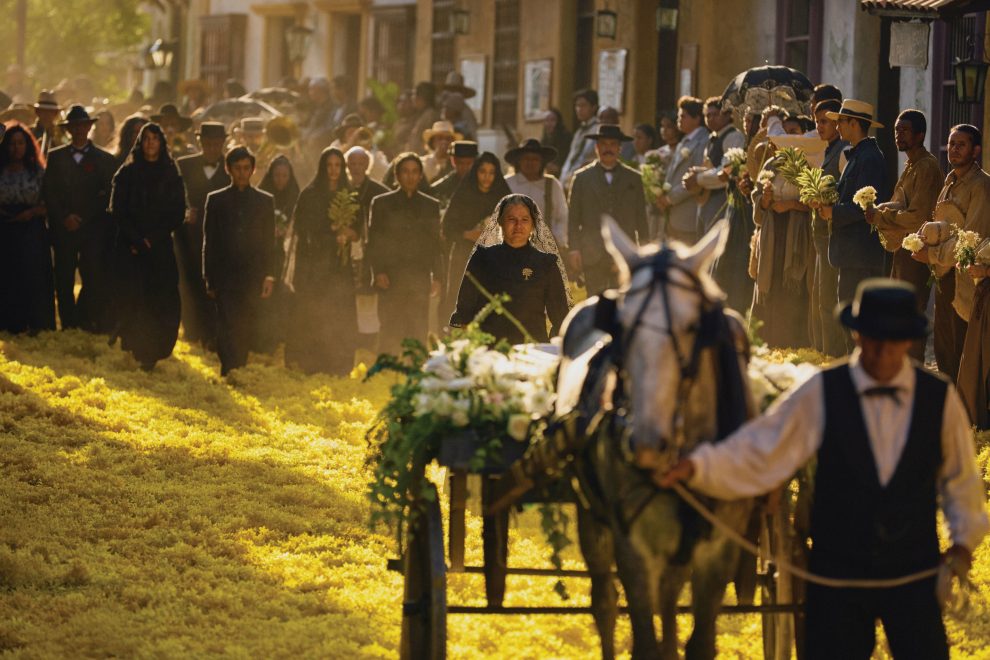
The challenge of how to speak to these difficult-to-name but profound truths surfaces in words such as magical, spiritual, or even sacramental. For example, how do you portray the intimate connection between a mother and her child? In One Hundred Years of Solitude (Netflix), when José Arcadio Buendía (Diego Vásquez) mysteriously dies, a thin stream of his blood flows across the town, purposefully meandering the streets until it arrives at the feet of his mother, Úrsula (Marleyda Soto), who instantly runs to him, already intuiting the loss of her firstborn. It’s precisely in this attempt to depict the hard-to-name “more” of human experience where magical realism excels.
Religion and politics are likewise woven into these series with both astute observations and critiques. In One Hundred Years of Solitude, contemplating the superficial and absurd religious practices of the people, two opposing generals observe, “Liberals go to Mass at 5 o’clock and Conservatives go to Mass at 8.” And yet as they go into battle against each other, Úrsula stands in the cemetery, holding a rosary, praying to God for peace. She has seen political parties with religious allegiances come in and out of favor and meet violent ends, but she still calls out to God to bring peace.
Fans familiar with these novels will appreciate the attention to detail of these productions, especially Like Water for Chocolate’s weaving together of Esquivel’s original and follow-up stories of Tita de la Garza’s life. Criticism can be leveled at these series for their depictions of violence and sexuality. However, the way they seamlessly merge the ordinary with the extra-ordinary, not unlike the Bible, to convey deep truths about the profound mystery of being speaks not just to the merits of these stories but also to the potential of magical realism to enrich audiences today.
This article also appears in the July 2026 issue of U.S. Catholic (Vol. 91, No. 7, pages 34-35). Click here to subscribe to the magazine.
Image: Pablo Arellano / Netflix ©2024