“She had an insane experience where she wanted to die and decided to devote her life to something [after], and then other people came in and were a part of it. That’s what happened to me with this movie.” In one tongue-in-cheek line, director Caroline Golum draws a connection between the toils and trials of 13th-century mystic and writer Julian of Norwich and her own process of making Revelations of Divine Love (2026), a film that adapts and takes its name from the text of the same name.
For Golum, a filmmaker and writer living in Brooklyn, New York, her interest in Norwich and her work came from an already-nurtured fascination with the writing of the Middle Ages and for medieval cinema as a whole. “I was very taken at first aesthetically with Julian’s descriptions of what happened to her, and it struck me as being very cinematic,” Golum says. “My interest in the Middle Ages had always been for the kind of prurient or nastier aspects of that time: the plague, the battles, wizards, the art … those aren’t nasty per se, but the focus on those are a reaction to the classical forms and work that precede it.”
Julian’s work is considered to be the first book authored by a woman, and when she was suffering from an illness at age 30, she had a series of visions (called “showings”) which certainly fit the bill of the more “prurient” aspects of the time (she’s frequently plagued by devilish fiends as she articulates in her showings).
In addition, Golum found religious synergy with Julian even though she grew up Jewish. “Growing up, especially in reformed Judaism, it’s less about liturgy and adherence to Halachic law and more about doing good works, being a part of a community and helping people where you can and making the most impact on earth because the afterlife doesn’t really factor into it,” she says. “Ultimately, it’s about improving the material conditions of the people around you while you can.”
For Golum, directing into those similarities was a key engine for creating this film. Though we only have Julian’s writings and have no tangible way of knowing if any of our cinematic visions of her life remotely resemble her experience, it’s a delight to see Golum and her contributors exercise their spiritual imaginations. The film is a love letter to spiritual weirdos everywhere, a life made flesh through artistic dedication and thoughtful collaboration.
Between delightful asides about baseball (Golum is a ride-or-die Mets fan) and musings about the state of American Christianity, Golum spoke with U.S. Catholic about embracing the artifice while making the film, her love for the radical ways Julian’s faith manifested, and how her film is a rebuttal in some ways toward the “woman goes slowly insane” genre of film.
This interview has been edited and condensed for clarity.
In an interview with director Guy Maddin, you shared that when you become “obsessed with something,” the only way that you can rid yourself of that obsession is to make a movie. I’m curious what you were “exorcising” with making this film and also with your first film, Feast of Man. Was there any linkage between what you were trying to rid yourself of?
I started working on Feast of Man in 2013. A lot of the impetus was me being young, cynical, embittered, and frustrated by why it is that the wealthy get away with whatever they want to get away with. So probably, what I was exorcising was a lot of youthful cynicism.
I see Revelations of Divine Love as an antidote to that. I’d finished Feast of Man, and it wasn’t going anywhere; I hadn’t gotten into any festivals, and the 2016 election had just happened. For the latter, I was not surprised by the outcome necessarily, but I also was not psychologically prepared for how [expletive][1] up it would make me. I think that youthful cynicism had kind of reached its limit of what was possible for me.
Being a hater only gets you so far, and so many aspects of my life kind of changed. Even though things around me have gotten demonstrably worse in the last 10 years, the things that were meaningful to me: the relationships I have with my loved ones, my feeling of comradeship and affinity with other people, my sense of stewardship for my immediate community, the art that I make and how I make it … all of that had improved. I began to think, “OK, things are really bad, if my guilt and my self-hatred doesn’t actually serve anybody. It doesn’t fix this problem.”
Enter: Julian of Norwich?
So when my writing partner, Dr. Lawrence Baum, went back to school to get a degree in medieval history, he read to me his paper about Julian of Norwich. I was very taken at first aesthetically with her descriptions of what happened to her, and it struck me as being very cinematic. I loved the Middle Ages already, but I’d never heard of Julian.
Was there something about the manifestation of Julian’s faith—or the way she practiced Christianity—you were drawn to?
When I started reading about Julian, and also dipping more into liberation theology or the more progressive aspects of Catholic theology, I was really taken by how many similarities there were. As someone who didn’t grow up going to church and didn’t grow up with the same familiarity with the gospels as other people might have, it was all very new to me. I only understood Christianity—at least in the United States, like mainstream Protestant Christianity—I only really understood it as a political action committee, a way of influencing the daily lives of regular people, sometimes for good and mostly for evil, or as a kind of engine for a modern-day crusade, a 21st-century attempt to seize the holy land—which is horse [expletive].
So when I was reading about the things that Julian talks about, who Christ is for her, and then also Bonhoeffer’s letter, “Who Is Jesus Christ for Us Today?”, I started putting together this kind of cafeteria Christianity, of me picking the things about it that were the most resonant for me, with the caveat that I’m not a believer.
I think especially in the case of the gospels, it’s convenient for us to tout the love and brotherhood part of it, but they also talk about the Christ who wields the sword. I would love to see Christianity, at least in the decadent West, get back to Christ wielding the sword not against the downtrodden and against minorities and queer people and the poor. I would like to see them wielding the sword against the Romans. Have we asked ourselves: Who are the Romans today? That’s who we ought to be fighting.
I think if you tell people that the wealthy are evil and that the answer is love, they will follow you because it’s resonant and because it makes sense. It makes sense to us. We are, by nature, cooperative animals. We didn’t come to dominate this planet and create these complex societies and evolve to the degree that we have without being collaborative. So thinking about Jesus, if you are a charismatic prophet, who’s saying, “Just because you’re poor doesn’t mean that you’re less worthy, just because you’ve sinned doesn’t mean you’re less worthy,” and you’re saying it in a way that people can understand in a way that they can connect to, it’s no wonder that Christianity popped off the way it did.
What you’re describing is making me think of one of my favorite scenes, where Julian speaks with a peasant, Walter (Pris McEver), who is considering taking up arms. The scene underscored the radicalization of faith figures like Julian and how someone could root their class solidarity within faith.
It’s an interesting moment. I think that a lot of the interactions and the scenes in the film, I kind of look at as parables.
That scene is a really strong illustration of how any of us navigate on any given day the political circumstances that we live in. The beauty of Julian’s story for me is that she’s literally walled into a church. She exists within the confines of an institution, the Catholic Church in England, which was in many ways synonymous with the state. It is a governing authority, and so much of her ability to do that work is contingent on being accepted by that institution.
One thing I wish we could have explored more in the film was Bishop Henry le Despenser, who was the bishop who probably enclosed her. His whole M.O. while he was the bishop was to place priests who were sympathetic to the landed gentry in these parishes. In the parts of the country where these kinds of peasant uprisings were fomenting, the bishop kind of tipped the scales a little bit. He put a thumb on the scale, and he put parish priests in these parishes that I think were meant to dissuade people.
But what I wanted in that scene with Julian and Walter is twofold. One example of Julian engaging with somebody outside of her immediate sphere, and even outside the realm of the church.
I also don’t want people to look at that scene and go, “Julian told this guy to revolt.” For me, I imagined it more as her saying “I know that I’ve got a job to do and I’m not going anywhere. I’m in this cell. I’m not leaving, but what I can do is offer some kind of solace or advice to people.”
In Julian’s case, what she’s able to do for other people may not be getting up there and throwing a Molotov cocktail at the landlord’s estate, but what she can do is she can listen to Walter and say, “What you’re saying is valid. It’s not sacrilege to be upset at someone who is betraying you and who is abusing you.”
It gets back to what we were saying about, “who are the Romans today?” If Christ were in Norwich in the 14th century, he would not be a landlord. He would be out there with Walter and the rest of them. In a way, that scene was also my nod to that, too.
I want to circle back to something you said before about finding Julian’s work being cinematic. What was the process of grafting the language of movie-making onto this adaptation?
I was so taken by her descriptions, and there isn’t really anything else like it in medieval writing from this era. The hard part for me was figuring out what we could shoot, not how it would look. The questions were more about how do we decide what we can show and what’s achievable for us, knowing that we have this very modest budget. But there were some scenes that were no-brainers. In one vision, she describes how she’s looking at the cross and it transforms from this inanimate object into the actual, physically suffering body of Christ. In the language of film, I could use a dissolve so that was one clear way there was an alignment.
I can see a vision of this story that isn’t so reverent, where you portray Julian’s visions as the stirrings of a mad woman. That isn’t the tone at all here. Can you talk about the tone and presentation of this film?
There are plenty of movies about women who are slowly going insane. I was a woman going slowly insane before I started making this movie. I would argue that I was perhaps still going slowly insane the whole time I was making it, and maybe I am still going slowly insane.
I think Todd Haynes’s Safe (1995) is one of the greatest films ever made, but I didn’t want to make Todd Haynes’s Safe set in the 14th century. I didn’t want to make a Hitchcock movie about a woman going nuts set in the 14th century.
Ultimately, I didn’t want the audience to write off Julian’s experience as a mere hallucination. Moreover, people in her community believed her. In the 14th century, if this happened to you, people bought it. I think it’s especially telling that her confessor, who’s a man and a member of the church, also believes her, that she is someone who gets that support and gets that buy-in from other people, because it flies in the face of everything that we’ve been taught to understand about the medieval era and the role of women in the medieval era.
In her writing, Flannery O’Connor had a term called “diminishments.” She shared that as you lose your health, you experience these diminishments. But these are gateways to gratitude. There’s an element where Julian, if she’s not glorifying her suffering, is at least grateful for it because of the revelations it gives way to. I’m curious how working on this film has reshaped this idea of suffering as gratitude, and how that landed for you?
I will say growing up Jewish, all Judaism is just kind of about suffering. So much of our narrative as a people is built around the fact that we are constantly beset upon. The value in that, if you’re smart, is that you run toward tikkun olam, which is to heal the world. You go, “Well, we’re suffering. So we know what it is for other people to suffer.” It’s why we have a Seder every year. It’s why we, at least in the reform movement, focus on the social aspects of religion. If we know what it is to suffer, then we have an obligation to ameliorate the suffering of other people whenever possible.
I think you get that same kind of weird, good cop, bad cop version of it in Christianity, too. As I said earlier, when Christ was alive, he was not hanging out with the Pharisees, Roman officials, or landowners. He was with prostitutes and lepers and outcasts. His work while he was on earth was to ameliorate other people’s suffering and to teach the value and the importance and the necessity even of ameliorating that suffering.
I don’t think that suffering makes you innately good or that there’s anything beatific about it. I think that there are plenty of people out there who do suffer, who are good. There are plenty of people out there who suffer, and they may not be such good people. I don’t think it matters. I think whether or not you’re suffering and whether or not it makes you good is almost immaterial; the answer here is that no one should be suffering, regardless.
I think we’re seeing this on the left right now, where they’re saying, “What do we do with all of these people who have fascism buyer’s remorse; what do we do with people who willingly voted to uphold a system that oppresses their neighbors, that makes life difficult for them, and who now regret it.” I think the answer is to say, “Look, you made a mistake. You can redeem yourself.” When bad things happen, rather than go, “Oh, this bad thing just happened to me,” you should zoom out and go, “If this bad thing is happening to me, it’s happening to other people too, and we’re all on the same ship.”
My friend wrote how the artifice of the film was a way to see through to the intention, love, and justice you and the crew embraced when making this film about Julian’s life. I’m curious if working on the film has reframed the artifice for you, as a way to show love and devotion?
This film is an ambitious idea; it’s not your normal, run-of-the-mill, low-budget New York indie movie. It’s not about a bunch of 30-somethings in their apartments going to brunch or whatever. And look, I love those movies. I’m not above that—I am someone in Brooklyn who goes to brunch.
I think a lot of people were drawn by just how much of a challenge this was. The thing we all have in common is that we all love artifice and spectacle. We love the art of cinema, the most meaningful aspects of it, which are the fantastical, the things that you don’t see in everyday life. Tessa likes to say that every movie is also kind of about its own making, and this film especially is.
Julian had an insane experience when she wanted to die and decided to devote her life to this thing, and then other people came in and were a part of it. That was me with this movie. I didn’t set out to make a movie about my life, but it became about my life.
What was cool was that we cultivated a really good environment. One of the values of shooting in an enclosed space and a contained environment is that you’re not zipping all over town looking for parking, you’re not dealing with train sounds, you’re not dealing with all this crazy [expletive].
The film set became a third space, a place where people come and hang out. I had friends who came by to help paint or whatever, and they’d just chill out by craft services all day. Devin, our production manager, was doing paperwork and handling all that stuff, and I’d walk in and ask about the Mets score.
I don’t know if anything I do is going to have any kind of meaning, but if nothing else, at least we can prove that you can make a movie, the kind of movies that we love, those weird Robert Corman movies, the classic Hollywood films, silent films, and even more experimental kind of artworks that we were drawing from, like the works of Kenneth Anger and James Bidgood.
We tried to the best of our ability to cultivate a non-hierarchical environment. I’m not a costume designer. I’m not a scenic painter. I’m not a producer. I’m not any of those things, but I can hire people who are experts in this field and trust that they’re going to know what to do, that they come through with a good idea or if I have an idea, it’s an exchange. On the projects I work on, I want to ensure people have equal say. That’s the world I want to live in. This is the society that I want to live in, is one without hierarchy. And it starts at home, I guess.
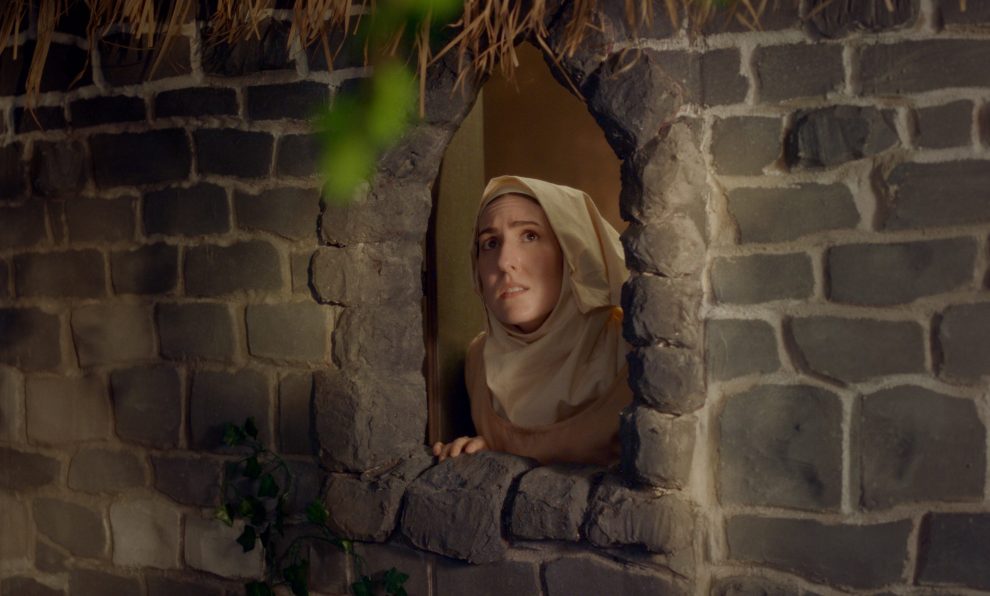
Image: Still from Revelations of Divine Love (2026)