Very truly, I tell you, unless you eat the flesh of the Son of Man and drink his blood, you have no life in you.
John 6:53
I think that even the most devout Catholic can sometimes forget the scandal of transubstantiation—the idea that, at each Mass, we gather around a shared table and take turns eating not just bread and wine, a metaphorical union with God, but literally partaking of Jesus’ body. But in John’s gospel, the crowd has not yet been lulled into complacency by religious ritual. “How can this man give us his flesh to eat?” they ask. After all, he isn’t an anonymous divine gift come down from heaven to feed us all (as manna was, to which he compares himself), this is Jesus, the “son of Joseph, whose father and mother we know” (6:42).
The Jewish crowd assembled in this story knew Jesus intimately. Across the distance of continents and centuries, we have forgotten this man, who existed in the same sort of distinct particularity in which we all exist.
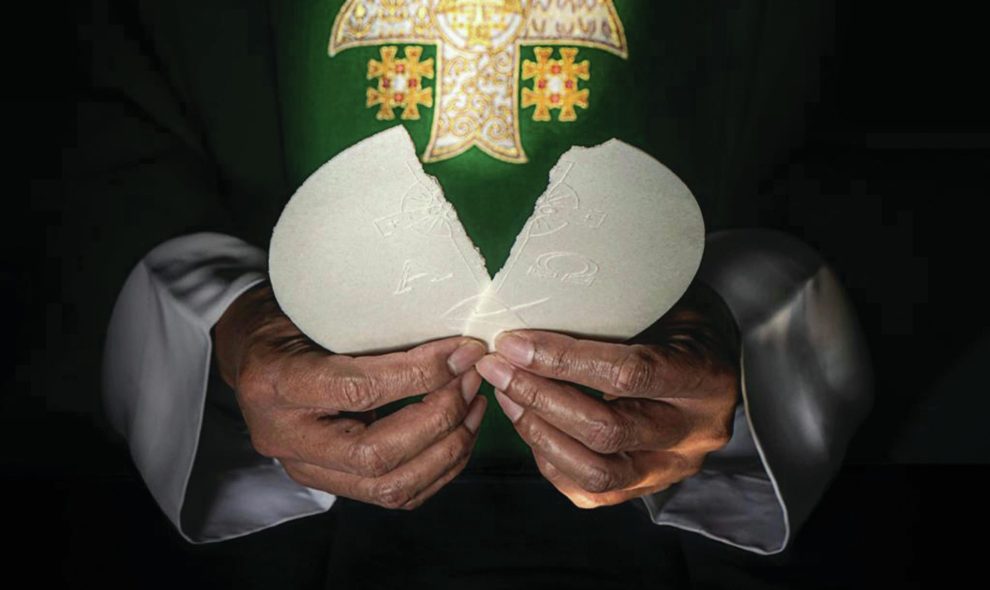
This month we celebrate the Solemnity of the Most Holy Body and Blood of Christ. Also known as Corpus Christi, this feast day is a time to celebrate the fact that the bread and wine of the Eucharist are the real presence of Christ, his body and blood broken to share. But what does it mean that this is Christ’s body that we share each week at Mass?
We might not know Jesus as personally as the people in John’s story, but here’s what we do know. He was a man. He was a Jew living under Roman colonization. He was poor. He had been a refugee, and the trauma of fleeing as an infant to Egypt lived in his body. His body had known hard work—both working with his father as a carpenter and also traveling around as an itinerant preacher. His was not an easy life.
Looking at the Eucharist through the lens of Jesus’ particular body illustrates something important about our faith. Communion is not merely a community-building tool, nor a personal weekly reset that leaves the world outside unchanged. It doesn’t promise us escape from our difficulties or the particularities of our own embodied experiences. Instead, it hammers home the promise that God is exactly among those embodied experiences, no matter how hard or traumatic.
If this is the body we consume—a body that knew the specific violence of empire—then the Eucharist cannot be received in ignorance of what empire continues to do. Jesus was a “practicing Jew in a territory controlled by Roman political, military, and economic forces,” writes M. Shawn Copeland in Enfleshing Freedom (Fortress Press). “Jesus was and remains marked by sex, gender, and sexuality. . . . In his body, Jesus knew refugee status, occupation and colonialization, social regulation and control.”
What this means, for Copeland, is that Catholics “can never cease speaking of bodies [including] bodies raped, maimed, slaughtered, and displaced in wars mounted by pretenders to antiquated conceptions of empires.”
As I write this column in April 2026, Iran’s Ministry of Health reports more than 3,300 people have been killed in U.S. and Israeli attacks against Iran, and more than 26,500 have been injured. In Sudan, civil war has killed an estimated 150,000 people, displaced almost 13 million, and left more than 21 percent of the population facing severe hunger. In Gaza, more than 72,300 Palestinians have been killed since October 2023—about 2 percent of the prewar population. And in Ukraine, more than 2,500 civilians were killed in 2025 alone.
“If my sister or brother is not at the table, we are not the flesh of Christ,” writes Copeland. Jesus’ body reminds us that each individual affected by war and global unrest is also present at the eucharistic table with us.
In this light, receiving the body and blood without flinching away from the pain that surrounds us, the broken bodies among us—both Christ’s and those of our modern-day siblings around the world—seems almost unbearable. To look at Christ’s body when we partake of the Eucharist is to feel deeply the brokenness of the world around us. Why, then, do we keep coming back? Why does this remain the central sacrament of our communal life together?
For Pope Francis, the answer to this question was that the Eucharist isn’t about our own desire for healing or consolation; it’s about Christ’s desire to have all of creation at the same table. “No one had earned a place at that Supper. All had been invited,” he writes in Desiderio Desideravi (On the Liturgical Formation of the People of God). “Or better said: all had been drawn there by the burning desire that Jesus had to eat that Passover with them.”
If this is true, if each time we go to Mass, we go because “we are drawn there by his desire for us,” as Pope Francis writes, then, he continues, the only “possible response—which is also the most demanding asceticism—is, as always, that surrender to this love.”
Surrender sounds easy—an almost passive acceptance of Christ’s love for us. But in this world of broken bodies, including that of Jesus, surrender is not a private spiritual posture, a personal relationship with Jesus.
In our broken world, surrender looks like refusing to receive the body of Christ while remaining indifferent to the bodies of Iranians, Sudanese, Palestinians, Ukrainians—the bodies of anyone whose suffering we would rather not carry to the table with us. It looks like putting aside the comfort we come seeking within church walls and refusing to let them insulate us from the pain outside. The Eucharist does not promise us relief from the brokenness; the promise of the Eucharist is that in brokenness, there is Christ—and there also, should we be.
This is what Jesus is asking of the crowd in John 6, and, in some ways, it is an even stranger ask than believing that Jesus, the man they’ve known since he was a little boy, is food for the masses. He is asking them to take his particular, vulnerable, empire-marked body into their own bodies—and to be changed.
And while there is pain in this, there is also wonder. Because while the Eucharist is Jesus’ body and blood, poured out for us, it is also bread and wine. Before a single word of consecration is spoken, it is wheat and water. It is grapes and dirt. It is soil and rain and sun and the hands of the people who planted and harvested and milled and baked. All of creation, present in bread and wine, present with all who are broken and seeking wholeness.
This article also appears in the June 2026 issue of U.S. Catholic (Vol. 91, No. 6, pages 46-48). Click here to subscribe to the magazine.
Image: Pexels.com/balladphotoworkchanel koraag