Nothing’s About to Happen to Me
Mitski (Dead Oceans, 2026)
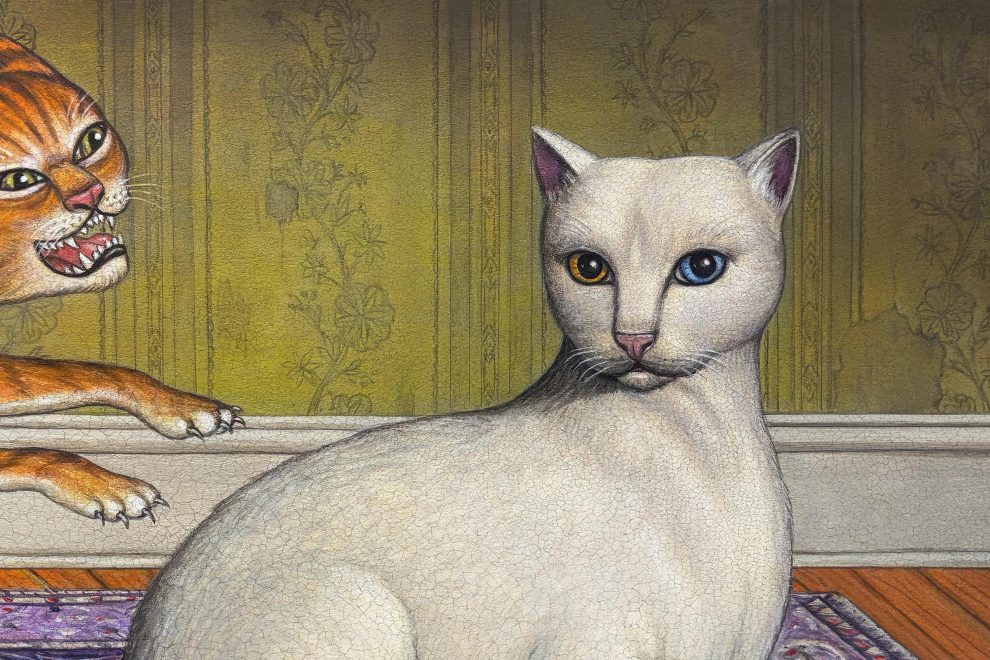
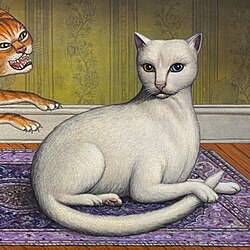
The cover of singer-songwriter Mitski’s new album, Nothing’s About to Happen to Me, features the painted image of a cat with different colored eyes calmly reposing on a rug, another feline in the background ready to pounce.
Is Mitski—born Mitsuki Laycock—that odd-eyed cat, a self-possessed deviant while the combative outside force bears down on her? Maybe. We can only speculate, of course (as her cult followers do, picking apart her songs on Reddit), and Mitski offers plenty to speculate about. Nothing’s About to Happen to Me is a wonderful album, not because it reveals more about its creator but because it doesn’t.
What we do know is what Mitski has said about it in interviews: that she wanted to do a stripped-down sound for her eighth studio album, but that this release told her it wanted to be something more. She’s backed by keyboards, drums and percussion, and a full orchestra and choir.
That orchestra is central to the first track, “In a Lake,” whose vibrating accordion gives folksy balladeer energy. It’s introspective, but the tone is far from the sad indie-girl music/TikTok anthems she’s become known for (think “I Bet on Losing Dogs” from 2016’s Puberty 2). On this track, the mezzo-soprano is leaving a small town, where being different is a handicap. “I’d never live in a small town / I’ve made too many mistakes / For where you gotta write your book early / Or it gets written up in your place.”
The indie rocker re-emerges on track 2—the catchy, anxiety-laced “Where’s My Phone?” The eminently relatable saga of a missing phone is a metaphor for losing yourself, perhaps to pop culture attention and fame. “I just want my mind to be a clear glass / Clear glass with nothing in my head,” Mitski sings.
With its smooth, jazzy bossa nova strings and percussion, “I’ll Change for You” is a song about wallowing in self-pity, but not too deeply. “How / Do I let our love die / When you’re the only other keeper / Of my most precious memories?”
Felines materialize in two tracks—the softer alt-country love song “Cats,” about a breakup but not a breakdown: “I won’t leave you ‘cause I still love you / So it’s up to you if you choose to go / In the meantime, sleeping by my side / Our two cats making sure I’ll be alright.” And on “That White Cat,” where Mitski ya-ya-ya’s through heavy percussive beats about a neighborhood cat that’s marked her house. “Gotta go to work / To pay for that cat’s house.”
A common thread in her previous albums is the female experience, not in an overtly feministic way but raw and unfiltered all the same. Her 2018 album, Be the Cowboy, is about facing repression and control using the masculine archetype of the cowboy. On this album, she doesn’t need symbols: “Dead Women” are powerless women, unable to control how their own stories are told. “Would you have liked me better if I had died? / So you could tell my story like it ought to be? / You’d find my parents and ask to see my things / Rifle through it all, fill the blanks with what you need.”
But unlike the fetishized voices she embodies, Mitski isn’t in danger of losing her own narrative.
This article also appears in the June 2026 issue of U.S. Catholic (Vol. 91, No. 6, page 37). Click here to subscribe to the magazine.
Image: Mitski