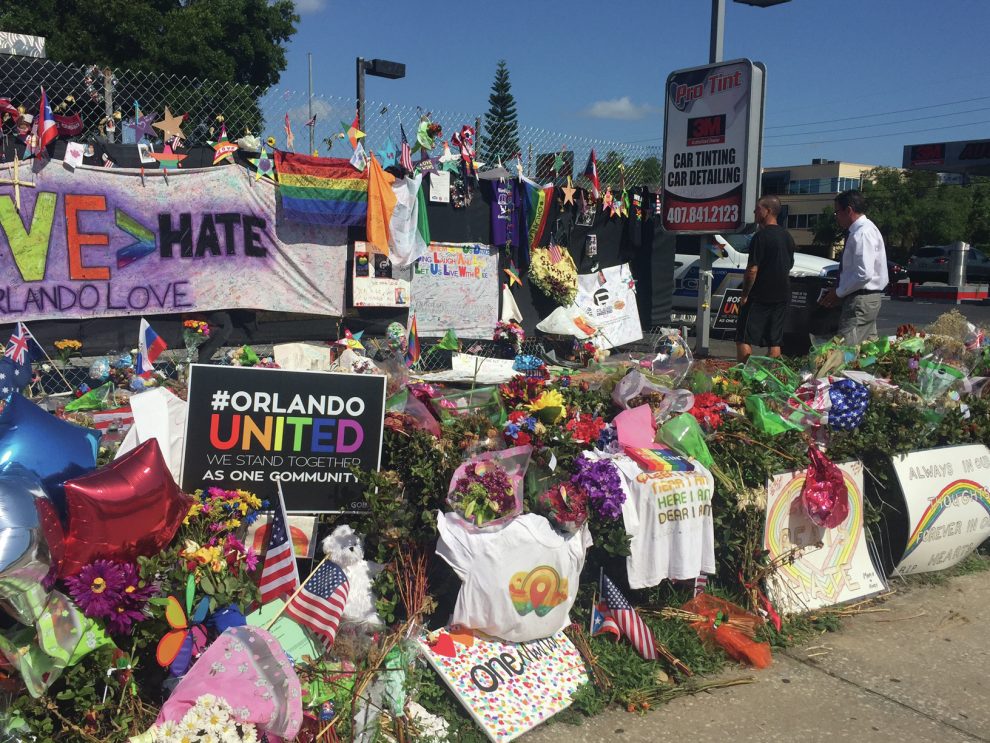
At Pulse nightclub in Orlando on June 12, 2016, a gunman attacked the crowd, murdering 49 people and injuring dozens more. This month, as we mark 10 years since their deaths, no permanent memorial has been completed. This failure, compounded by reports that some families refused to claim their children’s bodies because they were queer, raises the question: What do we owe the dead, especially when the harm they suffered is rooted in homophobia?
The church’s commitments to human dignity, the common good, and a preferential option for the poor demand a response that names the injustice clearly and refuses to normalize the dehumanization that made it possible. For many in Orlando, Pulse—an LGBTQ+ nightclub—was a sanctuary for those rejected elsewhere. The Pulse victims represent precisely those for whom the preferential option for the poor is demanded.
Catholic social teaching (CST) teaches that every human person possesses inherent, inviolable dignity. CST also insists on the common good: the sum of social conditions that allow individuals and communities to flourish. Pope John Paul II’s principle of solidarity—described in Sollicitudo Rei Socialis (On Social Concerns) as “not a feeling of vague compassion or shallow distress,” but a firm commitment to the good of all—obliges communities to stand with those who suffer.
These foundational principles of the Catholic faith carry direct implications for how communities respond to violence that targets marginalized communities, which not only destroys individual lives but wounds the social fabric itself. Sustained, truthful remembrance is a moral act that repairs that fabric. The delayed memorial in Orlando is not merely a civic failure; it represents a failure of solidarity.
Queer theory sharpens this critique. Lauren Berlant and Michael Warner describe heterosexuality as a dominant culture reinforced by state and church institutions. Eddie A. Rosa Fuentes notes that gay bars often function as therapy, temple, and home for those turned away by family and congregation. The refusal of some families to claim their children’s bodies and reports of churches denying funeral rites reveal how heteronormative contempt shapes communal memory and belonging. CST’s insistence on the dignity of every person stands in direct contradiction to such exclusion.
After the mass shooting at Pulse, this unity fractured unevenly. Some civic and religious leaders named LGBTQ+ victims; others offered abstract condolences that avoided naming the community. Sollicitudo Rei Socialis says structures of sin must be named and opposed, and Evangelii Gaudium (On the Proclamation of the Gospel in Today’s World) insists that authentic faith demands solidarity with the vulnerable and resistance to exclusion.
Sara Ahmed argues that the dominant culture struggles to grieve queer loss because queer lives are often framed as failed heterosexual lives. Selective grief reveals selective worth. Public statements that omit LGBTQ+ victims imply that their lives are not fully grievable, counter to the teaching that every life bears irreducible sacred value.
An ethic of memory demands truthful naming, institutional accountability, and durable commemoration. This work belongs to the virtue of justice: rendering to each person what is owed.
Despite institutional shortcomings, survivors, queer communities, and allies continue to remember through vigils, storytelling, and grassroots memorial work. Their witness embodies the solidarity CST calls the church toward, not as a rhetorical gesture, but as embodied commitment.
To remember rightly is to affirm that queer lives possess inherent dignity and to refuse the erasure that hatred depends upon. For state and church alike, ethical memory is an act of justice that honors the dead, strengthens solidarity, and protects the living.
This article also appears in the June 2026 issue of U.S. Catholic (Vol. 91, No. 6, page 40). Click here to subscribe to the magazine.
Image: Photo by Dannel Malloy, CC BY 2.0