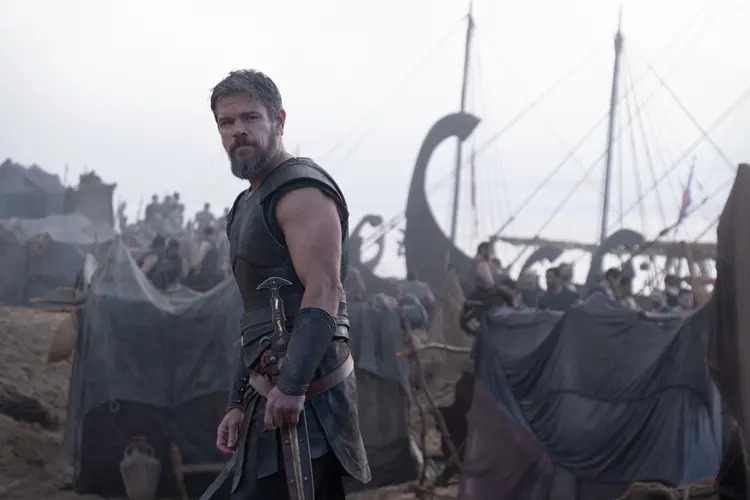
Toward the end of Christopher Nolan’s The Odyssey, Odysseus (played by Matt Damon) utters a despairing line clearly influenced by a Talmudic aphorism that’s also quoted in Schindler’s List: “Whoever saves one life, saves the world entire.” The Talmud sees absolute significance in the reverse as well—the destruction of one life—which is closer to the sense of Odysseus’s lament.
Giving a pagan Greek hero a line adapted from later Jewish wisdom is an interesting choice. Nolan also reinterprets one of Homer’s key themes in terms overtly drawn from one of the most revered of Jesus’ sayings, the Golden Rule. The ancient Greek precept of hospitality or xenia, called “Zeus’s law” in Nolan’s film, is repeatedly summarized as treating strangers and others “as you would be treated.” Yes: “Zeus’s law” is equated with Jesus’ words in Matthew 7:12 and Luke 6:31.
Nolan is almost the last filmmaker working in Hollywood today whose very name establishes any new release as a global cultural event. With The Odyssey, he has tackled one of Western civilization’s most culturally significant narratives (and most spectacular and cinema-ready) in the grandest possible style. The movie is the first feature film ever shot entirely in IMAX 70mm; filmed in eight countries and territories, it has the largest marquee ensemble cast of Nolan’s career. Given the director’s preference for minimal reliance on computer effects, the physical scale of the production was immense.
Nolan chose this latest film, he says, based on his personal affinity for this story: the tale of King Odysseus of Ithaca’s harrowing voyage home from the Trojan war; his belated reunion with his wife and son, Penelope and Telemachus; and his deadly reckoning with the horde of suitors plaguing his household in his absence as they seek Penelope’s hand and the throne.
Homer’s epic is “a very strong foundational text for me,” Nolan says. “I’ve been telling this story in all my films for years. It’s a family story, a love story, a revenge story, a war story, a coming-of-age story.”
The film also highlights a theme he’s previously circled but seldom engaged so directly: what his Odysseus calls “the fragile bonds between men”—the moral codes that hold societies and civilizations together. Perhaps the nearest precedent in the director’s work is The Dark Knight’s climactic scene: the Joker’s memorable ferry-boat social experiment, in which stranded civilians and convicted criminals must each decide whether to destroy the other or be destroyed themselves.
Heath Ledger’s Joker believes that people are “only as good as the world allows them to be,” and that, “when the chips are down, these civilized people” will “eat each other.” The Joker’s experiment fails, if barely.
The verdict of Nolan’s Odyssey is both grimmer and more high-minded. Like the filmmaker’s last work, Oppenheimer, The Odyssey has a downbeat, apocalyptic bent—but, unlike Oppenheimer, or any previous Nolan film, the new film focuses on what human beings owe one another.
This is a broader concern than Homer’s theme of xenia, often translated “guest-friendship,” which relates specifically to obligations linking the stranger or foreigner abroad (the xenos) and the local who receives them (the xenodokos). In Homer, xenia includes welcoming the stranger with a meal and providing bath and a bed, while guests are expected to accept hospitality courteously and not to become a burden or overstay their welcome. Xenos is the root of “xenophobia”—the fear of the stranger—which is the antithesis of xenia.
Catholic social teaching regarding welcoming immigrants has roots in ancient hospitality codes as well as Judeo-Christian religion; solicitude for strangers and foreigners is not specifically Christian. Within Nolan’s film, however, the language of the Golden Rule effectively transforms “Zeus’s law” of hospitality into Christian charity. (Offsetting this anachronism, Odysseus also says, “The gods help those who help themselves”—a saying often wrongly attributed, in monotheistic form, to the Bible, but actually originating in ancient Greece.)
Pre-Christian sources affirm the negative form of the Golden Rule, sometimes called the Silver Rule: “Do not do to others what you do not want done to you.” The Hebrew scriptures, however, are the first recorded source that positively enjoins loving one’s neighbor as oneself (Leviticus 19:18). The exhortation is explicitly extended even to “the alien, for you were aliens in the land of Egypt” (Leviticus 19:34). In the gospels, Jesus elevates love of neighbor, along with love of God, as the essential summary of the entire moral law, and Jesus directly includes foreigners, too (cf. Luke 10:25–37).
Hospitality was a religious duty in both the Homeric and biblical worlds. Just as Abraham’s three guests in Genesis 18 turned out to be heavenly visitors, Zeus and other deities were thought to travel the world in disguise. This was a constant social reminder that in receiving (or spurning) strangers one might receive (or spurn) a god. Zeus’s law is honored by Penelope (Anne Hathaway in a powerful performance) and especially young Telemachus (Tom Holland), as well as Odysseus’s loyal servant, the blind swineherd Eumaeus (John Leguizamo). Penelope’s rapacious suitors, especially sleazy Antinous (Robert Pattinson), are, of course, the ones who most notably violate Zeus’ law.
The importance of xenia in human society is heightened by the preternatural dangers of the story’s larger world, with its giants, sirens, and predatory monsters. Nolan’s telling emphasizes the non-xenia of the uncanny realm, from the brilliantly conceived, terrifyingly realized Cyclops (Bill Irwin), who makes no effort even to speak to tiny humans, to the witch Circe (an astonishing Samantha Morton), who talks about Zeus’s law but twists it to her own purposes. Upping the stakes are traveler’s tales of marauding “people from the sea” raiding and pillaging with no respect for Zeus’s law, threatening to undermine civilization with an age of darkness.
In Homer, the cause of the Trojan war is a grave breach of xenia: Paris, while a guest of Menelaus in Sparta, seduces his host’s wife, Helen, and absconds with her back to Troy. Ironically, when the Greeks besiege Troy, xenia is neither here nor there for Homer. It is quite different in Nolan’s retelling. For one thing, in the film the departure of Helen (Lupita Nyong’o) is presented as a mere pretext for the war, which was actually fought over control of trade routes.
The Christianizing of Zeus’s law has profound thematic consequences for Nolan’s project. (This would be a good place for those who haven’t seen the film to stop reading.)
Based on Virgil’s account in the Aeneid, Nolan opens with a lone warrior, Sinon (Elliot Page); Odysseus left him behind to explain to suspicious Trojans (who shoot first and ask questions later) that the wooden horse is an offering for Athena. Sinon is mortally injured, but at the mention of Athena one Trojan stops another from dispatching him, admonishing, “Respect their offering.” Shared piety leads the Trojans to erect the horse in the city at their temple of Athena. At night, of course, the hidden warriors slip out of the horse and open Troy’s gates to the Greek army.
The Trojan horse is the masterpiece of Odysseus’s celebrated cunning—but Nolan’s Odysseus ultimately rejects the ruthlessness of his own machination: a peace offering, a holy gift, turned into a weapon. “We violated all that’s ever sacred between people,” he confesses. “One man’s trick … to break Zeus’s law forever.”
This self-damning judgment parallels Odysseus’s regret for the savagery of the sack of Troy, including the rape and murder of women; later Greek literature explores this theme, though Homer does not. Odysseus’ words echo Circe’s bitter indictment of the “primal urges” and “appetites” of Odysseus’s men—traits she says are valued in battle. The blind prophet Tiresias (James Remar), whom Odysseus encounters in Hades, echoes this same theme when he says Odysseus might hope to save his surviving men from the gods, but he cannot save them “from themselves.”
Penelope offers a similar warning: Where xenia is neglected, she says, women are among the vulnerable who suffer more: “In this world, men do as they choose; I do what I can.” (This line reflects the Athenians’ terrible maxim in Thucydides’s Melian dialogue: “The strong do what they can, and the weak suffer what they must.”)
Nolan’s Odyssey is about the psychological consequences of war as well as the physical evils. Odysseus’s long-delayed homecoming is partly due to PTSD. Departing Troy, Odysseus risks an unknown route, a fateful choice masking self-destructive impulses. One of Nolan’s boldest adaptations is conflating Odysseus’s years with Calypso (Charlize Theron) with the narcotic lotus flowers; when Odysseus eats the flowers, he forgets his trauma, but also his home.
Throughout the film, Athena, (played by Zendaya) appears only to Odysseus. Is the goddess real—or only a manifestation of Odysseus’s guilt and trauma? The fact that she takes the form of a Trojan priestess Odysseus saw murdered could suggest the latter. No other deities appear onscreen, though their influence is clear. Religion plays virtually no role in Nolan’s earlier films, and his Odysseus isn’t very religious: “You can’t live by omens and sacrifices,” he says, and challenges Athena regarding the gods’ mysterious ways. Ultimately, though, Odysseus must surrender himself to the gods to find his way home.
Finally, Odysseus makes his ultimate confession: Odysseus and his men are themselves the lawless “people from the sea,” doing whatever would aid them in their journey home. By breaking the “fragile bonds between men,” Odysseus created broken men who went on to break civilization itself, heralding the twilight of the Bronze Age and the onset of an age of darkness.
Aristotelian virtue theory, which Christian moral philosophy embraced, teaches that the true cost of the worst we can do is that we become worse versions of ourselves, capable of still worse things. In Nolan’s Odyssey, this applies to communities and cultures as well as individuals. These themes carry a different weight today than they would have a decade ago; the film’s focus on a ruthless trade war—stripping away noble excuses to reveal broken human and national bonds—resonates with a new urgency in 2026.
Odysseus’s condemnation of the Trojan horse represents Nolan’s most searching cross-examination of one of his own work’s defining themes: the utilitarian lie. From the cathartic delusions at the hearts of Memento and Inception to Batman’s noble lie at the end of The Dark Knight and Michael Caine’s hopeful “Plan A” red herring in Interstellar, most of Nolan’s films turn significantly on a crucial lie told for utilitarian reasons. He makes an effort in The Dark Knight Rises to explore how a “noble lie” can backfire if the lie is exposed, but The Odyssey represents Nolan’s fullest exploration of the violence that we do to ourselves, as individuals and communities, when we rely on utilitarian ethics.
Nolan’s Odyssey is ultimately somewhat at odds with itself, as to an extent it must be. It laments violence and deception, yet the story demands that Odysseus use deception to wreak thrilling, crowd-pleasing vengeance on the odious suitors in his own home. In Nolan’s final twist, Odysseus accepts enduring consequences for this violation of Zeus’s law—yet this is presented, not as penance for a great sin, but as a way to placate the families of the slain suitors. It even allows a happy ending for the reunited lovers.
Ultimately, the film highlights commonalities between the pagan and Christian worlds. It falls short of a fully Christian view while going beyond a fully pagan one. Nolan’s Odysseus knows that if civilization is to rise again and endure, we must learn to treat others as we would be treated. What that entails, we must decide for ourselves.
Image: Matt Damon as Odysseus in Christopher Nolan’s The Odyssey, courtesy of Universal.