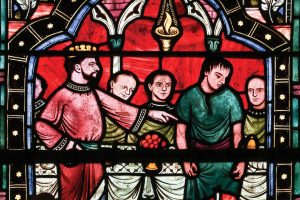
“I am deeply grieved, even to death; remain here, and stay awake with me.” • Matthew 26:38
Julian of Norwich made the remarkable claim that God not only loves us but also likes us. She bases her famous assurance—“All shall be well, and all manner of things shall be well”—on this revelation. Perhaps it’s wise for the more short-sighted among us not to argue with mystics. But if God views the world as it is right now in 2026 and still likes us, then it may seem like more evidence that there’s no accounting for taste.
Climate catastrophe looms. Environmental degradation is vigorously engaged. Wars are waged relentlessly. Life is cheapened. Social violence is shrugged off. Migrants and refugees are manhandled like criminals. The pain of the poor grows more urgent while the rest of us stream our favorite programs. What, exactly, does God find likeable in humanity?
For someone with elevated sight like Julian, it’s apparent God must also view creation from a higher perspective. In some cosmic quantum sense, God sees not only who you and I are at this hour but also who we’re capable of being. God looks at us and sees the exalted creatures originally molded with divine thumbprints still visible in the clay. God perceives our kingdom selves: who we might be when purged of selfish inclinations and moral failures in that ever-imminent realm in which the constructs of social sin are a distant memory and the divine reign is fully, finally, and brilliantly underway.
How could the God of mercy and justice not love this eternally holy view of things, the radiant vision which was the purpose of our creation? God created everything for love’s sake, to be in relationship with each and with all. Of course, God loves and also likes us: We are divinity’s everlasting partners in the dance of life. We are God’s own and God’s beloved. We are, each of us, God’s darlings.
Be comforted by this reality for a moment. Then feel its challenge. If every person since the dawn of time is dear to God, then what in the world are we doing in relationships both personal and global? As philosopher and activist Cornel West says, justice is what love looks like in public.
This suggests there’s not enough love in our public spheres. In our indifference to the planet’s suffering, in our tacit support of social policies and values that destroy hope for so many, we actively persecute God’s darlings. This puts us on the wrong side of history and, I dare say, the wrong side of eternity. I hope this scares you as much as it scares me.
During Lent we deepen our practice of fasting, prayer, and almsgiving. It’s easy to imagine these three as distinct activities on a random checklist of Lenten things to do. Yet reading Pope Leo’s apostolic exhortation Dilexi Te (On Love for the Poor) made me appreciate their unity as a single concentrated movement to restore us to the just side of history. Lenten observances aren’t about giving up treats, saying an extra rosary, or writing a fat check to Catholic Relief Services—though none of those are bad things to do. They’re not meant to enhance our personal virtue. Our sacrifices, our praying, and our giving are a unified effort for the sake of God’s darlings. We don’t take up a 40-day discipline to shine our halos, only to abandon it with relief come Easter. Lenten practices refine our constant striving toward that radiant self which God originally loved into being and, yes, likes enough to share eternity with.
Why aim our Lenten disciplines and lifelong striving toward the disadvantaged in society and in the world? Because the prophets, wisdom books, and teachings of Jesus all emphatically direct us to do this. As Pope Leo writes, love for God and for the poor are one: “This is not a matter of mere human kindness but a revelation: Contact with those who are lowly and powerless is a fundamental way of encountering the Lord of history.”
In his incarnation and crucifixion, Jesus became poor—which means God deliberately chooses to be poor with the poor. If we turn a deaf ear to human suffering and prefer merely to go to church, we’re wasting our time and squandering our eternity. Because the Jesus we expect to encounter in church is the same Jesus denied help in discontinued international aid, the sick Jesus who requires medical coverage as well as medical research in now-shuttered science labs, the hungry Jesus in need of school lunches and SNAP assistance. It’s Jesus who’s being snatched up by Immigration and Custom Enforcement and treated not only as a person without civil rights but as a non-person. It’s the Indigenous Jesus whose sacred lands are being exploited and water resources poisoned when mining and drilling permits enrich companies with heavy lobbying purses.
As Pope Leo reminds us, poverty comes in many forms: material, social, moral, and spiritual. We’re poor if we have no rights, no freedom, no voice, no space where we’re safe or respected. And God, in making what the church has long called the preferential option for the poor, chooses to identify with the very people our world currently ignores and devalues. Jesus is the poor messiah as well as the messiah of the poor, to whom the kingdom of God is promised in the beatitudes.
Fasting, prayer, and almsgiving are a unified practice enabling us to see as God sees. Second-century Justin Martyr noted how, at the heart of our liturgy, the worship of God is inseparable from concern for the poor. And St. John Chrysostom declared, “Do not honor Christ’s body here in church with silk fabrics, while outside you neglect it when it suffers from cold and nakedness. . . . Feed the hungry first, and only afterward adorn the altar with what remains.”
Pope Leo puts it firmly: “Doctrinal rigor without mercy is empty talk.” We may get liturgy and piety down to a science yet miss the passionate heart of the matter. Pope Francis also observed that we can’t teach without loving. Our Christian witness convinces no one if they don’t see our compassion first and foremost.
Fasting, prayer, almsgiving: We take less, widen our hearts, and share more. This triune lifestyle is a pointed rebuke toward the “dictatorship of an economy that kills,” the new tyranny being born as the few ultra-rich disenfranchise the great majority of persons and endanger planetary life. Dilexi Te summarizes our task with a powerful directive: “No Christian can regard the poor simply as a societal problem; they are part of our ‘family.’ They are ‘one of us.’ ” They are us, God’s darlings all.
Every Lent concludes with a weeklong recollection of the passion of Christ. It’s a reminder of our continual confrontation with the suffering Jesus in the man sleeping on the sidewalk, the woman asking for our change, the children incarcerated at our borders. Jesus asks his friends to remain with him, not to swell attendance at evening parish missions and Holy Week services but to accompany his suffering body in Sudan and Gaza, in our cities and impoverished boroughs and Indigenous lands. We remain with Jesus to offer support in such places but also to ask why our Jesus continues to suffer so here, there, and everywhere. God’s darlings deserve better.
This article also appears in the March 2026 issue of U.S. Catholic (Vol. 91, No. 3, pages 47-49). Click here to subscribe to the magazine.
Image: Pexels/Ahmed Akacha