My wife and I are in the thick of the newborn phase with our first baby, Frances. In normal times, parenting a newborn is intense: sleepless nights, constant feeding, endless diaper changes, and the many requisite anxious-new-parent trips to urgent care. But it is far from normal times in our South Minneapolis neighborhood, where we are occupied by a veritable army of federal immigration agents. Sleeplessness and colic are not the most intense parts of our lives these days—not even close. In fact, as I said to a friend the other day, “The hardest part of parenting a newborn has been the fascism.”
Here in Minnesota, things are not good—and that’s the “Minnesota Nice” way of saying it. Immigrations and Customs Enforcement (ICE) agents are shooting and killing residents. Federal agents haunt our streets and teargas innocent civilians. They disappear our neighbors from their living rooms, from their cars, from Target stores and gas stations. They deny elected officials their right to examine conditions of local detention centers. Reports on those centers, from people released from them, are terrifying. They assault high school students on school property. They pepper spray journalists and pull guns on legal observers. I changed the clothes I sleep in because they have a bad habit of banging on doors in our neighborhood in the middle of the night to interrogate us about our neighbors’ immigration status.
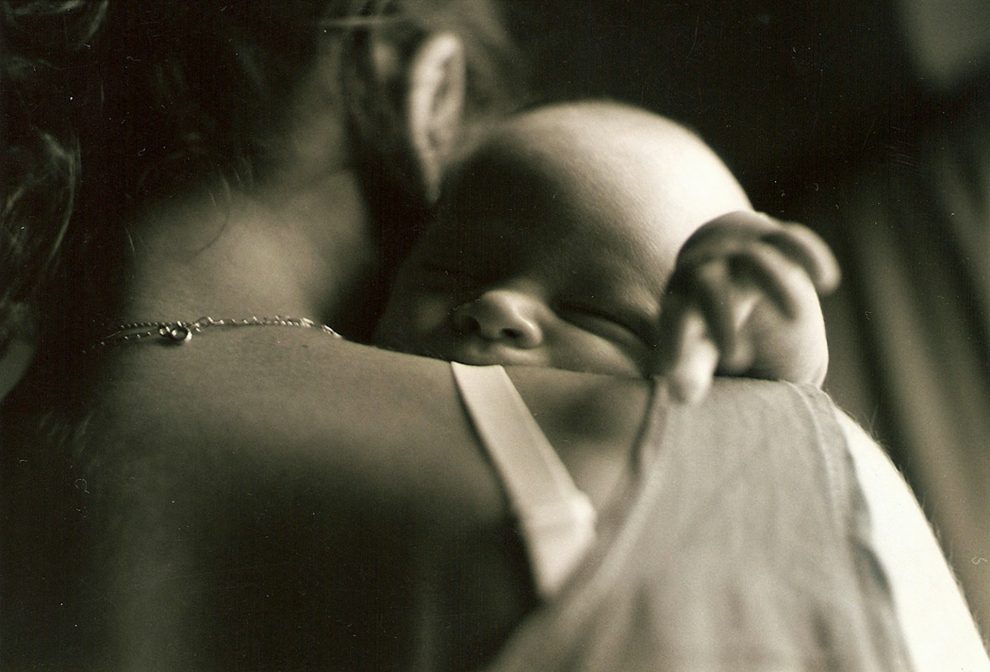
I hold my baby tightly, my tears falling freely on her tiny hands. “Oh Frances,” I say. “What a terrible time to be born.”
A few days ago, right after my wife and I got into the car with our baby, we heard that ICE was arresting nonviolent legal observers on our street corner. During arrests like this, ICE agents frequently toss out canisters of tear gas. I looked over at Frances’ big blue eyes, so new to this world, and imagined what would have happened to them if we had gotten into the car two minutes later, and if ICE agents had been as reckless on our street as they often are on others. Just a few weeks earlier, ICE agents tear gassed a car full of children in North Minneapolis. Did their parents feel as hopeless, as helpless as I did? Everything in me aches with pain, fear, and rage. Not even babies are safe from this terror.
My friend and I were making cookies in my kitchen a couple weeks ago. Her phone started buzzing: an amber alert. A 7-year-old white girl, Brynlee, is missing. “Please, God,” I prayed, “May she be found. May she be safe. May she be reunited with her family.”
That amber alert kept me up all night. Or, I should say, the amber alerts that I didn’t get kept me up all night. Because thousands of my neighbors, across the Minneapolis metro area, are also missing. They have been kidnapped from their homes by masked men holding big guns and driven away in unmarked cars with tinted windows. They are mocked and hurt and held in cages. They are untraceably trafficked across the country and, ultimately, around the world. They have been captured by an infamous gang of thugs who are terrorizing our communities in broad daylight. And yet, if I called the police to report my neighbors’ disappearances—like Brynlee’s family surely did—they’d tell me the kidnappers are their kin.
If I got an amber alert on my phone every time one of my neighbors went missing during Operation Metro Surge, my phone battery would be drained in hours. The cell towers would be overwhelmed. There would be no moment of silence for prayer in a megachurch. No carefully scripted press conference would go undisturbed. We would cover our ears to drown out unceasing buzzes and beeps from every pocket and purse. We would have no peace. Maybe we shouldn’t.
My baby is seven weeks old as I write this. She has started grabbing my finger and holds on with her whole tiny body strength. Her dark hair is getting longer, as are her razor-sharp fingernails. She has almost grown out of newborn-sized clothing. She knows my voice. And her skin is as white as mine, and as white as her other mom’s, too. If she went missing, even for the briefest amount of time, you’d better believe that I would report her disappearance to every authority, every bureau, every department, every neighborhood group, every news outlet. You would get an amber alert on your phone. Squad cars and taxpayer dollars would be deployed until she was back in my arms. But for my immigrant neighbors, whose skin is less white and whose accents are less regional? Those same squad cars and that same money are taking them far, far away.
“Oh, Frances. What horrors have we birthed you into?” I sing my oldest and most desperate prayers as I change her diaper: “Agnus Dei, qui tollis peccata mundi, miserere nobis. Agnus Dei, qui tollis peccata mundi, dona nobis pacem.”
And yet, even in the horrors, God is moving in and through my community. Vast networks of regular people take shifts around local restaurants and preschools to keep federal agents at bay. Moms walk other peoples’ kids to the bus stop. Organizers train thousands of Twin Cities locals how to keep their neighbors safe. Indigenous elders lead prayer services outside the detention center. Somali grandmothers bring fresh sambusa and hot spiced black tea to mourners at the memorials of Renee Good and Alex Pretti. My church hands out hot chocolate and hand warmers to people keeping watch on their blocks. Neighbors deliver groceries to families in hiding. Facebook pages are flooded with reminders to order food from immigrant-owned businesses. I’ve talked more to my neighbors in the past two months than I have in my entire time living in this house. Everyone has a whistle—or two, or twelve. And after a particularly impossible week, a dear friend brings the ultimate Minnesotan sacrament to our chosen family: tater tot hot dish.
I’ve often wondered why God, in Jesus, chose to come into this world incarnate as a baby in a vulnerable community occupied by a violent government. God could have come at any time into any group of people; could have come in power, or, at least, in peace. I hear the song of Mary, pregnant with Jesus under empire, remind me of God’s promise from long ago: God will scatter the proud, de-throne the powerful, raise the oppressed, fill the bellies of the hungry, and send the rich away. Maybe Mary sang these words because she knew they were true, but maybe she sang them because she needed them to be true—for herself and for her baby. I need them to be true for me and my baby, too, and for my neighbors, and for their neighbors. After all, if the dictators aren’t ousted, if the hungry aren’t fed, what business do any of us have bringing more innocents into this hurting, hurtful world?
But God’s promises—however radical—are good, and God’s words are true. Babies like Jesus were born in Palestine occupied by the Roman Empire, and babies like mine are being born right now in Minneapolis, and babies have been born under every fascist regime that has risen and fallen in-between. Why? Because God comes into this world fastest and most frequently to those on the margins, to those most in need of new life.
Right now, people with power are telling you that the surge of federal agents into Minnesota is ending. But local longtime organizers and city council members are skeptical. I am, too. After all, these same people have claimed to be conducting targeted searches when instead they are indiscriminately seizing citizens, witnesses, and children. They have killed innocent people in cold blood, and made claims about these killings that contradict clear video evidence. They have openly, repeatedly, and proudly defied laws, policies, and court orders. To believe that those same people have suddenly turned honest requires a level of forgiving and forgetting that I, for one, have not yet mastered.
My baby is starting to wake up, and I have a diaper to change. “Oh, Frances. I promise to keep working and praying for a better world for you, and your classmates, and your bus drivers. I promise to do everything I can to make this a safer, easier life to be born into a year from now, and ten years, and a hundred. I will tell you of God’s promises, because I believe them and because I need them to be true. And in the meantime, I will hold you close, washing your hair with my tears, and sing you my oldest and most desperate prayers.”
“Oh, Frances. What a radical time to be born. What a miraculous time to be born. What a just-right time to be born. Welcome.”
Image: Unsplash/Ivan Radulovich