We Catholics understand the importance of food. Our faith is centered around the Eucharist; the consumption of Jesus’ body and blood. But while the Eucharist is a Sacrament that causes God’s grace to manifest here on earth, other meals can be little eucharists as well. Sitting down with family and a bowl of homemade soup is not only an experience in fellowship, but an example of God’s love in providing for us. We marvel in miracle that is the cycle from dirt to vegetable to animal to us as humans. Fueling our bodies and dreams and prayers, a simple meal becomes an experience of God’s unbounding generosity and grace.
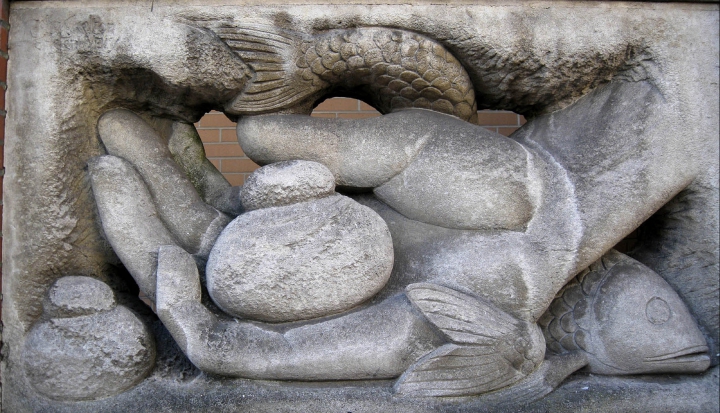
In the Gospel of John one finds another example of grace found through food. Jesus feeds five thousand people with five loaves of barley bread and two fish. Talk about an experience of God’s presence in the world around us!
Imagine being that little boy with the food. These strange, worldly disciples of Jesus come up to you, asking for you to donate the lunch your mother packed for you. Barley loaves—not as expensive as wheat bread, but all she could afford—and a couple fish. You’ve been standing outside all day in the sun, you’re tired and hungry, and honestly all you want to do is sit down and eat. But you give your food to these strangers—maybe out of generosity or love for Jesus, but maybe even a little bit out of fear of these strange men.
Whatever the reason, your gift brings a crowd of people together. Through their shared experience and breaking bread together, everyone in the crowd that day has a unique understanding of just how much God cares about them.
Something as simple as bread and fish and a crowd of people give us a whole new way to understand the immediacy of God’s presence among us. Jesus chose to show the crowd a concrete example of God’s love and grace, expressed in the material world through which we experience life.
If these small sacramental celebrations remind us of God’s love, they also show us exactly what that love looks like. The God in the Gospel story cares for everyone—cares for needs as basic as the need to eat lunch on a hot day. But God also calls the people to stand together in relationship to each other and to Jesus. The story is dependent not just on Jesus’ miraculous multiplication of the food, but also on that little boy who gave up his lunch, the faith of the disciples in following Jesus’ order, and the trust of the entire crowd that there would be enough for everyone.
Everyone there that day, rich or poor, was given the same simple food to eat. They shared a meal, broke the bread together, and became a community. There was no hierarchy in this new group. After all, it was a little boy who had given the food. It was a single man, a carpenter, who had fed them all. A man who, when they misunderstood and sought to crown him king, ran away from everyone. The story shows us that God’s grace is unequivocal and universal. It is not determined by obedience or orthodoxy. It’s not about how much you give or who you know. Instead, faith is about being willing to stand in relationship to God and those around you.
What better way to experience the radicalness of God’s love? The care for others and the sacrifice of one to feed the many showed the people on the mountain that everyone has value—even the least among them had something to offer. Maybe from then on the people who were in that crowd saw their actions a little bit differently. Perhaps, remembering how five loaves and two fish fed many, they were a little more generous. Or seeing each other the next day, they were a little quicker to greet one another, despite their differences in social class or political beliefs. That little meal of barley loaves and fish had changed their life forever.
We, too, are called to share God’s love. Maybe we can’t do anything as incredible as multiplying one lunch to feed five thousand people. But we can show God’s love in equally profound ways. Sometimes it’s as simple as taking the time to share a meal with your family or visit friends who you don’t see very often. But sometimes we are called to more difficult tasks. To strive for a world where five thousand strangers can sit down and share a simple meal. To work for justice and to end inequality in ways both big and small. To be examples of this radical love in the world.
Not all illustrations of God’s love are bread and fish. Words and actions have the power to show God’s presence as well. And so we are called to love one another as Christ has loved us. To feed and to clothe, sometimes to struggle and show anger. To sacrifice. This is where we find God’s grace.