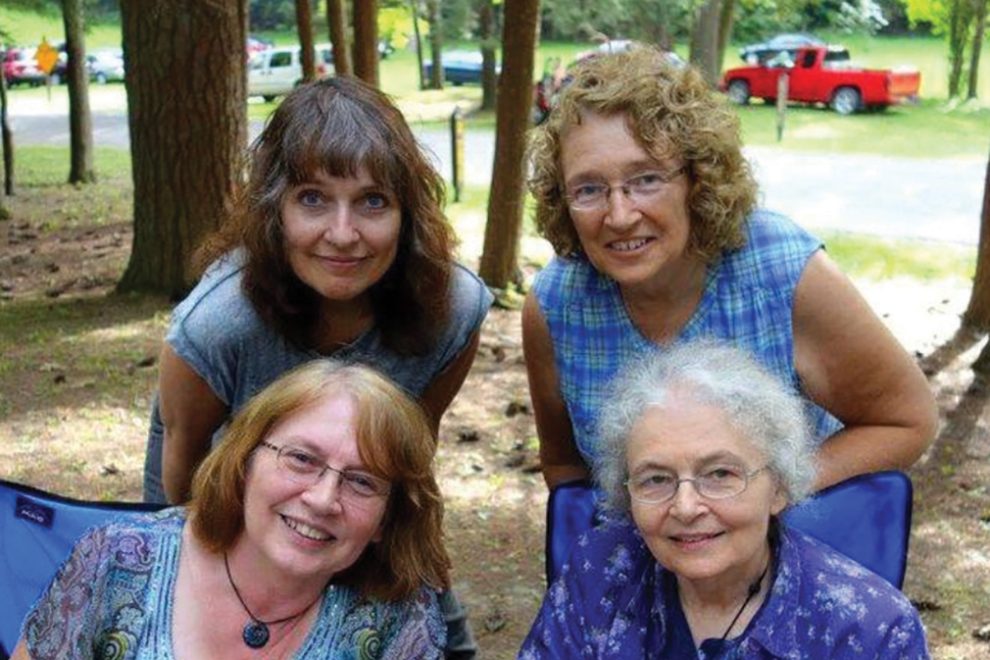
Somewhere, women were laughing. The sound carried me back to my childhood, when I’d lie in my bed comforted by the voices of my older sisters talking in their bedroom down the hall. Now, decades later, groggy and in pain after an emergency surgery, I was convinced my big sisters were talking together in the next room.
Earlier, as I’d counted my racing pulse through the pain that pounded my body, sleep had seemed impossible. Now, listening to what I thought was my sisters’ laughter, my heart slowed; my muscles eased; even the pain seemed less consuming. Sleep finally enfolded me.
The next day, the pain was back, worse than before, eating my brain until it was hard to hold on to a single thought. And then, again, I heard voices in the hallway, voices I was sure I recognized—and this time, my drugged mind wasn’t playing tricks on me.
My sisters came into my hospital room and sat by my bed, their faces older now but still nearly as familiar as my own. They made me laugh, as they always do, and the pain receded, just a little. They watched the machines connected to me and worried at the rising numbers; one of them called the nurse, but I was only vaguely aware. Whatever else was going on, my body recognized safety. My big sisters were there.
That hospital experience reminded me that family love lives not only in memory but in the body. Long before I knew words like grace, sacrament, or communion, I knew the meaning of those concepts in my flesh and bones. With their voices and hands, their humor and tenderness, my big sisters made spiritual abstractions tangible. They showed me I wasn’t alone. Their steady presence in my life taught me that love not only endures across distance and time but also continues to grow.
My older brother taught me something still stranger: that sibling love can even endure death. Although he died in a plane crash when I was 13, he too remains part of my soul’s household forever. My favorite photograph of him—one eyebrow raised, a small quizzical smile on his lips—has looked down at me from every place I’ve lived.
That look of fond skepticism was typical of our relationship in the years before his death. As he grew older, he changed from the tormentor who teased me relentlessly into a friend who encouraged me to ask questions. Despite the decades since his death, he has remained with me somehow, always demanding that I look again at my assumptions, that I have the courage to be curious.
My sisters assured my body that love remains near even when I am frightened and helpless. My brother taught me love does not merely comfort but also questions, unsettles, and calls us toward truth. These relationships have shaped how I understand what the church calls the communion of saints—not as an abstract spiritual concept but as something here and now, made real in the ongoing bonds between human beings.
Because of my siblings, the image in Hebrews of a cloud of witnesses has come to feel like an intimate, surrounding presence. These witnesses are not merely spectators looking down at us from some far-off heavenly observation deck; they are relationships that remain alive, continuing to touch and shape our lives.
My sisters still protect and comfort me (even when they are geographically distant—and even when we hurt one another’s feelings, as we do from time to time), and my brother continues to accompany me with his defiant openness to truth, pushing me out beyond my comfort zones, even though he is no longer in this world. My siblings’ voices reassure me, challenge me, and remain with me, no matter how old I am.
Long before we possess theological language, this is how many of us first learn to recognize grace—not as church doctrine but through the ordinary sacraments of our home lives. Family life is often our first school of spirituality. It is where we learn—or sometimes fail to learn—what love, trust, and forgiveness feel like.
When love is present in our families, even imperfectly, our bodies learn to recognize safety, belonging, and faithful presence. In our childhood homes, we may first comprehend that love can be intimate without being possessive, enduring without being static, comforting without always being easy. We may come to understand that those who love us remain present even when they are far away, even when relationships are imperfect, even when death has changed the form of their presence.
My family of origin was far from perfect, yet it never ceases to reveal to me the divine presence: unseen yet near, consoling yet challenging, always calling me more fully into love. I hear that message in the sound of laughter and familiar voices; I see it in the skeptical raised eyebrow of someone death can never entirely take from me.
The living who come to our hospital bedsides and the dead who still ask something of us all belong to the ever-present communion of love. Through them, God reminds us that divine love is not limited by physical proximity—or even by death.
This article also appears in the October 2026 issue of U.S. Catholic (Vol. 91, No. 10, pages 38-39). Click here to subscribe to the magazine.
Image: Ellyn Sanna (top left) with her three older sisters. Courtesy of the author.