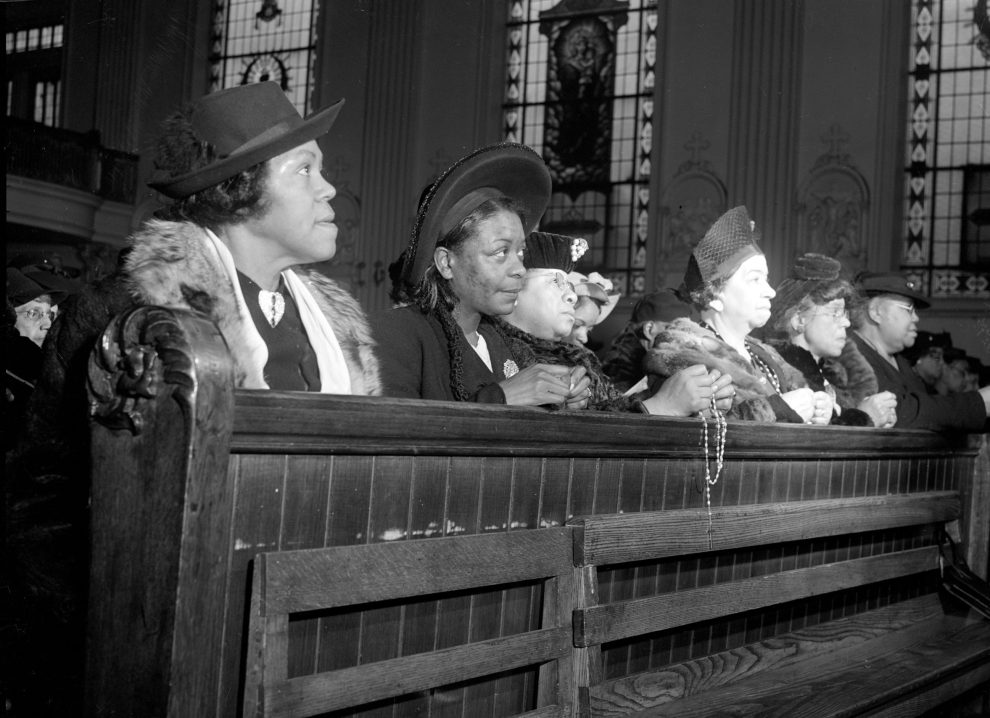
St. Columbanus at 71st and Prairie on the South Side of Chicago was my grandmother’s parish for nearly 50 years. One of many Black Catholic parishes in Chicago, it was the place my father, aunt, and uncle attended grade school; where my grandfather helped barbecue for the parish fundraisers; and the church where my grandmother served in the Ladies Auxiliary of the Knights of Peter Claver. My cousin married his wife there. It was a center of neighborhood life and of our family’s story. It was where our family’s story added to the ongoing story of Black Catholic history in America.
Now that all of our family has moved away from the neighborhood, I have been reflecting on how we are passing on Black Catholic traditions and expressions of the faith. I am considering how I, as a mom, aunt, cousin, and ministry leader, continue to contribute to Black Catholic history. I believe the church is enriched by Black spirituality and culture. I want to continue to pass on this legacy of faith to the next generation.
In my reflection, I found myself revisiting the U.S. Black Bishops’ 1984 pastoral letter, “What We Have Seen and Heard.” In the letter, the bishops identify four distinct hallmarks of Black spirituality: It is contemplative, holistic, joyful, and communitarian. Each of these four characteristics lives within my family as expressions of our faith, through which we form one another in discipleship and also bear witness in faith to the whole church.
The bishops call joy a “hallmark of Black Spirituality,” demonstrated through celebration, hope, and trust in God, marked by the “movement and song, rhythm and feeling, color and sensation, exultation and thanksgiving” of Black life. I see this joy in my family as we cook on holidays, dance at family parties, tease and brag on one another. It comes out when my aunties say things like, “Look at God!” after a cousin gets an acceptance letter to college. Or when a cousin says, “Praise Jesus!” because someone gets a new job. We tell each other stories about all the times “God brought us through,” demonstrating for young ones that we have much to celebrate, even in the face of racism, discrimination, or hardship.
My family also demonstrates a contemplative spirituality, rooted in prayer and aware, as the bishops write, of the “vital intimacy of God’s closeness.” One specific memory that comes to mind is my grandmother handing me the first theology book I ever read. I had just attended a retreat at church and told her how much I enjoyed it. She wanted me to have the book so I could love the Eucharist as much as she did. When I opened it, I discovered the pages filled with her notes and her favorite phrases underlined. Each note pointed me to a deeper understanding of the sacrament, revealing the depth of my grandmother’s love for Jesus and her devotion to his presence in the Eucharist. Through her gift, Grandma showed me her contemplative nature and invited me to experience something similar.
My family’s holistic faith is easy to see. I sway, clap, and lift my hands when I sing or pray at Mass. My aunt creates art and textiles inspired by her time in meditation. My father regularly visits friends in the hospital, assists with their physical care, and prays with them for healing and strength. Body, mind, and spirit are all engaged, naturally. They simply always influence one another.
Finally, we live our faith in, through, and for the community. Drawing from the South African concept of ubuntu—“I am because we are”—we understand that who we are is rooted in our relationships to others. We tell stories about the Wimps when they came to the South Side of Chicago and about the people who influenced our grandparents’ conversion to Catholicism. Our major life events always include aunties, uncles, and cousins—some who are biologically related and many who are not. We support Black businesses; advocate politically and socially for racial justice; and pray for one another’s needs. Whatever “one member suffers,” as St. Paul says in 1 Corinthians 12:26, “all suffer together with it; [and] if one member is honored, all rejoice together with it.” We are members of our community, and faith is a central part of our shared life.
These four expressions are things I can live out every day, no matter what parish I attend or whom I am privileged to accompany in faith. They are ways that I, like my relatives, can express my whole self as a follower of Jesus. And they tether me to my family’s Black Catholic history even as I write my own.
Yet, even as these expressions of faith are authentically Black, they are also truly Catholic. Every baptized member of the body of Christ is called to joyfully share the good news of Jesus. Each of us can find intimacy with Jesus, which shapes us in body, mind, and spirit. And all of us are called to community with our family members in Christ in order to build the kingdom of God on Earth as it is in heaven.
I am glad my family had St. Columbanus so many years ago as a place to grow in God’s grace. And I am grateful there will be new parishes, neighborhoods, and communities where God will write new stories of faith for our family. God is still shaping our Black Catholic history. I am so glad I get to be a part of what comes next.
This article also appears in the November 2026 issue of U.S. Catholic (Vol. 91, No. 11, pages 38-39). Click here to subscribe to the magazine.
Image: Jack Delano, Sunday Mass at Saint Elizabeth’s Catholic Church, Chicago, Illinois, 1942, Photograph