Julia Minchew’s conversations with her 3-year-old, Annie, go something like this.
Annie: “Mommy, when I get bigger, I’m going to go downstairs, take my car, and go pick up Finnegan.”
Julia: “Well, honey, he’s in heaven, and we won’t see him for a very long time.”
Annie: “Will you die one day?”
Julia: “I’m going to die, and you’re going to die.”
Annie: “I don’t want to die.”
In December 2020, Minchew and her husband lost their 18-month-old son, Finnegan, to the rare genetic disease Tay-Sachs. In March 2023, their daughter, Annie, was born.
Minchew hasn’t shied away from telling Annie about her brother who died. But as Annie asks more questions, Minchew sometimes finds herself at a loss. Minchew, who was raised Catholic, wants to share with her daughter her core belief that death isn’t the end and love is the most important thing. But “Google will say, keep religion out of it because you want kids to understand that death is permanent,” she says. “So, you don’t go somewhere, but you do. It’s confusing.”
Minchew also wants to pass on her memories and love for Finnegan to Annie, but she doesn’t want to transfer her own grief onto her child. “Annie will say, ‘I miss Finnegan,’ even though she has never met him before,” Minchew says. She affirms her daughter’s emotions and looks for active, physical ways to support her in processing them.
Like many parents, Minchew is stumbling through conversations about death and dying with her child. In a time when tragedies feature prominently on the news, yet children often remain removed from real-life encounters with dying and death, these conversations become even more fraught. It can be difficult to figure out how to speak honestly about death with kids without overwhelming them. Luckily, resources do exist to help caregivers have these hard conversations.
What death means
A mature understanding of death, according to child development psychologist Marjorie Schaeffer, includes four components: nonfunctionality (the body stops working permanently), universality, irreversibility, and biological causality. Children grasp these components slowly over time.
Preschool-aged children often view death as temporary and reversible. “This age can be particularly harmed when we use metaphors to talk about death,” says Schaeffer, who teaches at Saint Mary’s College in Indiana. Being really concrete about the fact that a loved one died and can’t come back prevents children’s tendency toward magical thinking, where they think there is somewhere they can go or something they can do to bring the person back.
At earlier ages, “kids often believe that death is a choice,” Schaeffer says. “They can be really angry at people in their lives for choosing to die.” They are also egocentric, focusing on how the death impacts them. “They need reassurance that their world is stable,” she says.
Children’s limited life experiences joined with magical thinking can also lead them to believe they caused a death. “It’s very easy for children to pick up on, ‘I wore the green shirt, that’s why I didn’t get the part,’ or, ‘I fought with my mom, and she lost the baby,’ ” says Colleen Narbone, a counselor and former hospice chaplain.
By the time children reach ages 5 to 7, they usually grasp the first three components of death—nonfunctionality, universality, and irreversibility—but understanding biological causality often takes a few more years.
When Linda Moran’s nephews were 7 and 9 years old, their mother—Moran’s sister Nancy—died of breast cancer. Moran had gone through her own father’s death when she was 14 and had felt isolated and unsupported. “When bad things happened, you did not talk about them,” she says. “There were no pictures of my dad, no reference to him, nothing.” Moran wanted to offer her nephews the support she never had. She tried to be honest and answer all their questions and often had them over at her house.
One evening the boys were playing outside when the older one ran inside. “Aunt Linda, I need to ask you something,” he said. “What happened to my mom’s body that made her die?”
Moran took off her dish gloves and drew him a diagram of how the cancer had spread up his mother’s spine and went to her brain. “He looked at me and said, ‘OK, thanks,’ and went outside again,” Moran says. “He was outside playing games and having a blast, but that was on his mind.”
Schaeffer affirms that Moran was right to answer his question as she did. “For children whose parents have died, they should know the cause,” she says. “We sometimes think it’s gruesome, but that’s appropriate for older kids.”
As Moran observed how much a strong support system mattered for her nephews, she decided to provide this for other children as well. She got a master’s degree in psychology from Benedictine University in Illinois and eventually founded Buddy’s Place, a family grief support program.
In her decades of working with families, she has observed that children need concrete explanations of death. “I’ve heard stories of children who go on airplane rides and are hysterical once they get there, because they thought their [deceased] parents were up in the clouds,” Moran says. “Even if we’re using a faith-based foundation to support kids’ grief, we need to be aware of their cognitive development.”
While caregivers often worry that experiencing the realities of death will overwhelm children, Moran and other experts suggest giving children the choice of encountering it on their own terms. For example, she says, you might offer your child the option to visit Grandpa and hold his hand before he dies and give them the option to leave the room if they need to. “You let them be the teacher and tell you what they need and what they can handle,” she says.
“If children know and they make a choice, often it’s a better integrated outcome for them.”
Narbone says. “In a situation where there’s no control, it gives them some choice and control.”
Faith-filled imaginations
Facing death at a young age can challenge children’s fledgling faith. When Laura Fanucci was 10, her 21-year-old brother died of cancer. “I was so deeply sad and angry at God,” Fanucci says. “I didn’t understand why people’s prayers didn’t help.”
At the same time, Catholicism’s rituals and beliefs can support families and children in the grief journey. In 2016, Fanucci and her husband lost twin daughters days after birth to twin-to-twin transfusion syndrome, which means their blood vessels were connected in utero. They had three boys already and went on to have two more boys after the twins’ death.
Fanucci has tried to be as honest and open with her children as possible, without overcomplicating things. She also continues to speak of the twins as members of the family. “When we do family prayers, we pray for everybody by name and include Maggie and Abby,” she says. This reflects the Catholic understanding of the communion of saints, Fanucci says, where “the living and the dead are united with the Lord, and the dead can be a helpful presence in our lives.”
This sense of ongoing connection with loved ones, Narbone says, is affirmed by grief expert David Kessler’s insight that “love never ends.” The Catholic rituals of receiving Mass on behalf of the dead, celebrating All Saints Day, and praying to the dead are all embodied ways of honoring that connection. “[Our deceased family members] are now saints,” she says.
“Rituals help us make sense of reality and process what happens in our lives when we lose someone, when somebody is ill, or when somebody is born,” says Hosffman Ospino, a theologian at Boston College. From baptism to the Eucharist to confession to anointing the sick, “the sacraments are these powerful rituals that are constantly reminding us that death does not have the final word,” he says. “It is a transition into something that we aspire to be, which is in the presence of God.”
Other cultures have something to offer Western cultures when it comes to observing these kinds of rituals. Hispanic, African, and Asian cultures all have a strong sense of family life that acknowledges family members remain in communion even after death. “These are strong ties that not even death breaks,” Ospino says. “There’s a sense that these people are still present in our lives.”
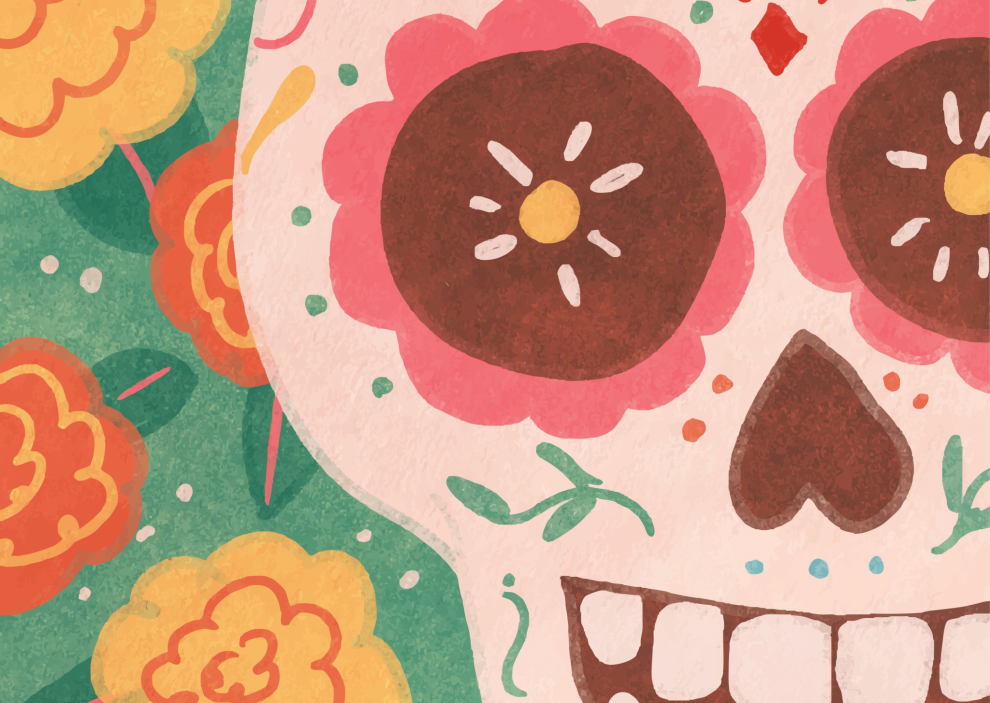
These convictions can be seen through observances of Día de los Muertos. Families adorn altars with marigolds and celebrate the lives of their dead with food, music, and gatherings. Other Latino/a practices also serve as reminders that death is not the end. Latino/a families create altarcitos—small memorials for the dead in their homes—carry pictures of dead loved ones in their wallets, and often name children after dead family members.
For Ospino, these efforts are similar to other Catholic practices memorializing the saints. “We remember their good deeds and how they were models of faith, life, solidarity, of the gospel,” he says. The idea that our memories of the dead keep them alive is also profoundly theological. “We live eternally because God loves us and remembers us. As long as God remembers us, we exist and are alive,” he says.
“I think children have a sense of the scope of life being bigger than this present time,” Fanucci says. “It enlarges the imagination and expands the soul to say that things are bigger than what they see and know.” This sense was deepened when recently, her 12-year-old looked up at her from the table and said, “It’s really cool that I have sisters in heaven and I’ll get to meet them someday.”
Complicated deaths
Leticia Ochoa Adams’ son, Anthony, died by suicide in 2017. Anthony was 22 at the time and had two daughters, ages 1 and 3, while Adams’ three younger children were 14, 17, and 18. Adams, who had entered the Catholic Church about seven years prior, “did not have the energy or capacity to try to use fluffy language or try to say, ‘Oh he’s in a better place, your daddy went to heaven,’ ” she says. “All I had the capacity for was honesty.”
Anthony’s death falls into the category of what experts call disenfranchised griefs and deaths. According to Moran, these also include homicides, deaths from diseases such as AIDS, and overdoses. “Those deaths have an element of secrecy and shame attached to them,” Moran says. “Yet the survivors and children deserve respect and support as much as anybody else.”
For Adams, being unflinchingly honest about Anthony’s death with her children and grandchildren has meant allowing them to feel or do whatever they need to feel or do. For instance, her teenage children were angry with their brother. “They had grown up without their dad, and now Anthony had abandoned his children,” Adams says. Adams affirmed those feelings: “Yeah, he did leave his kids. This is really [crappy], unfair, and unkind. He did put his pain on you.”
The Catholic concept of purgatory has been a helpful way for Adams to address some of the difficult aspects of Anthony’s death. Purgatory allows that Anthony would eventually make his way to heaven but recognizes the weight of his choice to die by suicide.
Adams explains it to her children and grandchildren this way: “He understands the pain his action caused us. Now he’s going to work hard and try to help us and pray for us because he is in the face of God. That’s who he is and what he would be doing—Anthony would do anything to repair the damage his choice made.”
At the same time, Adams recognizes that mental illness played a role in Anthony’s death. She’s gone down all the roads, macro and micro, “from what our genetics have been through since the first Europeans landed on these lands, which included some of our family, to what happened to Anthony in particular and to their father as they were growing up.”
Adams’ family is Mexican American. Racial inequity, Adams says, contributed to Anthony’s suicide, starting before he was born, when she was told that the responsible thing to do would be to get an abortion. Adams holds together the tension of social patterns and individual choices in understanding Anthony’s death. “His suicide came from generations of trauma. My own choices contributed to his trauma—I drank a lot, divorced their dad, and got back with him over and over again,” Adams says. “All these things I had to take responsibility for without taking responsibility for his suicide.”
This is what Adams means about not using “fluffy language” with her children and grandchildren. She would cut off anybody who started to tell them things like, “This is God’s plan” or “Everything happens for a reason.”
“I’m not denying that [God has a plan],” Adams says. “But at the beginning we had to know this reality—this awful, horrific, traumatic tragedy. We had to start there before we could get to the parts about the good that God could bring.”
Suffering and solidarity
“One of the things that can come out of grief and loss, if you do your own work, is compassion and solidarity with the wounds of the world,” Fanucci says. In 2025, when a mass shooting happened at Annunciation Catholic School in Minneapolis, where Fanucci’s family had friends, Fanucci talked about the shooting and the community’s response with her kids. When Fanucci heard about Renée Good’s murder, “My heart cracked open, because I know what it means to lose a family member.”
“The reason we care whenever anyone dies is because we know what it does to a family. We are trying to help our neighbors because other people have ministered and cared for you,” Fanucci told her kids. “We are called out of our sufferings to be the compassion we were shown in our own suffering.”
Ospino’s family does parish ministry in Lawrence, Massachusetts, one of the poorest cities in New England. His children, now ages 15 and 12, have witnessed their community members struggle with hunger, drug addiction, violence, and plenty of premature deaths. He helps them frame injustice as part of the human experience and the sinfulness that accompanies life.
“When people don’t have enough to eat, when moms don’t have access to prenatal care, when somebody does not have enough money to pay for health insurance . . . all these people end up suffering an early death, and those early deaths are the result of sin,” Ospino says. “We need to accept some responsibility as a society and as a church.”
When Ospino’s daughter was around 5, she saw a person sleeping on the street during the winter and wanted to take them to their house. “That was one of the biggest challenges I received from someone,” Ospino says. Although Ospino couldn’t agree to bring the person into the house, he found a middle ground by supporting his daughter in writing a letter to the mayor of Cambridge asking the city to do something to help people who were homeless.
“We live in a culture in which we hide poverty or injustice from children,” Ospino says. But Ospino thinks there are ways children can be supported in facing these realities and be empowered to respond. “You witness, you process, and then you do something,” he says.
Schaeffer recommends having ongoing conversations about social inequalities before an actual death experience. “If we wait for death to have these conversations, we might have waited too long,” she says. Schaeffer, who is Jewish, has a 5-year-old daughter. “We’re having these conversations about inequality, death, and our religious beliefs now, so we don’t have to start from scratch.” She suggests visiting and revisiting these topics one by one over time. “We can scaffold it to where they are in development. We don’t have to shove it in all at once.”
Pathways for grief
Minchew has recently found a way to talk about Finnegan’s death with Annie that seems to fit better than anything she’s said yet: “Everything physical of him died, but his soul went to heaven.” Continuing to talk about it, she said, even if imperfectly, is the best thing she feels she can offer her daughter.
This approach aligns with experts’ perspectives. “You’re not going to have one conversation with your kid about death,” Schaeffer says. “Kids are developing cognitively in such wonderful ways, so they’re going to revisit this.” A death will mean something different to a child at age 3 than the same child at age 18. “Young kids who have had tragedies will have to reprocess this at different ages,” she says.
In the fall of 2024, Minchew started growing tree seedlings in her urban lot in Delaware, Ohio. Annie helps her collect seeds from oaks, redbuds, sycamores, and other native trees in the neighborhood. They give the seedlings to family, friends, and community organizations, including a local high school that planted an area they are calling “Finnegan’s Forest.”
Finnegan loved looking at trees. Sharing seedlings is a way for Minchew to continue talking about and sharing her son with others. “Now I get new memories and Annie has memories,” Minchew says. “It gives her a path to grieve through.”
This article also appears in the October 2026 issue of U.S. Catholic (Vol. 91, No. 10, pages 10-25). Click here to subscribe to the magazine.