Whenever my extended family gets together for a meal, the same stories are told and retold. One story leads to another, and before long we’re all laughing and remembering. Yes, these stories repeat what we know already, but the way they connect sometimes surprises us, opening new vistas on a shared past we thought we’d already heard in full.
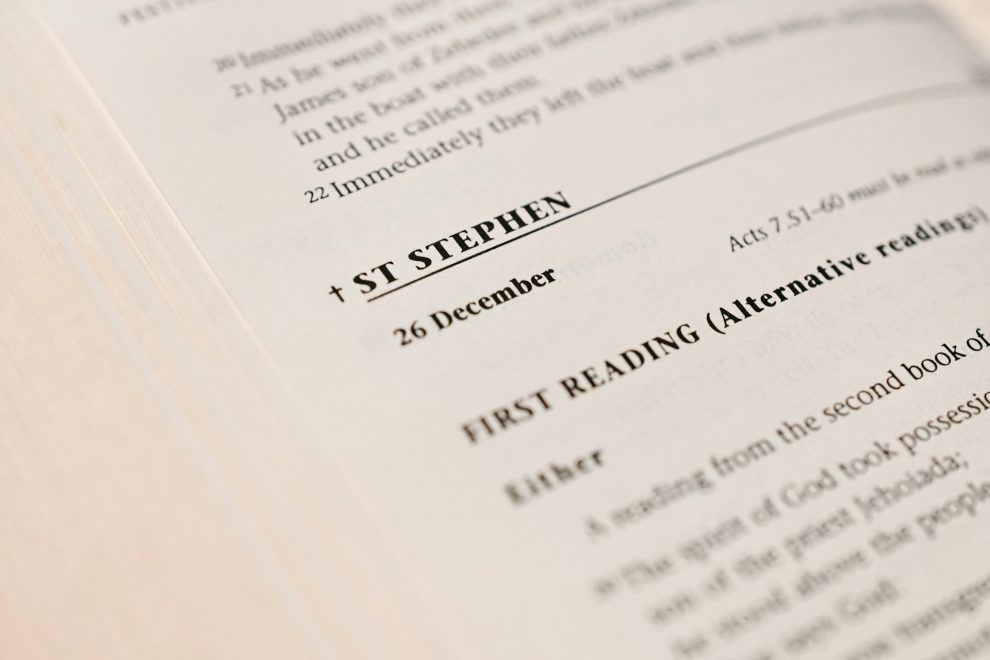
Experiences like this can help us understand the lectionary—the book of readings used every day in liturgies. In some Christian traditions, pastors and preachers choose what passages of scripture to read during worship. But in Catholicism (and in Orthodoxy, Episcopalianism, Lutheranism, Presbyterianism, Methodism, and the United Church of Christ), these readings are preselected according to a three-year cycle. With very few exceptions, any Sunday Mass anywhere in the world has the same readings as at your home parish.
The origins of the lectionary lie in the very beginning of Christianity, as Jesus taught by telling stories to friends and followers (Luke 14:15–24). On the road to Emmaus, the resurrected Jesus meets his disciples as they share stories about the happenings in Jerusalem and helps them understand those events, connecting them to the scriptures (Luke 24:13–35). One of our earliest descriptions of Christian worship tells us that when Christians gathered for the Eucharist, they listened to readings from the memoirs of the apostles and the writings of the prophets (Justin Martyr, First Apology).
As Christian worship became more structured, communities needed ways to decide which stories would be heard when. We don’t know exactly how this worked. Some choices likely followed the older Jewish practice of picking up readings from a scroll where the previous reading left off. Some choices probably seemed especially meaningful for different local situations. And as the liturgical year expanded, other choices focused on stories that fit emerging feasts and seasons. Over time, these processes developed into what we now call lectionaries: organized systems for proclaiming scripture throughout the year.
The current Roman Catholic Sunday Lectionary reflects this development. As described by Norman Bonneau in The Sunday Lectionary: Ritual Word, Paschal Shape (Liturgical Press), what was once a one-year cycle, each day with two readings and a psalm, became a three-year cycle with select readings and a psalm for every day of the year. Each Sunday’s selection begins with the gospel: Cycle A is Matthew, Cycle B is Mark and John, and Cycle C is Luke. During Advent, Christmas, Lent, Easter, and other feasts, the gospel highlights the liturgical season. During Ordinary Time, the gospel readings progress semi-
continuously. The first reading is chosen to echo some part of the gospel, and the psalm gives the whole assembly a chance to respond. The second reading, outside of Ordinary Time, connects with themes of the season or feast; in Ordinary Time it moves steadily through the New Testament epistles.
Like family stories told around the table, the lectionary readings are familiar. As we hear them again and again, they help us see ourselves and our lives differently. They shape our shared identity, connecting us with one another and the larger church across time and space. And if we listen closely, we may find our hearts burning within us as we encounter the Lord along the way.
This article also appears in the August 2026 issue of U.S. Catholic (Vol. 91, No. 8, page 48). Click here to subscribe to the magazine.
Image: Unsplash