Throughout one’s life, there is a natural ebb and flow of grace, resulting in seasons of abundance but also seasons of weariness. In the midst of a particularly difficult season, when I felt that keeping myself small was essential for survival, I was invited into the home of Natasha, my childhood best friend—and I became the single Protestant in a family of Catholics. Her German-Swiss-Puerto Rican family became my family. Natasha’s mother cleaned out an old office in their home, painted the walls, bought furniture, and gave me my own bedroom. Here, for the first time in a very long time, I felt like God was giving me permission to take up space, even to expand. This sense of safety is likely the first small seed that led to my joining the Order of Christian Initiation for Adults (OCIA) program.
Living with my friend, I entered into a way of life that was new to me. For one, the same exact prayer was said before each meal. We thanked the Lord for the food and asked to bless the hands that had helped prepare it. This was one of the first times in my life I came across repeating prayer as ritual. I was used to long, rambling prayers created in the moment, which always seemed to me more about showing off one’s ability to quickly and poetically string together a seemingly never-ending list of words than to focus on the grace of God. But with this new form, I came to look forward to grace at the dinner table, its shortness and sweetness grounding me before dining together.
The family also brought me to my first ever Easter Sunday Mass. I remember soaking in the quiet beauty of the sunrise service—the pink hues of the dawn, the birds chirping in the oak trees, and Spanish moss dripping from the branches—as scripture readings and prayers filled the air.
When I learned that every single Catholic church around the world read the same scriptures every single Sunday, I envied this sense of communion. Catholics seemed to be connected in a way that I had never felt before. I began identifying as culturally Catholic, though I hadn’t been raised in the Catholic Church and had only attended a handful of Masses.
But when I finally felt happy and safe, life pushed me to move on. I moved to the nation’s capital, where I participated in a small religious fellowship. It required a unique component—to create an intentional community with the other fellows. My roommates and I would spend hours talking about faith, even though we had grown up in a wide range of traditions and practiced our beliefs in different ways. I learned so much from those late-night talks on our worn-down couches in the living room, because they challenged me and made me question what I believed. Were the core tenants of my faith truly my own, or had I simply not been exposed to other ways of thinking? I felt my understanding of God begin to expand, and I wanted to find a home church that aligned with this bigger, newer version of God I was getting to know.
At that point in my life I was most drawn to spirited and lively denominations. Baptist, Pentecostal, and evangelical services captivated me, because these spaces are where I learned what it means to worship with body, mind, and soul aligned. When I worshipped alongside others who would dance and shout and cry our Lord’s praise, it felt like every part of my being came alive. I loved the way I felt flooded with the presence of the Holy Spirit. It felt transcendent. But then I began wondering if I was truly serving God, or if I was just serving myself.
I began questioning why I believed what I believed, so I church-hopped constantly, seeking something new that still felt truthful and right. There was an Episcopalian church that I liked, but it wasn’t quite what I was searching for. A friend invited me to sit in silence with him at a meeting of the Religious Society of Friends. This I surprisingly enjoyed, but I craved more structure. I tried attending a Universalist service with my roommates, where I witnessed a rendition of a song from Hamilton by the chorus in lieu of a worship hymn.
Still, I never felt fully aligned with any of the churches. Some days I would enjoy a service at whatever church I was attending, but then another day I would feel disconnected—not only from its community but from God. I would stop going, because I interpreted this to mean that my soul felt called somewhere else.
Soon, I felt so disillusioned by my failure to find a home church that I didn’t want to attend service at all, no matter the denomination. So I snoozed. I stayed in bed. But the desire to feel part of something greater than me begged me to wake up. I quickly ran an online search for churches near me and scrambled to a Catholic parish only 10 minutes away.
This was the first Catholic service I attended in my new city. I was ushered into a folding chair sitting next to a wooden pew, for I was late and all the other seats had been taken. It was as if my body had registered the movement from the profane to the sacred simply by entering a beautiful parish hall. I began to cry. Although I didn’t understand the sea of spoken phrases that everyone else seemed to know, the bowing of heads, the kneeling, and the signs of crosses made, there was an instinctive sense I could no longer deny rising within me—I had finally come home. I cannot describe this feeling exactly, but it was a deep sense of knowing that surpassed my human reasoning.
However, this sense of knowing didn’t make it any easier to accept. I felt at odds with several of the Catholic church’s institutional positions. Why do I have to perform works alongside my faith? Why do people pray to saints? What even is purgatory, and where is it in the Bible? Are believers making the pope into an idol of sorts? Why is the church so hierarchical, and can there truly be one, objective truth?
Yet I found myself undeniably drawn toward its liturgy and mysticism. It was just so different from the way I had been raised, and its mysteries both repelled and fascinated me. So, I decided to try OCIA at the Cathedral of St. Matthew the Apostle. I figured I didn’t have to commit to the conversion at the end if it didn’t feel right. What harm could there be besides gaining more knowledge (and losing $100 as a “suggested donation”)? I dedicated one year to an exploration of this tension, fully immersing myself into the traditions of the Catholic faith, even if I didn’t believe or come close to agreeing on some points.
In my first class, I met LJ, the OCIA director. The first thing he said at the start of the class was, “God is not a man,” and I knew I was in the right place.
LJ reoriented everything I believed about God. LJ stressed that God exists beyond our plane of human understanding. This realization brought a sense of relief. It seemed a natural continuation of my spiritual journey that I had begun in the fellowship, wrestling with who I believed God to be. It was OK to not understand, because I was never meant to fully understand it in this lifetime.
Then we prayed at the end of that class. I watched everyone seamlessly make the sign of the cross, and I panicked because I had missed the first two or three classes. I was caught up with not knowing which shoulder to touch first. But I knew that I wanted to keep coming. I also trusted that they would teach the motion again soon. (And they did a couple classes later. It’s up, down, left, right, for those who want to know.)
The faith I learned growing up always felt focused on my personal feelings. Are you experiencing ecstasy? Or are you in a period of spiritual drought? But LJ helped me see that my feelings aren’t the only things that matter when it comes to practicing my faith, for belief transcends feelings. I learned about saints who had dark nights of the soul and how it was during these periods when they felt nothing at all that they were able to transform from a normal believer into a saint. They were able to meet God truly despite their feelings of desolation. I thought back to the times my feelings had kept me from attending church services. It hadn’t meant that those churches were untrue. I just hadn’t understood that my feelings were not the answer I should be seeking.
I no longer feel burdened by my feelings. I can attend Mass, even if I don’t feel like going. And I don’t have to feel guilty about begrudgingly showing up. What matters is simply choosing to go, keeping the faith.
Becoming Catholic helped me reverse the notion of inviting God into my finite human body. Rather, I am being invited into God. It taught me my feelings don’t limit my capacity to practice faith. It showed me how to become a part of something bigger than myself. When I receive the Eucharist, when I recite the Lord’s Prayer or sing hymns in unison, when I am enveloped by the liturgy, I connect to something divine and true, because instead of God descending into me and the limitations of my humanity, God invites me to increase in holiness.
This article also appears in the September 2026 issue of U.S. Catholic (Vol. 91, No. 9, pages 16-17). Click here to subscribe to the magazine.
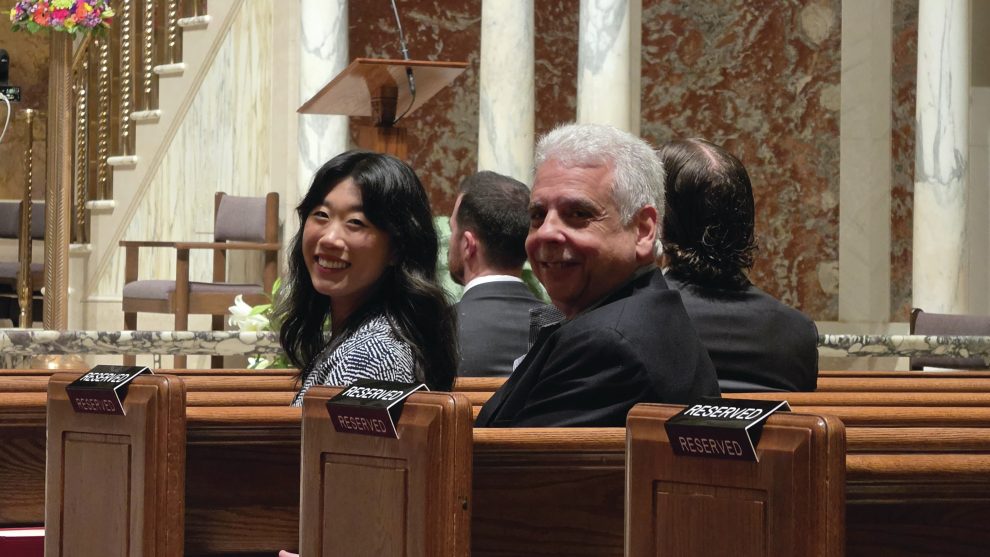
Image: Courtesy of Hojung Lee, the author at her confirmation