Catholic educational institutions have a long tradition of helping students understand and engage a range of social issues—from immigration and the economy to environmental degradation and international conflict. Yet many Catholic schools, especially institutions of higher education, have been unsure how to foster conversation and encourage activism around the crisis in Israel-Palestine. Even as other challenging issues are tackled head on, there has often been a tendency to sideline the cause of justice, peace, and equality in the Holy Land.
As we write in the following excerpt from our forthcoming book, Palestine, Israel, and Catholic Social Teaching: A Guide (Orbis Books), the core tenets of our faith compel us, as American Catholics, to pay attention to Israel-Palestine, to advocate for those who are suffering, and to promote the common good. In doing this, we have a valuable tool—the principles of Catholic social teaching.
Prioritize moral clarity over “balance”
Because Israel-Palestine is often simplistically framed as a two-party “conflict,” there can be a temptation to create programs or craft statements that equally balance “both sides.” Universities and other institutions of learning should always endeavor to uphold universal human dignity, and they have a legitimate desire to ensure that diverse views are presented on varying issues. However, for Catholics, neutrality in the face of injustice must be resisted. As Pope Leo XIV expresses in Dilexi Te, “God shows a preference for the poor. . .[the Church] must be a Church in which the poor have a privileged place.”—the “poor” encompassing any group which is marginalized.
The CST principle of ‘the preferential option for the poor’ compels Catholics to be attentive to inequalities and power imbalances that exist. As we detail in our book, in the Holy Land Palestinians bear the brunt of the suffering, both the outright violence and also the structural violence born of Israel’s military occupation and its policies that grant fewer rights to Palestinians.
Acknowledging this doesn’t take away from mourning the loss of each Israeli and Palestinian life; it is not about favoring one group at another’s expense. It rather points us to systemic injustice. Thus, when it comes to Israel-Palestine, there are limits and problems with calls for “balance” or “neutrality.” As Patriarch Emeritus Michel Sabbah, the former head of Catholics in the Holy Land, has said, “we must actively take sides, the side of justice and peace, freedom and equality.”
This is important to keep in mind when planning programming around Israel-Palestine. Consider how you would organize or frame an event around another social justice issue from a Catholic perspective—say, immigrant detentions, racism, or climate change. It would be important to feature voices of those impacted, and allow them to speak from their experience and expertise. Because the tradition of CST has a moral standpoint, we would not be tempted to “balance out” such a speaker or present perspectives that seek to justify marginalization or deny the dignity of some.
Thinking through parallel examples can help us remember that our primary concern should be amplifying voices that echo and embody the principles of CST, rather than simply representing all perspectives on Israel-Palestine. At the same time, we should continue to foster spaces where dissent and discussions across differences are welcome.
Apply the label of bigotry only when it’s warranted
Throughout the U.S. and beyond in recent years, Muslims, Arabs, Palestinians, and Jews have faced discrimination amid the surging violence in Israel-Palestine. Catholics must avoid religious and ethnic bigotry toward these groups, and we must avoid falling into stereotypical thinking. Collective blaming should also be rejected; we should not presume that Muslims, Arabs, or Palestinians support militant groups like Hamas, or that Jews unquestionably support Israel or ideologies of Zionism.
At the same time, we should avoid applying charges of bigotry in ways that are unwarranted. For example, some organizations and public figures use overly broad definitions of antisemitism, considering criticism of Israel or opposition to Zionism as constituting bigotry against Jews. This move serves to quash truth-telling about unjust realities or to delegitimize activism for Palestinian rights. We should thus be aware of, and push back against, the misuse of the label of antisemitism.
Criticizing Israel’s actions in Gaza, political ideologies of Zionism, or even the notion of a Jewish state that would prioritize the rights of Jews over others, is not antisemitic. In a similar way, criticizing Hamas should not be viewed as automatically anti-Muslim. Using terms like antisemitism and Islamophobia inappropriately can cheapen them and undermine our efforts to root out these very real forms of bigotry.
Integrate interreligious dialogue and social justice
The Church has long been involved in interreligious dialogue with Jews, Muslims, and people of other faiths. Amid the Gaza genocide, interreligious bonds between these groups in the U.S. have, in many cases, become frayed or strained, leaving many Catholics unsure how to navigate this terrain.
Desiring to maintain longstanding and hard-won bonds with some U.S. Jewish institutions, some Catholic leaders have been reluctant to speak critically of Israel or vocalize Catholic teaching on war, peace, and social justice. This has, in turn, led to understandable distrust and frustration among Palestinian and Arab Catholics, as well as Muslim dialogue partners, who often feel that Church leaders overlook their suffering in the attempt to maintain good relations with Jewish colleagues.
Drawing on the CST value of the inherent dignity of every human person, Catholics should make sure that we are not valuing the humanity of one group over another. Studies have shown that Palestinian voices and suffering are often not represented in news media to the same degree as Jewish Israeli ones. And there have been numerous incidents of Palestinians and other advocates of Palestinian rights being disinvited from events, censured, or apologized for after the fact.
Catholics should also work to better integrate interreligious dialogue with advocacy for justice. The two are not necessarily at odds. Dialogue about the political is fruitful and often required. While dialogue programs that prioritize theology, spirituality, and ethical principles are necessary and enriching, they can sometimes divert attention from engaging real-world injustices. To be authentic and effective, dialogue must often engage hard issues, even if it causes tensions or brings disagreements to the surface. Efforts that prioritize interpersonal harmony while eschewing all talk of injustices and political issues can sadly end up as exercises in avoidance of what is at the heart of the matter.
Defend free (and ethical) speech and expression on campuses
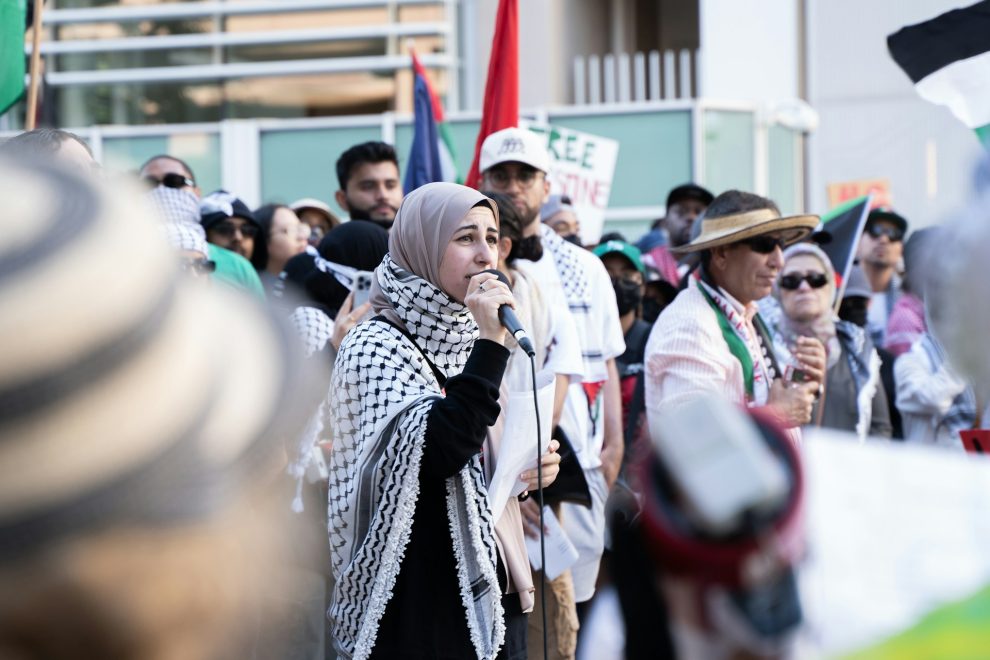
In 2024, when the campus encampments focused on the Gaza war materialized, they became the largest anti-war protest movement since the Vietnam War. These protests were aimed at securing a permanent Gaza ceasefire and opposing U.S. complicity in Israel’s genocide. While some protests veered off course and, at worst, became violent, the overwhelming majority, 97%, remained peaceful. Nonetheless, many universities and colleges clamped down on such protests. Schools, including Catholic institutions, called in local police rather than engaging with student demands, even when they were in alignment with Catholic teachings. Many institutions have also since tightened protest protocols under pressure from the White House and Congress, otherwise curtailing activities related to Palestine on their campuses. This dynamic, which started under Biden’s presidency and escalated under the Trump administration, has often confused critique of Israel with antisemitism.
The two of us have also witnessed numerous examples of Catholic universities wanting to vet or restrict the content of speakers or publications that deal critically with U.S. policy toward Israel or advocate for justice for Palestinians. This trend must be reversed. At a baseline, Catholic schools should uphold their commitment to academic freedom and freedom of expression. Beyond that, they should not simply “tolerate” critical student speech but, rather, welcome, encourage, and support them in vocalizing the prophetic implications of CST.
American Catholic students have long participated in political demonstrations fueled by their faith. Advocacy for an end to war and genocide in Palestine should be seen as part of that broader tradition of the Catholic struggle for human rights.
Support efforts to divest from destruction and bloodshed
Some students at Catholic schools have also pushed their institutions to divest from companies that are involved in manufacturing weapons or equipment used by Israel to engage in war, apartheid, occupation, or genocide. There is ample support for disinvestment in alignment with CST. In the 1980s, U.S. dioceses joined with the anti-apartheid movement to divest from corporations doing business in South Africa. More recently, the USCCB issued guidance on socially responsible investment including practices to specifically limit weapons production and foreign sales of weapons.
Israel’s war on Gaza “built an unprecedented arms pipeline” that generated “substantial business for big U.S. companies—including Boeing, Northrop Grumman and Caterpillar,” according to the Wall Street Journal. In urging divestment, student activists are seeking to disrupt that pipeline. Catholic groups in the Christians for Ceasefire coalition have also joined with broader campaigns of boycott and divestment from companies supporting Israel’s military suppression of Palestinians. This includes Chevron, whose gas fuels nearly 50% of Israel’s electricity grid, including illegal settlements, military bases, and prisons, and Palantir, which has surveillance contracts with the Israeli military.
Despite the Catholic precedents for screening out unjust investments, some Catholic schools have resisted student activists urging them to disclose investment information or to disinvest from companies profiting from destruction in Israel-Palestine. And yet already in 1973, in his seminal “Men and Women for Others” speech, former Jesuit superior Fr. Pedro Arrupe called on Catholic schools to “to draw no profit whatever from clearly unjust sources.” A shift in approach is long overdue.
Leaning on Catholic social teaching
The issue of Israel-Palestine has often been avoided by U.S. Catholics, with some justifying their distance by saying the issue is “too complicated,” “complex,” and “hard to understand.” While this framing is often well-meaning, it allows us to elide the present-day realities and the ethical responsibilities we have as American Catholics. We cannot forget the U.S. role in supplying nearly 70% of the weapons that enabled Israel’s destruction of Gaza. The framework of CST has long offered Catholics a way to navigate social and political issues. It’s time for Catholics more widely to apply these rich principles to Israel-Palestine and to do our part to advance more just U.S. policies toward the region.
This article also appears in the August 2026 issue of U.S. Catholic (Vol. 91, No. 8, pages 38-39). Click here to subscribe to the magazine.
Image: Unsplash