Forty years ago, I was asked to consider a Plowshares action. My measured response was that I would, but I would need three months to pray on it.
A Plowshares action is an act of civil disobedience rending an instrument of war incapable of being used in warfare. It’s nonviolent because it’s directed toward the weapon, not people. It’s a movement in the sense that many such actions have occurred over the years.
During my fourth year of college seminary, the dean told me that the seminary was considering asking me to leave due to my stuttering. I knew that if I left, I would immediately move to 1-A status on the draft. At the time, I had a divinity student status. This raised the question: Where did I stand regarding the Vietnam War? I proceeded to write a letter home talking about my possible dismissal from the seminary. I wrote how proud I was of my parents, both WWII veterans. I wrote how proud I was of my German great-grandfather, who fought in the Civil War. I wrote that I would gladly join them in service to our country.
I let the letter sit overnight, and I tore it up the next morning. That’s not who I was. I rejected violence. I rejected war. I embraced pacifism. I embraced the call to love your enemies.
After I was asked about the Plowshares action, I prayed about the action, possible arrest, trial, and imprisonment. I would miss my ministry. I did not know if the archdiocese would suspend me or not. That fall, I visited my Irish grandmom’s grave. She died two months before I was born, but I always believed that she still accompanied me.
Sitting on the ground with my Bible, I asked her: If I did the Plowshares action, what could I expect to happen? I opened scripture to Matthew 10:17–20:
Beware of people, for they will hand you over to courts and scourge you . . . and you will be led before governors and kings for my sake as a witness before them. . . . When they hand you over, do not worry about how you are to speak or what you are to say. You will be given at that moment what you are to say. For it will not be you who speak but the Spirit of your Father speaking through you.
It was clear: I was going to participate in the Plowshares action.
There were four of us: myself, a classmate, a woman who worked in social services, and a retired army officer. I only knew my classmate. We were supported by a larger group from the Brandywine Peace Community and an even larger one from the Atlantic Life Community.
Until that point, Plowshares actions had centered on stopping nuclear war, but I wanted to focus on present-day reality: Ronald Reagan’s war in Central America. I wanted to do the action locally, to witness to the people from my area, the people to whom I ministered. Ultimately, we decided to focus on the war in Nicaragua and nuclear war. Willow Grove Naval Station was the perfect location. There were planes on the base used in nuclear war and helicopters used in Central America.
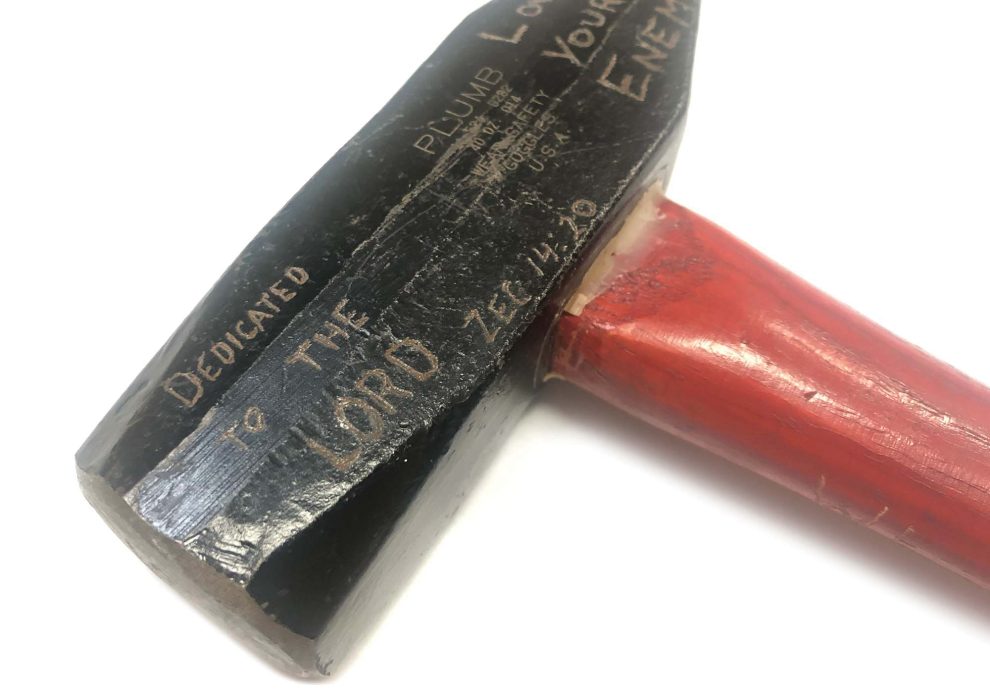
We put together documents explaining our actions, our ministries, and our faith journey. We planned on using household hammers. On my own, I carved: “Be at peace with all” (Heb. 12:14), “Dedicated to the Lord” (Zech. 14:20), and “Love your enemy” (Matt. 5:44).
We had our blood drawn and filled small baby bottles with it. If we were going to protest the killing of lives, we had to show that we were willing to sacrifice in some way. We would pour our blood on the instruments of war.
On the morning of January 6, 1987, the Feast of the Epiphany, when Jesus was given to the world, I went on the base, sometimes crawling through snow, to the helicopters. When I opened the door and sat on the console between the seats, I paused. Knowing I had come onto the base without being stopped, knowing that I could readily leave without being stopped, knowing that, if I left, my life would go on without a penalty to be paid, but also knowing I believed God sent me here to witness to God’s love of humankind. I used my hammer to break some glass over the gauges and pour the blood over the broken panes. And thus began the witness of the Epiphany Plowshares.
At this time in history, would I do it again? Would I risk so much again? If I believed God was asking me to do this, I would. Could you? Would you?
This article also appears in the July 2026 issue of U.S. Catholic (Vol. 91, No. 7, page 8). Click here to subscribe to the magazine.
Image: Hammer engraved with scripture used in the Epiphany Plowshares action