Some time ago, while visiting the Art Institute of Chicago, I was struck by Claude Monet’s series of haystacks. What captivated me was not the subject itself but how it changed with the light: morning, dusk, winter, summer. The same form appeared again and again, yet always different. The haystack remained; illumination transformed perception.
That experience has become, for me, a way of thinking about Pope Leo XIV’s pontificate.
It is far too soon to define his pontificate exhaustively. However, as we approach the first anniversary of his election on May 8, we give thanks not only for Pope Leo himself, but for the witness of leadership he continues to offer in these turbulent and complex times for the church and the world. What we see from his living pontificate are multiple facets emerging over time—each revealing something real, yet none capturing the whole.
To understand Leo’s ministry more fully, we must examine the path that shaped it: his origins, family faith, and the communities that nurtured his vocation. His formation in Chicago and Rome deepened his intellectual, spiritual, and pastoral vision, while religious life and its charism formed in him habits of prayer, community, and discernment. Through pastoral service, missionary experience, and leadership, his gifts were refined, shaping a leader attentive to both the local and universal church. Yet beyond every human element runs a deeper thread: the quiet guidance of the Holy Spirit.
Leo is, in a real sense, a son of Chicago and of a church marked by immigrant faith, urban complexity, racial tension, and pastoral resilience. That background formed in him an instinct for engagement: a willingness to meet the world as it is, not as we might wish it to be.
His graduate formation at Catholic Theological Union (CTU) provided Leo with an education in contextual, communal, and globally attentive theology. From the beginning, CTU has been a bold reimagining of what it means to be church—what today we call synodality, walking together. In a fractured world, communion is at the heart of CTU’s mission and visible in the remarkable diversity of the school’s students and alumni.
Leo is also an Augustinian, shaped by a tradition that places community, interiority, and the restless search for truth at the center of Christian life. The Augustinian charism—rooted in the conviction that our hearts are restless until they rest in God—forms leaders who listen deeply, who value friendship and common life, and who seek unity without erasing difference.
Years as a missionary in Peru further deepened Leo’s formation. There, the gospel was a lived reality among those who are poor and marginalized. The church was a church of accompaniment, where faith is tested and clarified in the face of injustice, poverty, and hope. That experience shaped not only what he thinks, but how he sees.
Leo’s service as a major superior of an order required yet another dimension of leadership: one attentive to governance, discernment, and the complexities of guiding a global religious community. And his ministry as a bishop called him into a deeper pastoral responsibility to shepherd a people entrusted to his care.
Taken together, these experiences—Chicago, the Augustinian tradition, CTU, missionary life in Peru, leadership as a major superior, and pastoral service as a bishop—form a coherent whole. They help explain the particular quality of his leadership today: attentive, grounded, relational, and globally aware.
The election of Pope Leo marked a historic moment, as he became the first Bishop of Rome to be formed within the distinctive cultural and ecclesial landscape of the United States. That context—marked by postwar expansion, social upheaval, racial injustice, war, technological optimism, and the transformative vision of the Second Vatican Council—brought forth a church that is both confident and wounded, vibrant yet in need of purification.
For Leo, the Vatican II remains a guiding star. He understands it as a living source requiring renewed study and deeper assimilation. In his vision, fidelity and reform are not opposites. The church grows not by abandoning Vatican II, nor by reducing it to slogans, but by entering more deeply into its vision.
That vision is inseparable from Leo’s insistence that love—especially love for the poor—is the criterion of faith. The poor, Leo recognizes, are not objects of charity. They are subjects who reveal the gospel anew, and in whose faces, the church encounters Christ. Leo also recognizes that poverty is not only material. It includes the loneliness of a digital age, the loss of meaning, and the quiet despair of those who feel unseen.
Leo’s teaching on human dignity flows from this same conviction, as he refuses to view migrants and refugees as signs of hope, reminding the church of her identity as a pilgrim people. His consistent ethic of life resists fragmentation, insisting that the unborn, the migrant, the poor, the prisoner, and all the vulnerable are situated on the same moral horizon.
With the rise of global violence, Leo has become increasingly vocal about the urgent necessity of peace, warning that while destruction takes only moments, rebuilding can take a lifetime, lamenting a world that invests in devastation rather than in healing. In a time of crisis, the pope is calling Christians to proclaim courageously that, in fidelity to the gospel, there is a better way.
Pope Leo’s insistence on human dignity is a summons to shape social, political, and economic life in ways that protect the weakest, heal divisions, and affirm that no life is expendable.
Synodality, too, is central to his vision, as an ecclesial way of life. It is rooted in listening: to the Spirit, to one another, and to reality itself. A synodal church is one in which authority serves communion and where discernment emerges through humility and shared responsibility.
Standing before Monet’s haystacks, I realized the subject never changed—only the perspective did. So it is with the church. Christ remains the same, yesterday, today, and forever. The call to holiness does not change, but the light falls differently. As Pope Leo guides the church through the unique challenges of our time—artificial intelligence, migration, polarization, fragile peace—this is also a good way to think about his leadership.
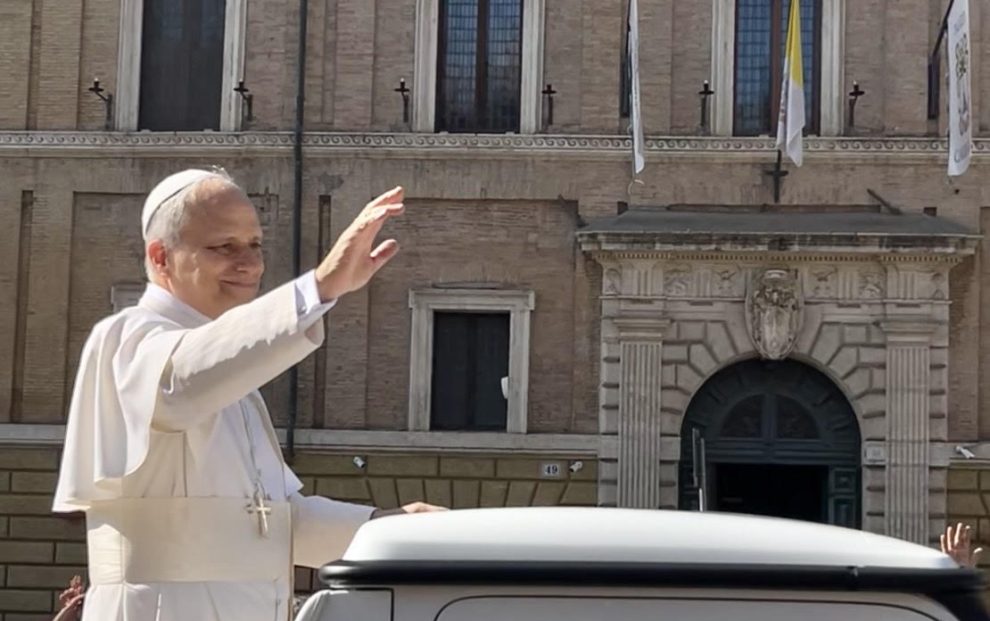
Image: Wikimedia Commons/Proinséas (CC BY-SA 4.0)