

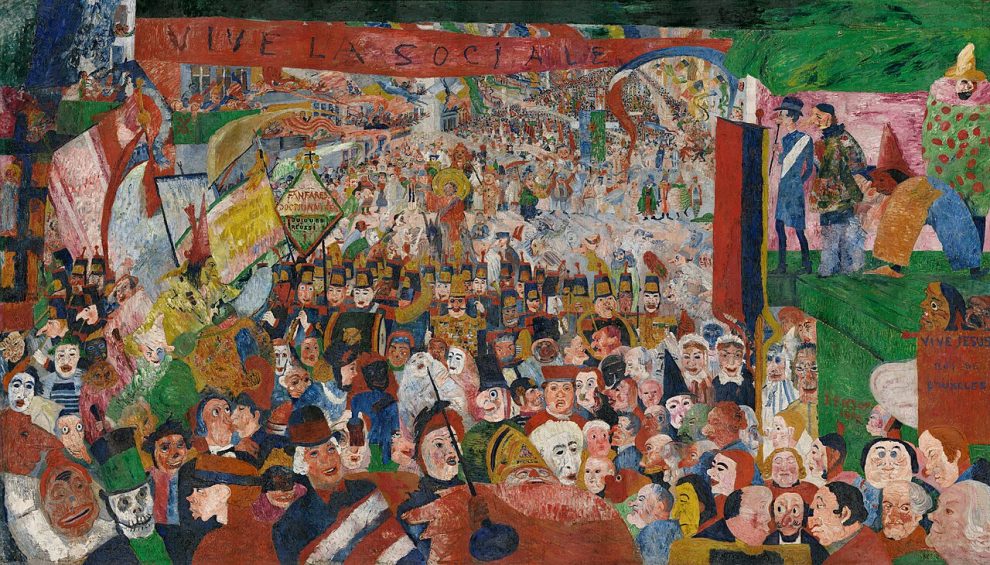
One of my favorite paintings of Palm Sunday is James Ensor’s “Christ’s Entry into Brussels in 1889.” It’s a chaotic painting: half mob, half Mardi Gras parade, with Jesus lost in the turbulent crowd. He is followed by some and ignored by many more. For Ensor, Jesus is the political leader standing against the ills of modern society and standing for the oppressed and afflicted. For me, today, I get a glimpse of Jesus in the midst of the protests sweeping the United States—opposing unjust systems, showing love for those society casts aside, making his voice heard.
I really struggle with language that calls Jesus “king,” whether for Palm Sunday or Christ the King. I don’t like the traditional image of a man on a throne; I don’t like the pomp and circumstance of royal processions with loyal subjects showing unwavering and unthinking devotion. As I write, both this country and the world are experiencing the direct effects of politicians and systems acting as kings, focusing solely on material wealth and power. Leaders and CEOs are displaying outright contempt for the poor and powerless. Hatred is now a model of governance, the expected mode of business.
But as I think about Jesus processing into Jerusalem, knowing the fate that awaits him, I see a radically different and countercultural model of kingship—one of solidarity, one of justice for the oppressed, one that ends at the cross. As so many struggle to find hope in the present environment, Jesus’upside-down version of kingship gives a blueprint to follow and a space for optimism.
I cannot help but see the parallels between the authorities of Jesus’ time and today’s situation. There is ruthlessness, complete apathy towards the most vulnerable, oppression, violence, and the killing of innocents in misguided attempts to consolidate power. Understandably, the Jewish population of the first century was expecting a worldly king to come save them from Herod and the Romans’ grasp—a king who would respond to Herod’s violence with more violence, engaging in an earthly power struggle. They expected a king who would wage war on behalf of the righteous, who would overthrow the barbaric, who would finally set the world aright using whatever means necessary.

What sort of king am I searching for? Definitely not those of history nor of today—not political despots, not “redeemers” who respond to violence with violence, not leaders who misuse and abuse power. Instead, as the church celebrates this bittersweet day, I glimpse a different type of king. A king who strives to be compassionate in the midst of violence. Who gives of himself out of deep, abiding love. Who teaches that there is, indeed, another way.
Palm Sunday presents big questions: What does it mean to look towards a king like Jesus in this present moment? How can the United States move away from a rhetoric of violence and instead embrace solidarity? Where is there hope?
I find it helps to focus on actions and ideals, not labels or titles. When I march in the streets demanding “no kings,” what I’m really demanding is a country and world where compassion is more important than greed, where everyone has dignity, where love in all its forms matters again. Is this not exactly what Jesus teaches?
Feminist Latina theologian Ada María Isasi-Díaz chooses to speak of the kin-dom of God rather than the kingdom. She notes this extreme disconnect between the kingdoms on earth and the proclaimed kingdom of God. God is about family, relationships, and kin—not hierarchical structures andkings. In this family or household of God, those who suffer at the hands of kings, the most disadvantaged, are given the most care. The whole system is turned upside-down. Those who are oppressed are placed at the center, listened to, and are given say in their own liberation. Everyone belongs to one another. Here, no one is free until everyone is. And it seems that so, so few are free right now.

Here, I don’t mean freedom patriotically or literally, but rather freedom in the broadest sense: that space where each and every person can be their fullest, truest selves without fear of harm or judgement. The freedom where people can be all God created them to be, with flaws and imperfections but also with brilliance and grace. The freedom where all can love one another wholeheartedly as friends, family, and beloveds. Where each can speak from a multitude of identities and experiences, not just the ones who are most palatable to those in power.
Who are you? What are your gifts? What can you do with them?
Not everyone is Isaiah, well-versed in prophetic speech. Neither is everyone a psalmist, with their haunting words. Nor is everyone Paul, writing and preaching.
But reading the passion narrative on Palm Sunday provides insight into many other gifts and roles. The many women who follow Jesus, who minister to Jesus throughout his lifetime. Joseph of Arimathea, who uses his wealth to ensure Jesus’ proper burial. Mary Magdalene and the other Mary, who stay by Jesus’ tomb, who keep vigil in a time of deep grief. All of these are such human actions. Doable actions. Moments that are not world changing but that do make a clear, small difference. Every human has such skills and gifts that, though they seem small in the grand scheme of things, are invaluable to those who receive them.
One of my own gifts is music, a means to provide comfort and prayer in the midst of strife. At my parish, we always sing Jesse Manibusan’s “What Sort of King?” when we celebrate the Feast of Christ the King; we could just as easily sing it for Palm Sunday. The song’s bridge proclaims a vision of the kin-dom: “Those without choices will have a choice! Those who were silenced will find their voice! Ev’ry one will be welcomed in to a kingdom where justice shall reign!” Choices, voices, and welcome—this is both a blessing and a responsibility.
Karl Rahner explains this kin-dom is already but not yet. It is so easy to focus on the “not yet” part of that statement: the ways in which the world falls short, wars and conflicts that seem to multiply by the day, even personal failures and faults. And yet there are moments of deep beauty too, glimpses of the reign of God right here, right now. Marching arm in arm down main street, echoing Jesus’ own march into Jerusalem, fighting for the rights of the poor and oppressed. Neighbors coming together to buy and deliver groceries for those who cannot leave their homes during ICE raids. Simply being present to each other.
In the Gospel of Luke, Jesus tells the repentant thief on the cross: “Today you will be with me in paradise.” What is this paradise today, what is this heaven? For me, it’s the kin-dom. It’s community. It’s knowing that, whatever horrors are thrown my way from kings of today, I am surrounded by support and loved ones.
As a member of the body of Christ, I am constantly reminded of the Christian duty to become Christ for one another—to bring Jesus’ reign out to the world. To become kin. To, as the Rule of Saint Benedict so eloquently states, welcome the stranger as Christ himself.
I cannot personally change policies or systems. I can protest and advocate, but with current models of kingship, I often feel my voice doesn’t matter. But I can protect my neighbors. I can show immigrants in my community that I love them simply by showing up. I can sit with my students of color and my LGBTQ+ students as they search for hope. I can listen to the stories of those on the margins and hold their hands while they cry. I can be kin.
This is Jesus’ upside-down kin-dom.
Image: Wikimedia Commons







Add comment