

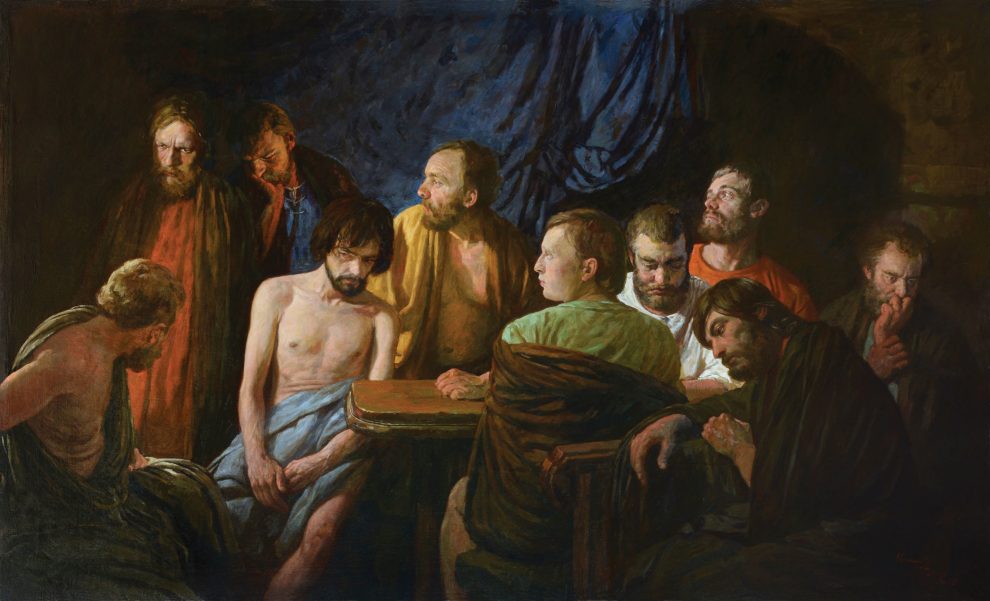
Alleluia, Christ is risen! Jesus suffered, died, and was buried; on the third day he rose again, in accordance with the scripture.
So often, when we talk about Easter, the story stops there. Mary Magdalene finds an empty tomb. Jesus appears to the disciples at Emmaus. Thomas places his hands on Jesus’ wounds. All is triumphant, and all of creation is saved through Christ.
We have been taught to imagine resurrection as the end of violence and the promise of a resurrected world. The lion will lay down with the lamb, the last shall be first. But in the time before this eschatological vision comes to pass, perhaps the problem is that we assume resurrection cannot happen in a violent world. Far too often, we interpret all the promises of the gospel as being in some other world—the afterlife, the beyond.
In reality, our world—with all its inherent violence and injustice—is exactly the world in which the resurrection happened. Christ’s rising from the dead signifies not the opposite of violence, but instead God’s presence within it.
The part of the story we don’t often tell, however, is that when Jesus appears to the disciples for the first time, they are hiding in a locked room, afraid of persecution. The week after Easter, we hear in the Sunday gospel that Jesus appears to the disciples not once, but twice, two weeks in a row, while they are in hiding, afraid that the people who killed their leader will come for them. That second time, they knew Jesus was resurrected; yet they still hid. The political threat remained. The resurrection was not necessarily a source of eternal triumph for them: They still had to find a way to live within empire, an empire that had crucified their teacher.

I’m thinking of those disciples hiding in the locked room this year. Today, it’s hard to figure out how to write about the resurrection when the crucifixion seems ongoing. Immigrations and Customs Enforcement (ICE) continues to terrorize cities and detain families and children who are in the country legally. The release of the Epstein files has uncovered vile abuse of young children. Violence against LGBTQ+ people and people of color continues. How does one celebrate the resurrection when our siblings’ suffering is still so present and ongoing?
In John’s gospel, resurrection is shaped by death. The doors are locked. Jesus appears with wounds. The disciples remain afraid. Resurrection does not undo the cross: It unfolds in its shadow.
In her book Spirit and Trauma (Westminster John Knox Press), theologian Shelly Rambo describes trauma as an “encounter with death” that does not simply end. It is a “radical event or events that shatter all that one knows about the world and all the familiar ways of operating within it,” she writes. “A basic disconnection occurs from what one knows to be true and safe in the world.”
This is exactly what the disciples experienced—trauma. And this is the lens through which they experienced Christ’s return. Rambo points out that “when resurrection is imagined as a triumphant victory in which death is conclusively defeated, it can unintentionally silence those who know that death lingers—that violence leaves a remainder.” At a time when we too are experiencing trauma, both individually and societally, Rambo’s words give us a different way to interpret and understand the resurrection.

Rambo also reflects on the gospel of John in her resurrection theology. She points out that the disciples in the locked room aren’t the only ones who are fearful or dealing with trauma. Mary Magdalene is weeping in the dark and can’t recognize either what’s going on in the tomb or the risen Jesus when she meets him (this disorientation, Rambo writes, is not uncommon after people have gone through trauma). John’s so-called “beloved disciple” recognizes Jesus, but he never gets close; he only sees him from a distance. “Their witness tells us something important about the events being witnessed,” Rambo writes. “The events themselves are ungraspable in any straightforward way. . . . The event of death is known precisely for the ways that it escapes cognition.”
To live after trauma can seem unimaginable. Life following violence is fundamentally different. A friend living in Minneapolis told me about seeing ICE agents detain a teacher from a daycare on her block and how her neighborhood happy hour text thread has turned into information about feeding people afraid to leave their houses and neighborhood patrols. “I am profoundly changed by the last two months,” she said.
For Rambo, the resurrection is not about triumph over death but about what it means to be the one who remains alive. “Death persists. Life is not victorious. There is no life after the storm but only life reconceived through the storm,” she writes. “Read through the lens of trauma, the witness of Mary Magdalene and the beloved points to the impossibility of envisioning life ahead. They depict the messy and inconclusive experience of living beyond a death. But in the aftermath of Jesus’ death, their survival is haunted by Jesus’ words of farewell and his instructions about remaining. Survival is given shape through the curious imperative to remain and to love.”
To remain then—to be an Easter people, as it were—is not about pretending that death has been defeated once and for all. Instead, it is about refusing to let violence determine the shape of our lives. It is to stay rooted in Jesus’ command to stay and to love one another, even when empire would prefer we hide passively in a room behind locked doors.
Theologian James Cone insists that the cross is not just a generic symbol of suffering: It is an instrument of state terror. The cross was meant to humiliate. When Christians proclaim resurrection, Cone argues, we are not spiritualizing that violence—we are declaring that God has taken sides and stands with the crucified. Jesus’ resurrection means that empire doesn’t have the final word.
If that is true, according to both Rambo and Cone, then resurrection doesn’t remove us from violent systems or erase the violence that has been done to us. Instead, it locates us within these systems, alongside those who suffer. Resurrection doesn’t erase the marks of state violence—after all, the risen Christ still bears his wounds.
The problem remains: If we accept that the cross is a lynching tree, as Cone writes, a tool of state violence, where is redemption? What does the resurrection look like? Womanist theologian Karen Baker Fletcher writes that siding with the crucified doesn’t mean getting stuck in their suffering. Instead, in Dancing With God (Chalice Press), she writes that resurrection is the power that “turns the cross into two pieces of wood instead of a tool of destruction.” Resurrection, she suggests, is a “healing big enough to hold anger and turn it into justice seeking, rather than vengeance seeking.” It is the Spirit’s work of transforming bitterness into justice-seeking love.
In Minneapolis, neighbors are not pretending violence is over. To borrow Rambo’s language, they are remaining. They are organizing patrols and food networks. They are loving their neighbors. According to both Rambo and Baker Fletcher, they are practicing a form of resurrection that does not deny death but refuses to mirror it.
Resurrection, then, occurs in the shadow of crucifixion—it is God’s refusal to abandon the crucified. Easter does not promise that violence will cease overnight. Instead, the resurrection promises that violence is not ultimate. In locked rooms and homes where immigrants are afraid to leave for fear of being detained, in neighborhoods rising up to love their neighbor and in detention centers, the risen Christ is present. The cross still stands in our world, but it does not get to tell the whole story.
The disciples stayed behind locked doors, afraid even when Jesus appears to them. But Jesus also leaves them with what he once called God’s greatest commandment: to love one another as God loves them. It was in this promise of God’s love that the disciples could begin again to breathe in the midst of trauma, and it is through this commandment that we continue, even when the triumph of Easter feels impossible to imagine.
This article also appears in the April 2026 issue of U.S. Catholic (Vol. 91, No. 4, page 46-48). Click here to subscribe to the magazine.
Image: Andrey Mironov, Appearances of Jesus Christ, 2010, oil on canvas, 105 cm x 173 cm. CC BY-SA 4.0








Add comment