

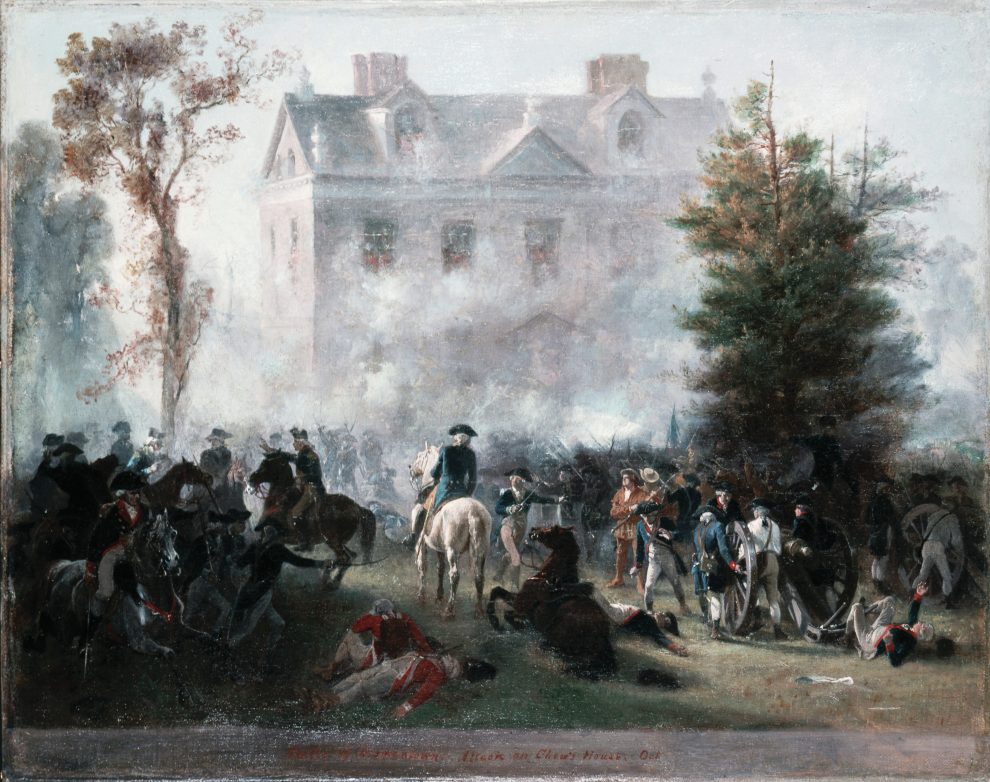
The American Revolution (PBS), directed and produced by Ken Burns, Sarah Botstein, and David Schmidt, is not only smart, but also wise.
The Federalist and the National Review have critiqued the six-part, 12-hour documentary for being woke—which apparently means that it fails to align with popular histories that ignore the experiences of all Americans, including Indigenous people, enslaved people, and loyalists who supported Britain. As John McWorter of the New York Times said, “It’s not woke, it’s magnificent.”
The inclusivity of The American Revolution offers depth and texture to a story we all think we know—but largely don’t—about the eight-year-long conflict from 1775 to 1783.
Geoffrey C. Ward’s writing treats audiences as if they have a brain and can handle the facts. Facts such as the founders arguing for the inalienable freedom of white people while keeping Black people in bondage and warring with Indigenous tribes. (Some founders pointed out this collision of values, of course, and it eventually became an arguing point in constitutional debates, yet the dissonance between talk of freedom and practices of racial subjugation is clearly a deep contradiction.)

Facts such as the Revolutionary War also being a civil war, in which the rebels weren’t the majority, and colonists who were loyalists fought alongside the British against the patriots. Indigenous, enslaved, and free Black people tended to join the rebels.
Facts such as the Revolution not being born of politely conducted ideological debates in drawing rooms, but amid turbulent, blood-soaked confusion, infighting, and fractious prejudices between colonies that possessed distinct personalities and distrusted one another.
Facts such as the British sometimes behaving more honorably than did the new Americans, who, at the end of the war, attacked and even killed loyalists while the British Army protected fleeing enslaved people, even offering some transport to other countries.
Events sparking the Revolution are more complex and multilayered than high-school history courses might make them seem. For example, that taxation without representation meme has a few additional facets to it. The British government had incurred significant expenses in troops and funds protecting colonists during the French and Indian War, and the Stamp Act (and other taxes) were aimed at recovering costs.

Burns and Ward also make the self-interest of the country’s founders quite plain. Along with giving birth to democracy, they were also seeking to acquire land and build their own fortunes.
The Black presence in Colonial America—in the North as well as the South—is woven throughout the story, as it was woven throughout the reality of the time. Burns’ retelling isn’t problematic; it’s true. What requires self-reflection is the scrubbedclean version of our history. It’s a common and human thing to clean up messy events, yet the messy versions are closer to the truth.
Burns does what Burns does so well. A solo violin is evocative, helping to weave scenes from paintings and reenactments into a cohesive and compelling narrative punctuated by cannon blasts and gunfire. Historians and writers comment as talking heads, and a healthy percentage are women, people of color, and even Brits.
Peter Coyote’s quintessentially American voice narrates. Off-camera actors with recognizable voices—among them Meryl Streep, Mandy Patinkin, Tom Hanks, Morgan Freeman, and Paul Giamatti, who played John Adams in the HBO series of the same name, reading Adams here again—deliver renowned lines that stir us still, as well as personal messages from soldiers’ letters home and accounts from wives and families.
Burns and Ward honor the small, human stories in the telling of this immense, international one. Kids throw snowballs and oyster shells at a lone British sentry. A father pulls a cart through a battlefield, searching for his son’s body and collecting those of neighbors he recognizes. Virginians didn’t much like New Englanders and everyone thought the frontiersmen undisciplined.
The haphazard, unpredictable nature of conflict, the way war doesn’t follow a script, is made vividly real—as is the pain and agony of face-toface, hand-to-hand bayonet battle. A soldier fires without orders, setting off disastrous events. A family slain in their own home leaves a blood pond ankle-deep. There is no glossing over the violence.
Complex, often less than noble, and fraught with contradictions, Revolutionary times still have lessons to teach us. One historian says that democracy is not the aspiration that created the Revolution, but the Revolution created the conditions that allowed democracy to arise.
We’re reminded that colonial demagogues rose to power by pandering to the passions of common people. That, among much else revealed here, resonates meaningfully with our modern moment.
In the Revolutionary War, what Americans were willing to risk for freedom is simply astounding. The dogged persistence of a starving, freezing army of rebels of different races, speaking different languages, hailing from different nations, and holding different ideas about what this country should look like is, at its core, the quintessential American message.
It’s a message that is keenly relevant to Christians and Catholics today. The path to justice can’t be owned or dictated by one ideology or culture but is constantly hewn in an inherently imperfect, ongoing struggle of all peoples to create an ethics and morality of human rights for all of us.
This article also appears in the March 2026 issue of U.S. Catholic (Vol. 91, No. 3, pages 36-37). Click here to subscribe to the magazine.
Image: Wikimedia Commons






Add comment