

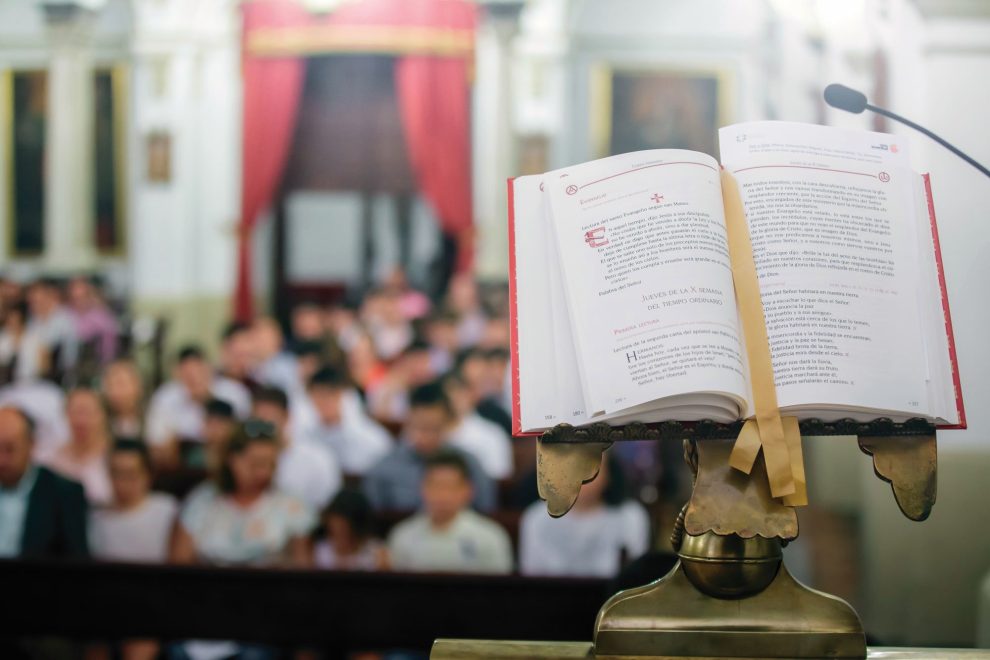
For our Sounding Board column, U.S. Catholic asks authors to argue one side of a many-sided issue of importance to Catholics around the country. We also invite readers to submit their responses to these opinion essays—whether agreement or disagreement—in the survey that follows. A selection of the survey results appear below, as well as in the February 2026 issue of U.S. Catholic. You can participate in our current survey here.
The survey says . . .
Updated translations—whether for scripture or for the Mass itself—help my participation in the liturgy.
- Agree – 83%
- Disagree – 17%
It is important to me that the language used at Mass is inclusive (e.g., avoids male pronouns for God or referring to “mankind.”)
- Agree – 73%
- Disagree – 27%
The church should stop creating newly revised translations and just use what it already has.
- Agree – 10%
- Disagree – 90%
My first experience of the 2010 English translation of the Mass was not ideal. On that slushy Advent evening, our presider—experienced enough to have now lived through two new English translations of the liturgy—lost his place during the eucharistic prayer. Several times.
As I pretended not to watch while pages were flipped and ribbons were shuffled, my heart sank. General confusion and liturgical awkwardness did not bode well for the “new” translation of the source and summit of the life of the church.
Certainly, our first edition of the English Sacramentary, which appeared in 1973, warranted revision. Completed with remarkable rapidity, the Sacramentary responded to Sacrosanctum Concilium’s (On the Sacred Liturgy) invitation for the faithful to pray and sing in their own languages, seeking to ensure full, conscious, and active participation. Yet its ironed-out language occasionally sounded a bit like an inspirational poster. Many of the liturgy’s rich allusions to scripture, tradition, and sacramental symbols were simply lost in translation. Pastorally interested worldwide consultations, held in 1982 and 1986, affirmed that the translation could be improved.
Yet the end result resounding in our ears and falling from our mouths on the First Sunday of Advent in 2011 felt stiff and surprising: And-also-with-your-spirit.
Aside from minor pastoral disasters, I know of one more challenge. The translation approved in 2010 was not the first attempt at an English-language revision. Members of the International Committee on English in the Liturgy (ICEL) had begun working as early as 1981 on a new English translation of the Roman Missal. After 17 years of work, ICEL submitted an English-language vernacular translation to Rome for the recognition of the Congregation for Divine Worship in 1998.
Their submission was rejected.
Instead, a new instruction appeared in 2001, Liturgiam Authenticam (On the Use of Vernacular Languages in the Publication of the Books of the Roman Liturgy). Representing a significant departure from the previous technique of “dynamic equivalence,” which favored the “receptor” language’s syntax, Liturgiam Authenticam instructed that Latin liturgical texts were to be “translated integrally and in the most exact manner, without omissions or additions in terms of their content, and without paraphrases or glosses.”

While tendencies toward inspirational poster messages were nipped in the bud, new oddities of sentence structure and antique verbs (e.g., “beseech”) peppered our prayers. For many liturgical scholars, the 2010 translation felt like a blow to post-Conciliar liturgical renewal, which sought to respond to the needs of the church in the modern world, attend to culture, and invite intelligent participation.
How do we feel now, when the blazing “liturgy wars” of the ’90s and early 2000s have cooled?
My feelings have evolved in two ways. First, I began my teaching career by devoting a whole day of my upper-level liturgy courses to liturgical language. We compared styles of translation. Students had opinions. The discussion felt important.
But, by 2021, I sensed that students didn’t care as much. And for good reason: They were eight when the translation changed. Now, in 2025, a first-year college student was 4 years old when the new translation appeared. Aside from this, students have changed. Maybe they want to hear Mass in Latin. Or maybe they don’t think too much about religion at all.
In addition, I’ve simply made my peace with our awkward English for the same reason I no longer wig out about electronic keyboards at Mass: I cannot spend my spiritual energy upset about liturgical snafus, musical missteps, or a bumbling translation. I desperately need the bread of life to fill and refine my poor muddled soul with its grace. If I need a fork and a sharp knife to cut through the words, so be it.
But, my less self-focused pastoral self still harbors some concerns. I might be able to draw spiritual meaning from an obtuse or even poorly delivered text. But if I am tired, have a child I’m calming, or lose focus for one moment—the text is gone. It washes by in a blur of Charlie Brown’s “WAH WAH WAH.”
In short, my pastoral concern is this: We can train ourselves to hear oddly cast English, just as we train ourselves to hear Beowulf, Shakespeare, or Jane Austen. But I think we can do a little bit better than that with our English-language vernacular. Wasn’t the challenge to accessing liturgical meaning (and actively participating in the transformational grace received in liturgical celebration) precisely the problem the employment of vernacular languages hoped to solve?
As we move past the 15-year mark with our current English translation, and as United States Roman Catholics receive revised English and Spanish translations of the Bible, we might start to wonder about the next English translation of the Mass. How will it sound? And will we be able to hear it?
Readers weigh in:
I am concerned about our future church becoming irrelevant to our future generations who are offended by old traditions of using male references to God and/or all people. When my generation was growing up, noninclusive language was all that was used everywhere. We did not give that much thought. That probably contributed to the thought that men were the important people in the world and were the only ones who could be clergy. This, in turn, strengthened clericalism, which is still a very prevalent problem in the church. Catholic social teaching demands that we respect the dignity of every human being, and yet more than half of our believers are excluded from the language used in scripture and in liturgies.
Louise Johnson
Modesto, Calif.
I notice younger priests trying to bring back customs from the “old days”: cassocks, birettas, vestments, Latin Masses, crucifixes and tons of candles on the altar, etc. Whatever happened to training in the seminaries regarding the real changes of Vatican II? This causes confusion in the parishes when you have a younger, more conservative priest living with an older, Vatican II priest. I live with two younger conservative priests who do not respect my liturgical style and insist upon little changes in the liturgy that add nothing substantial to the celebration. Even the addition of one word changed in the prayers sets them off. It’s difficult for the Spirit to act if everything is set in stone.
Stephen Blum
Delphos, Ohio
I have been hoping for a movement to replace the too often tragic translation resulting from the demise of the International Commission on English in liturgical translation. I use the old translation from an old sacramentary in my daily prayer, and even those can use editing at times, which I do almost every day.
Daniel Conroy
Langley, Wash.
Before ICEL goes back to a blank drawing board, however, it may wish to pause and consider our abandoned 1998 translation.
The 1998 translation sought a middle way between the terseness and simplicity of the 1973 English translation, and the increasingly archaic translations found in pre-Vatican II hand missals. While the committee still employed the translation method (dynamic equivalence) of the 1973 missal, it hugged the “rhythm, flow, and word-play” of the Latin original.
Aside from translations, the 1998 text included a significant amount of new material—enough to make the Missal too unwieldly to bind in a single volume. Perhaps the most notable component appears in alternative orations appointed for each Sunday in the three-year cycle of the lectionary. The prayers, laden with scriptural images, beautifully connect the opening rites to the Liturgy of the Word, offering 40-second homilies in poetic form. The inclusion of such prayers responded directly to the Council’s call to enrich the faithful’s love of scripture, and had precedence in the 1983 Italian-language edition of the Missal.
One might ask why that 1998 translation was abandoned, the members of ICEL disbanded, and a new translation process mandated. What happened to the poems, and why did we end up with another wet potato chip, as liturgical scholar Aidan Kavanagh once quipped?
While a thorough examination of tensions around translation technique, liturgical reform, or collegiality and authority are beyond the scope of this piece, I do want to identify one stumbling block for contemporary English liturgical prayers: inclusive language.
The 1998 translation team carefully employed inclusive language, removing use of masculine pronouns for humanity and avoiding masculine pronouns for God. This approach prompted deep suspicion by critics who viewed the technique as a subversive act by radical feminists.
Back on the plain of present-day pastoral reality, the use of inclusive language is a mixed bag. True, contemporary secular English tends not to use man to describe men and women. Some argue we should move beyond male/female binaries to employ the pronoun they/them/their, even in singular form. Yet most Roman Catholic institutions, even those using inclusive language, affirm the use of masculine language for the Triune God.
Right now, I do not believe we need the use of inclusive language to commandeer attempts to enliven our active participation in liturgical celebration. Nor would I argue that the faithful adequately receive the rich fare of worship as best they should with the upside-down syntax necessitated by the word-to-word translation of our current English texts.
Maybe it is time to consider what language we might borrow to sing our praise to the living God. We have a few things to learn from our 1998 translation—and from our present experience. Let’s loosen up our tightened hearts to ask for a word which we can hear: the Word that changes our lives and calls us to God.
Survey results are based on responses from 89 uscatholic.org visitors.
This article also appears in the February 2026 issue of U.S. Catholic (Vol. 91, No. 2, page 31-35). Click here to subscribe to the magazine.
Image:





Add comment