

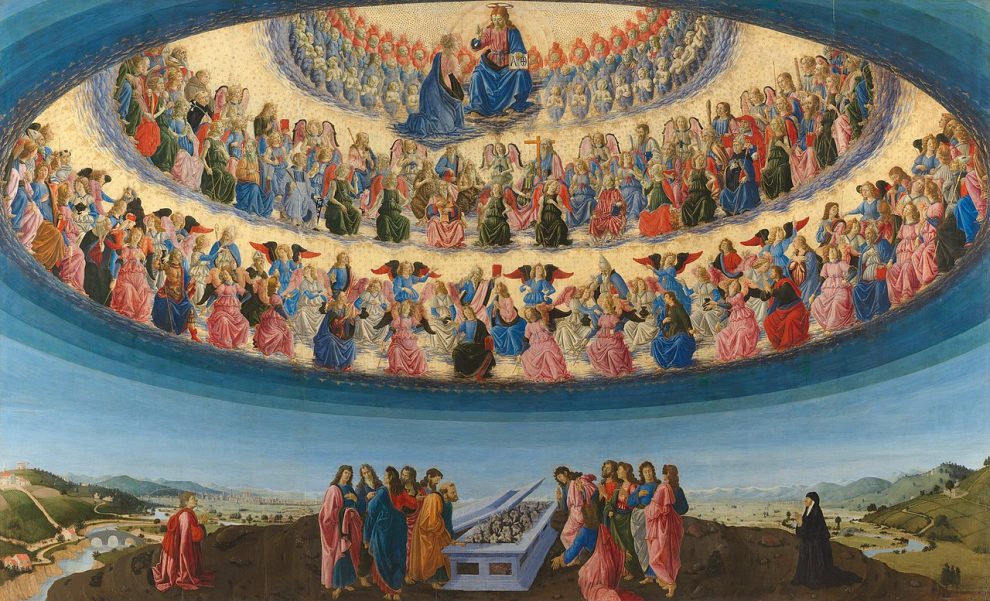
In 2013, the indie-rock band Vampire Weekend released a hit song called “Unbelievers,” in which the singer inquires whether the fire that “awaits unbelievers” is the fate that “half the world” has planned for them—in other words, the burning depths of hell.
One possible answer comes from the tradition called universalism. There are variations on universalism, some of which are controversial, but its basic claim is that all humans will ultimately be saved. In other words, to answer Vampire Weekend, no fire is waiting for anyone, even unbelievers.
Catholic doctrine is clear that God creates all human beings in God’s own “image and likeness” and relates to humans as a loving parent to their children. Therefore, God’s deepest desire is for all to be saved—which means that a kind of universalism is already alive in God’s work of creation. At the same time, Catholic doctrine holds that damnation is always a possibility because of free will. Through our choices, we can ultimately choose to reject God’s offer of salvation.
Yet the Catholic Church only claims to have revealed knowledge about salvation—the communion of saints—and makes no claims about any particular person being damned. Flemish Dominican Edward Schillebeeckx, a 20th-century theologian, called heaven and hell asymmetrical ideas. He pointed out that, in the end, there is only God’s reign. Hell, he argued, is not eternal punishment because that is not compatible with a God of love and justice. Rather, hell is the person’s choice to enter annihilation.
The Jewish scholars of Jesus’ time were already ruminating on the possible salvation of the Gentiles. Once Christianity separated from Judaism, one of the earliest Christian writers to make the case for a kind of universalism was Origen of Alexandria. Origen wrote of apokatastasis—a Greek word indicating the restoration of all things into original goodness—including Satan and the damned.
The church condemned Origen’s account of apokatastasis, which involved a belief in the preexistence of souls. However, theologians have continued to debate the idea of an ultimate restoration. Gregory of Nyssa, Maximus the Confessor, and others have all reinterpreted the idea. In the medieval Latin West, mystic Julian of Norwich advanced a kind of universalism, although one that required human cooperation with God’s grace. In the 20th century, Catholic theologian Hans Urs von Balthasar and Reformed theologian Karl Barth wondered: Dare we hope that all will be saved? They reaffirmed the possibility of universal salvation, if not the actualization of it.
The Catholic doctrine of purgatory can be envisioned as part of a universalist theology, since people in purgatory are on their way to eternal salvation.
Even if one is not a universalist, the answer to Vampire Weekend’s question is still that no one is predestined or fated to be damned. The future is in flux and always open to how and when one encounters and responds to God’s presence. As Julian of Norwich pointed out, in the end, “all shall be well, all shall be well, and all manner of things shall be well.”

This article also appears in the February 2026 issue of U.S. Catholic (Vol. 91, No. 2, page 49). Click here to subscribe to the magazine.
Image: Wikimedia Commons





Add comment