

When we think of the saints, we may picture peaceful souls lost in prayer, far from political turmoil. In fact, however, many of the holiest people in Christian history were anything but quiet and compliant. On the contrary, their intense connections with God put them at risk.
Faithfulness propelled these saints into situations where conscience and law collided—and despite the danger to themselves, they chose love as their higher law. Their inner commitment to God flowed outward, into the world. For them, civil disobedience was an act of faith; their resistance was the direct product of their spiritual lives. They were holy troublemakers and spiritual rebels whose faith put them in conflict with the powers of their day.
Prioritizing God’s call
During Christianity’s earliest centuries, Christ’s followers understood that allegiance to Jesus meant defiance of empire. When Roman officials demanded loyalty to Caesar, believers such as Perpetua, Felicity, Justin Martyr, and Agnes claimed a different ruler. They went to their executions as witnesses to a greater authority. “Stand fast in the faith,” Perpetua told her companions, “and love one another.”
These early Christians’ courage shaped the lineage that’s still ours today: When we are obedient to Christ’s law of love, our prayers often become protests. The martyrs’ resistance was not rebellion for its own sake but a commitment to a higher allegiance. They remind us that faith and witness are inseparable. As we worship God, we too may hear the divine call to confront unjust power. Can we answer as those early martyrs did? Are we willing to obey love’s demands?

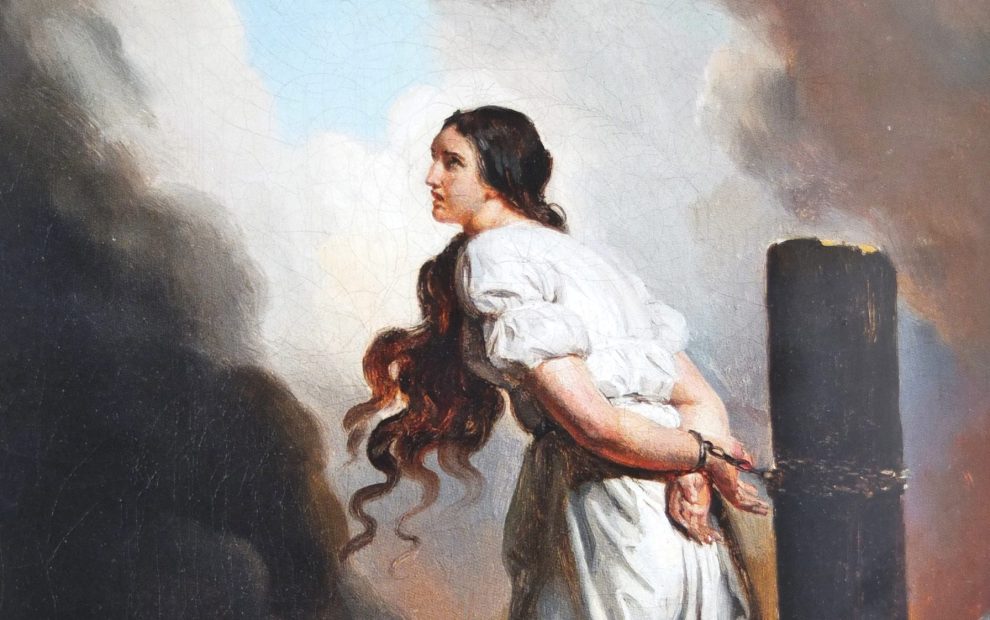
Centuries after Perpetua and her companions, that same fierce obedience burned in Joan of Arc. While still an adolescent, Joan was a visionary, a mystic who encountered God directly and intensely. The angelic voices she heard did not lead her to a life of quiet holiness, though; they drove her straight into the heart of war. She donned armor, led troops, and claimed divine authority against kings and bishops.
“Act, and God will act,” she said, expressing the same theology we’ve been describing. Our love of God demands that we act in love, regardless of the consequences. Joan’s deep spirituality didn’t protect her from physical danger; the church condemned her, and the state killed her. Her story, however, is proof that interior vision can spill outward until it changes history.
Across time, saints have differed in temperament—some fiery like Joan, some gentler, like Thomas More in the 16th century, who resisted not with his sword but with his silence. When King Henry VIII demanded that England place its monarch’s authority above the church’s, More refused to make the oath of loyalty; the king had him executed for his refusal. “I die the King’s good servant, and God’s first,” More said from the scaffold. Like Joan, he placed the divine call higher than any human demand. Sometimes, holiness expresses itself with a simple refusal to compromise the truth.
What does love demand?
Obedience to love carries us across the borders we thought defined right and wrong. Sometimes, it has also carried believers across literal borders. Harriet Tubman, for example, defied the Fugitive Slave Acts to shepherd enslaved people in the South to freedom in the North. Like Joan, she too heard divine instructions—visions that told her when to hide, when to run. “I said to the Lord, I’m going to hold steady on to you,” Tubman said, “and I know you will see me through.” Her defiance was prayer in motion.

In every generation, contemplation and resistance have turned out to be twin expressions of faith; this same reality shone even in the dark years of Nazi fascism. St. Titus Brandsma, a Dutch Carmelite, spent his final years urging Catholic editors to reject Nazi propaganda. His resistance caused him to be imprisoned at Dachau, where he eventually died. But he was also later canonized, as the church affirmed that rebellion can be sacred. At his canonization ceremony, Pope Francis said that Brandsma’s actions had fostered the “spiritual and social growth . . . of the entire human family.” For Brandsma, contemplation and action were two sides of the same coin.
Dietrich Bonhoeffer, the Lutheran theologian, made the same discovery in his seminary and then later in a Nazi concentration camp. Prayer without justice is hollow, Bonhoeffer realized. Hitler put both men to death, but their voices still ring out to us today. “Silence in the face of evil is itself evil,” Bonhoeffer wrote.
The German students of the White Rose movement took those words to heart. Twenty-one-year-old Sophie Scholl passed out leaflets that named the truth her nation denied. “What does my death matter,” she said as she went to her execution, “if by our acts thousands are warned and alerted?” Obedience to God, she realized, required disobedience to the Führer.
Cries of justice also rose from the cotton fields of Mississippi; among them was Fannie Lou Hamer’s voice. Beaten and jailed for insisting on the right to vote, she prayed and sang in her jail cell. Freedom, Hamer knew, is both communal and reciprocal. “Nobody’s free until everybody’s free,” she proclaimed.
And in 20th-century El Salvador, Archbishop Óscar Romero also discovered that sometimes love demands outrage. Once a quiet and cautious scholar, the sight of his people’s suffering transformed him. His homilies—broadcast across the nation—called soldiers to refuse unjust orders. “A church that doesn’t provoke any crisis,” he warned, “what gospel is that?” The bullet that struck him during Mass ended his life but could not silence the challenge he left behind.
Holiness is never passive
Across these lives, the same patterns repeat: Inner communion with God births external courage; contemplation ripens into action. These individuals’ defiance did not spring from rage but from intimacy with God. In stillness, they heard a command that sounded simple and absolute: Love one another. Everything else that happened in their lives followed their obedience to those three words.
The laws they broke varied—imperial decrees, royal oaths, racial codes, fascist edicts—but their reason for their actions was the same: They recognized a deeper law. To obey that law meant risking their lives, but to disobey it would have endangered their souls’ connection with God.
Their stories still ask us uncomfortable questions: What modern laws and policies contradict the law of love? Where do our prayers call us not to comfort but to courage? To follow Christ has never meant unmindful submission to power. It means cultivating the silence where we can hear God’s voice—and the boldness to act on it, whatever the cost.
Holiness, these rebellious saints remind us, is not passivity. It is the steady, creative energy of divine compassion taking flesh in a world that resists it. From Rome’s arenas to Nazi camps, from underground railways to modern city streets, the Spirit keeps whispering the same invitation: Listen deeply, love fiercely, and, when love demands it, break the law.
This article also appears in the January 2026 issue of U.S. Catholic (Vol. 91, No. 1, pages 17-19). Click here to subscribe to the magazine.
Image: Alexandre-Évariste Fragonard, Joan of Arc at the Stake, circa 1822, oil on canvas, Musée des Beaux-Arts de Rouen






Add comment