

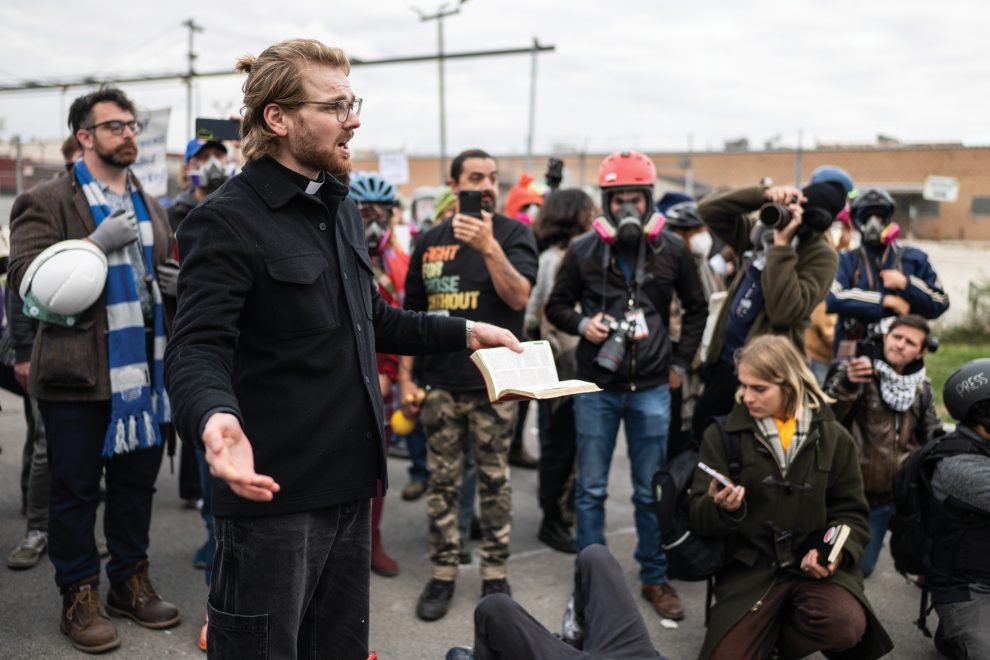
This past October, outside Chicago’s Broadview Detention Center, federal agents struck Presbyterian pastor David Black seven times in the head and upper body with pellet bullets containing a chemical irritant as he prayed for those detained inside. These agents attacked a member of the clergy in full public view while he exercised a First Amendment right. If federal agents felt free to harm a peacefully praying pastor, what further violations of the rights to religious expression and peaceful assembly might follow? The next month, one possible answer to this question became clear: Federal officials further infringed upon the First Amendment by banning prayer outside the Broadview Detention Center altogether.
This is just one example of how, in 2025, the deployment of National Guard units and agents from various federal agencies—including the Department of Homeland Security (DHS), Immigration and Customs Enforcement (ICE), Customs and Border Patrol (CBP), and DHS-contracted private operatives—led to the use of force in situations when it clearly was not justified. These actions not only escalated tensions between civilians and law enforcement but also raised critical ethical and constitutional concerns regarding the boundaries of government authority.
Black’s violent encounter with federal agents reveals how deeply respect for civil liberties and basic moral restraint has eroded. But this incident cannot be understood in isolation. It reflects a deeper political and moral disorder that the country continues to confront: authoritarian ideologies and the erosion of civil liberties that are explicitly named in the United States Constitution. The reckless use of force against Black suggests that segments of the American public and some government actors still have not learned that the unchecked use of state power combined with a disregard for constitutional freedoms threatens the very fabric of democratic life.
Consider the broader context of religious liberty in the United States. The Constitution protects every individual’s right to worship, pray, gather, and act according to their own conscience without intimidation or interference from the state. These protections extend beyond houses of worship into public spaces, where religious expression has long been a visible part of American civic life. When federal agents use force against individuals peacefully engaging in acts of faith, the government undermines one of the nation’s oldest and most cherished liberties. The assault on Black underscores how precarious these freedoms become when state institutions adopt a posture of suspicion or hostility toward any religious activity that does not align with political priorities or law-enforcement agendas.
The Catholic moral tradition offers enduring guidance on the appropriate use of force. Augustine’s just war theory and Aquinas’ elaboration of Augustine in the Summa Theologica insist that violence, although sometimes permissible, must be guided by moral intent and directed toward restoring peace and justice. Even in wartime, force must be proportionate. Deploying overwhelming or excessive violence violates this fundamental principle.
By these standards, the attack on Black was unjust. He was unarmed, posed no conceivable threat, and was engaged in an act of prayer. The force used against him was wildly disproportionate and therefore morally indefensible. Within this moral framework, the state’s actions constitute a grave failure. Maintaining political priorities and law-enforcement agendas cannot supersede the right to worship freely, and it most certainly cannot override the inherent dignity of the human person.
Defending religious freedom requires that government forces exercise the highest degree of restraint when citizens pray, worship, or act according to conscience. When the state disregards this responsibility, it not only violates individual rights but also erodes the foundational commitment to pluralism that sustains American democracy. An assault on a person praying is more than an instance of excessive force; it is a warning about the consequences of allowing the state to intrude upon the sacred space of religious expression.
As we embark on the new year of 2026, Catholics and all individuals with a commitment to goodwill are urged to contemplate the events of recent years. The use of force and suppression of prayer outside the Broadview Detention Center serves as a poignant moral parable, highlighting the perils of unchecked authority and the vulnerability of civil and religious liberties. A nation that proclaims liberty and justice for all must ensure that proportionality, moral restraint, and respect for human dignity are not mere aspirational ideals but tangible commitments manifested by those who wield public authority. Only through unwavering commitment can the promise of religious freedom, a cornerstone of the American experiment since its inception, be safeguarded for all.

This article also appears in the January 2026 issue of U.S. Catholic (Vol. 91, No. 1, page 40-41). Click here to subscribe to the magazine.




Add comment