

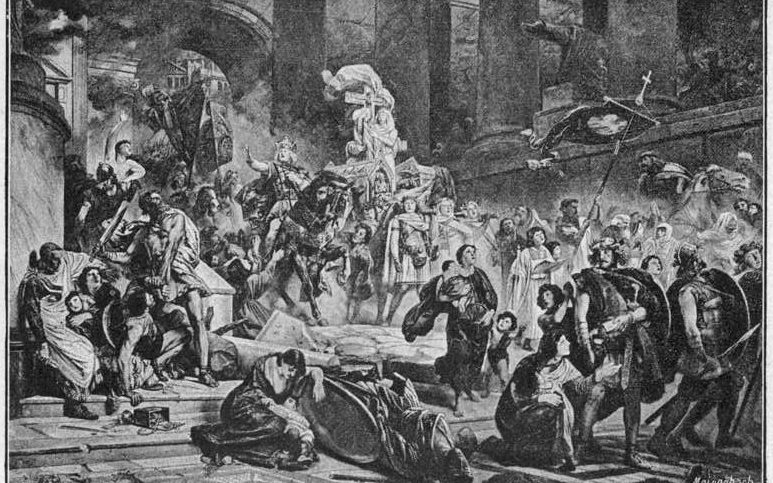
In August 410, Visigoths seized the city of Rome, the Eternal City, sacking it over the course of three days. This event stunned the world, prompting St. Jerome, writing from Bethlehem, to say that the “whole world perished in one city.” The event signaled a major turning point in the fall of the Western Roman Empire.
Refugees from Rome crossed the Mediterranean and flooded to Northern Africa, as well as other territories in the East, including Palestine. Jerome asked in wonder why “we should every day be receiving in this holy Bethlehem men and women who once were noble and abounding in every kind of wealth but are now reduced to poverty?”
The numbers of refugees were overwhelming, and the holy places were crowded with penniless migrants. “There is not a single hour, nor a single moment,” Jerome said, “in which we are not relieving crowds of brethren, and the quiet of the monastery has been changed into the bustle of a guest house. . . . Who would have believed that mighty Rome, with its careless security of wealth, would be reduced to such extremities as to need shelter, food, and clothing?” Making matters worse, not all refugees were met with Christian charity: Many were attacked by thieves who thought that they hid gold in their ragged clothing.
Europe, the poorer region
In the 21st century, when we think of refugees and migrants fleeing violence or poverty in search of a better life, we imagine people fleeing the Global South for the Global North. Coming from poorer parts of the world, they journey towards safer and more prosperous destinations. However, history teaches us that the world has changed greatly over time, and this wasn’t always the case.
In the 5th century, when the Visigoths sacked Rome, the Roman Empire included parts of Algeria, Tunisia, Libya, Egypt, Turkey, and the Middle East, areas today regarded as poorer than western Europe. Back then, however, these were the wealthier and more populated parts of the Roman Empire. The only great city in Europe was Rome itself; the rest of the empire included Carthage, Constantinople, Antioch, Alexandria, and Damascus. The imperial government in Constantinople brought in over ten times the amount of gold, in annual revenue, as the western part of the empire did.
After the death of the Emperor Theodosius in 395, the Roman Empire was divided in two. The eastern part of the Empire—which included parts of eastern Europe such as what is now Albania, Bulgaria, and Greece; Turkey; part of Libya and Egypt; and the Middle East—could no longer afford to subsidize the Western part—or what is now Western Europe and the Levant, or the coastal areas of what is now Morocco, Algeria, Tunisia, and part of Libya. The East, which would develop into the Byzantine Empire, would continue for another thousand years. The fate of the West, however, went into decline, leading to the circumstances that led to migrants fleeing Western Europe.
More southern migrations
The Visigoth invasion was not the only time that European refugees fled to Africa. In 1492, Spanish Jews were forced to choose between conversion to Christianity or exile. Most of the expelled Jews sought refuge in North Africa. Many eventually settled in territories belonging to the Ottoman Empire. Sultan Bayezid II welcomed them and, criticizing Spanish King Ferdinand, said, “You call him king who impoverishes his states to enrich mine?”
Centuries later, in the late 19th and early 20th centuries, poverty forced Europeans to flee south in search of a better life. This included Italians from southern Italy and Sicily. While many migrated to the United States, others settled in the Middle East and North Africa due to both economic factors and Italian political instability.

Migration today
Today, poverty and political instability continue to compel people to leave their homes. According to the Geneva-based International Organization of Migration (IOM), in 2020 there were 281 million international migrants: This amounts to 3.6 percent of the global population. The number of international migrants has also increased over the past five decades: In 2020 there were 128 million more migrants than in 1990 and over three times the estimated number of people living in a country other than their country of birth in 1970.
The IOM has also reported that, since 2014, more than 63,000 migrants have died. About 28,000 of these deaths occurred in the Mediterranean.
According to a 2021 report from the Africa Center for Strategic Studies, primary causes for African migration include war, government repression, and limited economic opportunities. Of the top 15 African countries that migrants flee, more than half are in conflict. The United Nations High Commissioner for Refugees (UNHCR) reported that, by the end of 2024, the conflict in Sudan had exacerbated the world’s largest displacement crisis, with 14.3 million people forced from their homes.
Our duty as followers of Christ
On April 25, 2021, Pope Francis, speaking after the recitation of the Regina Caeli, referred to a tragedy the previous week, when a large number of migrants died after their inflatable boat sank off the coast of Libya—despite having sent out distress calls. “I confess I am extremely sad,” he said, “over the tragedy that has once again taken place in the Mediterranean. One hundred thirty migrants died in the sea. They are people. They are human beings who begged for help in vain for two whole days—help that never arrived.”
Following in the footsteps of Francis, Pope Leo XIV has also appealed for aid to migrants. On October 14, 2025, Leo met with the President Sergio Mattarella of Italy. He thanked the nation for its work in opposition to human trafficking but urged the country to remain open to welcoming and integrating migrants.
The witness of these two popes is a reminder that, as we witness the suffering of those fleeing across the Mediterranean north to Europe, there was a time when other generations of refugees crossed this very same sea, but going in the opposite direction. May we always remember Christ’s words in Matthew 25: “I was a stranger and you welcomed me.”
Image: Wikimedia Commons, the Sack of Rome in 410




Add comment