

I spent half of October in Tunisia, a country with more olive trees than people and more date palms than cars. (I actually have no idea if these facts are correct, but that’s certainly what it felt like as we drove through hour after hour of olive groves.)
It was date season when we were there, and I found it hard to wrap my head around the sheer scale of the harvest. Everywhere we looked, it seemed like, huge dark clusters of ripe dates hung 20 to 30 feet off the ground in tall palm trees. We would regularly pass pick-up trucks loaded high with dates. Entire town markets were devoted to dates, ensuring that people in Tunis and the other cities had enough for the whole year. At every meal, every restaurant, every hotel, people proudly offered us dates fresh off the tree, sometimes encouraging us to try them with bsissa, a paste made of roasted sesame seeds and other nuts that resembles a thick and filling peanut butter and is often eaten to break the Ramadan fast.
Tunisia, of course, is on the other side of the Mediterranean Sea from where Jesus was born and raised, but the agriculture is similar. People still, to this day, live primarily off what the land can provide—things like dates, olive oil, honey, fish, grains and small flocks of chickens and sheep. Very little is imported, and everything has its use. Experiencing the date harvest, seeing how the entire country comes together to harvest and save the dates for the next year, it was easy to imagine how the same cycles of planting and abundant harvest might have existed 2,000 years ago.
Indeed, while there are many reasons we celebrate the birth of Jesus in December (many of which are laid out in this month’s Glad You Asked essay), some scholars have suggested that perhaps his birth was more likely to have occurred during the fall harvest season. Biblical scholar Raymond Brown, for example, points out that the story about shepherds suggests that Jesus’ birth occurred in spring or autumn, relatively mild seasons when shepherds kept their flocks outdoors overnight. Other biblical scholars have connected the time of Christ’s birth to the Jewish harvest festival of Sukkot, which occurs in mid-October. Maybe Mary and Joseph saw sights similar to the ones I saw in Tunisia—teams of men scaling tall date trees, town squares full of baskets upon baskets of dates, camels and donkeys and horses laden down with the abundant harvest.
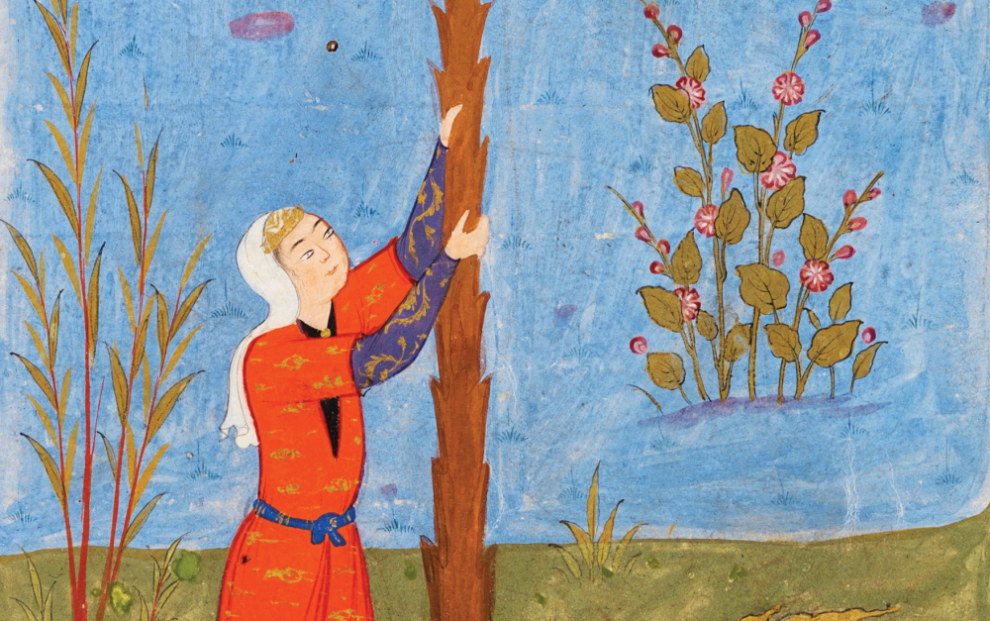
There’s actually a story that suggests this—one not from the Bible, but from the Quran. (The Quran mentions Mary 70 times, referring to her as the greatest woman who ever lived because God chose her to give birth to Jesus.) In this particular story, Mary has gone into the desert to labor alone. Unmarried and pregnant, she faces judgment and scorn from her family and acquaintances; the Quran doesn’t have much to say about where Joseph is in this whole story.
Exhausted and tired from contractions, Mary eventually takes shelter under a date palm tree. “Oh, I wish I had died,” she cries out. God, in return, calls out to her not to despair but to shake the trunk of the date tree. When she does so, ripe dates fall, allowing her to eat and be refreshed. She gives birth to Jesus and returns home, where she is welcomed back.
It turns out that this story contains a kernel of truth: For centuries women have eaten dates to prepare their bodies for labor. Indeed, modern studies suggest that there is actually some scientific value to this practice, and that it may have some impact in softening a woman’s cervix to prepare her for labor and delivery. I first heard this story in the final weeks of my own pregnancy, and the daily dates my OB suggested I eat made me feel connected to generations of women reaching all the way back to Mary.
But also, how different is this story from our traditional tellings, both in scripture and the popular imagination. There is no stable, no star, no crowds of shepherds or magi. Just Mary, alone in the desert, at the end of her strength. In some ways, it seems a bleaker narrative; a woman cast out by her community, in pain, taking shelter under a date tree. She must have felt so frustrated when she saw the tree; here was nourishment, but how was she to get it?

Date palms are tall palm trees and harvesting the fruit normally requires at least two strong men—one to scale the tree, which has very few handholds, and another to grab the large bunches of dates the first passes down. No wonder Mary wanted to die: In addition to labor pains and loneliness, she probably felt helpless. Only with God’s intervention and her own action would dates gently fall into her lap after shaking the tree trunk.
But this story also, in some ways, gives Mary a more active role in Jesus’ birth than most of the gospel writers do. Aside from Mary’s initial “yes” to God and Luke’s mention that Mary is “pondering in her heart” the events surrounding Jesus’ birth and childhood, Mary plays a passive role in the story. Joseph must go to Bethlehem; Mary follows along and gives birth to a baby, who she places in a manger. Joseph has a dream, so she follows her husband to Egypt, where her child and family will be safe. In the Quranic narrative, it is Mary who reaches out and physically does God’s will, shaking the tree so the dates fall.
Perhaps because Mary’s physicality is so absent from the gospel story, Christians can’t even agree over whether Mary experienced labor pains. The Quran leaves no doubt that Mary did the work of laboring to birth Jesus. And, when Mary was exhausted, hungry, and thirsty, God’s response wasn’t abstract promises but tangible resources: dates to slake both her hunger and her thirst and perhaps, to make labor a little easier on her body.
The story hammers home something true about our faith: It is not enough to say yes to God; we must do something about it. If the gospels show us a Mary who says yes to God, the Quran shows us a Mary who does something about it. Belief is about both the surrender to God’s plan and the willingness to reach out and act, even when it seems hard. God could have said, “I know you are tired; I’ll let some dates fall right into your lap.” But instead God asks Mary—asks all of us—to stretch, to act, to do what may seem downright impossible.
Catholics don’t believe that faith is merely a personal belief in Jesus Christ. Our relationship with God is personal, yes, but it doesn’t stay in our heads or in silent prayers. Pope Francis once said, “You pray for the hungry. Then you feed them. That’s how prayer works.” In other words, prayer and action cannot be separated. The two nativity stories—both in the gospels and in the Quran—show the two sides of our faith. Belief and action, prayer and labor.
During Advent, we spend a lot of time waiting—for Christ’s birth, for the peaceable kingdom, for the light of the world. But Mary’s laboring in the desert shows us that waiting is not passive; it is hard, active work. Trusting in God is not only about our words or intentions but about the very real ways we respond to God’s invitation. Sometimes this looks like reaching out in the midst of exhaustion and despair to shake the nearest tree, trusting that God will provide nourishment. Other times it looks like showing up to do the work of justice, even when we’re tired or unsure.
The incarnation began with Mary saying “yes” to God—but the verbal assent to God’s plan isn’t enough. We continue to build the kingdom of God every time we act out of faith. And, perhaps, if we stretch toward God, even when it feels like we can’t go any further, we will find that nourishment falls into our open hands.
This article also appears in the December 2025 issue of U.S. Catholic (Vol. 90, No. 12, pages 47-49). Click here to subscribe to the magazine.
Image: Wikimedia COmmons



Add comment