It was a beautiful autumn morning. The air was cool, the leaves beginning to change colors and the skies blue with scattered clouds, as I marched with a thousand siblings in Christ in a eucharistic procession from St. Eulalia Parish to the Broadview Detention Center outside of Chicago.
We were tired. Our city, neighbors, and families were living through a season of trials and tribulations. We were also angry. People were being abused, abducted, and occasionally killed with impunity by a legal government entity, Immigration and Customs Enforcement (ICE). We needed to know we were not alone in our suffering, or in our burning desire for justice in this time of oppression.
So, we gathered, prayed formally in the sanctuary, then prayed with our feet on the one-mile march behind the blessed sacrament. We channeled our strong emotions into the collective moment. We sang songs, prayed the rosary, laughed, teared up, and waved with joy at families coming out of their homes to see us and to offer their support. For a short time, we tried to be Christ’s body.
This was organized by the Coalition for Spiritual and Public Life (CSPL). The goal was a simple request: for ICE to allow entry to a small delegation of around eight Catholic ministers—priests, sisters, laypeople—to the facility to offer the Eucharist and pastoral care to the detainees. Since we try to follow the way of Jesus and practice love of our enemies, we intended to offer sincere pastoral care and the Eucharist to ICE agents as well. This request was in accordance with local, national, and international laws and norms based in human rights for anyone being detained.
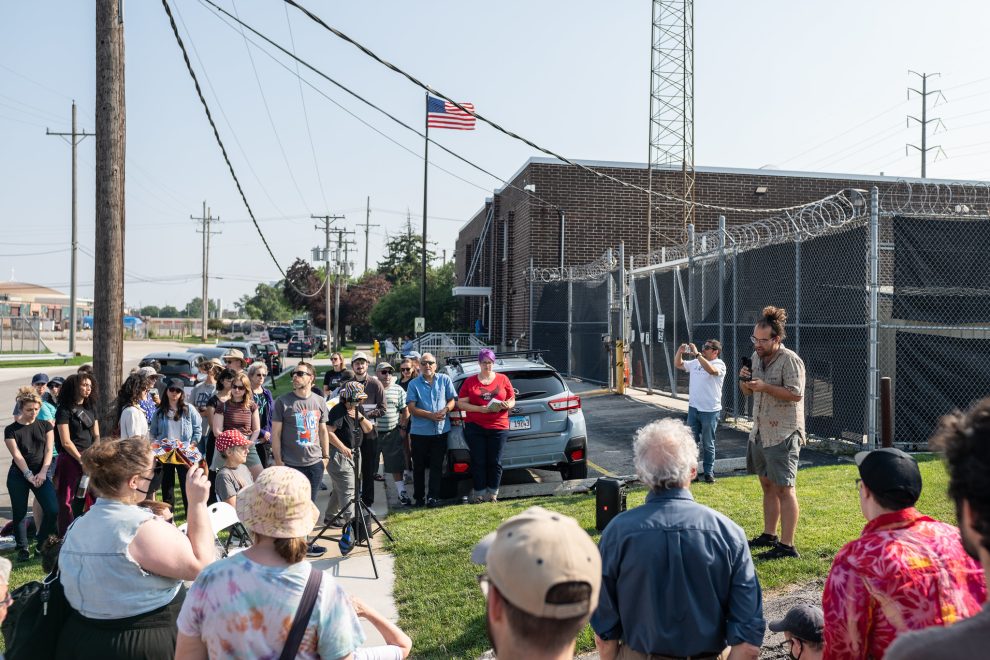
After arriving in the parking lot next to the detention facility, we listened to the organizers as they instructed us where to gather legally since there were no specific plans for actions of civil disobedience. The delegation approached the facility, while the rest of us prayed, chatted, sang, and hoped for the delegation to be permitted entry to carry out their ministerial calling.
We saw no one from ICE anywhere in the vicinity, so the Illinois State Police—who escorted our procession—contacted ICE over their radios. They then relayed the news to the delegation of ministers: they would neither meet with us nor allow us entry. This was not an enormous surprise. What was surprising was the utter absence of any ICE officials. Not only were we denied entry; no ICE representative or agent even had the courage to meet with us face to face.
In the days and weeks prior to this procession, ICE agents had been not only visible but constantly active and confrontational with protesters. Sometimes from the roof, looking down. Sometimes face to face among the crowd. They had been documented physically engaging with protestors, sometimes using smoke bombs or concussion grenades, and once even shooting a clergy member in the head with pepper spray balls without provocation.
Yet here we were with nothing but the monstrance that contained the Eucharist, a team of eucharistic and pastoral ministers, and a thousand unarmed women and men of all ages, all wearing the same yellow shirt with an image of Our Lady of Guadalupe and a verse from the Magnificat—and no one had the courage to meet us.
At first, many of us were furious, but the leadership delegation led us in prayer and shared the Eucharist in the parking lot next to the detention center. In that space and moment, we could still be Christ’s body in solidarity with those whom we were prohibited from meeting.
After closing prayers and songs, I walked over to the wall of the detention center and, trembling with anger and sorrow, knelt on the pavement, and placed my hands on the cold brick wall. I prayed that God’s Spirit would make itself known to our siblings on the other side of the wall. I prayed for the liberation of the imprisoned, justice for our broken society, and repentance on the part of the perpetrators who were serving sin and evil. Ultimately, I prayed that God make a way out of no way.
But that was it. The procession, Eucharist, prayers, singing, and rituals were concluded. We had failed.
As we walked back, frustrated, to the parish, a thought occurred to me. Yes, we failed. But in that very failure was a small victory: We demonstrated that God’s power is stronger than the power of the nation-state. Because the men with the guns, uniforms, and military accoutrements, as well as their commanders, were afraid of us. They were cowards, and for a very simple reason: they could not control the media narrative or the optics of this encounter. They could not ascribe nefarious intentions or sinister meanings to us or our Catholic rituals and symbols. I think they understood that they had already lost, because their consciences were guilty, while ours were clean, and we were calling them to confess and repent.
Had they met with us, refused us entry, and received our nonviolent response to offer pastoral care to them as perpetrators—even though we could not reach those in detention—their moral acquiescence to evil would have become apparent to a much broader audience, and to themselves as well. That kind of moral disruption could not be tolerated in an institution defined by the power of violence, terrorism, and fear. Nonviolence, courage, and humane encounters with “enemies” would call their entire existence into question. That could not be tolerated.
In 1963, Martin Luther King Jr. wrote, “On sweltering summer days and crisp autumn mornings I have looked at the South’s beautiful churches with their lofty spires pointing heavenward. I have beheld the impressive outlines of her massive religious education buildings. Over and over, I have found myself asking ‘What kind of people worship here? Who is their God?’”
I am a Catholic in an ecumenical marriage, living in Chicago, and these words from King haunt me often. The ICE officials and their commanders on all levels of government often proclaim their faith, most often in some variation of Christianity. But I wonder—just as King wondered. Especially after last fall, in the aftermath of Operation Midway Blitz and the sloth-like response of so many faith communities and the swifter response by communities where faith is more marginal.
Jesus taught that oftentimes the work of co-creating God’s “kin-dom” was already present in almost imperceptible ways. That’s why he used metaphors like that of the mustard seed and the yeast in the dough. As the one-year anniversary of the Broadview procession is upon us, there is reason to hope. The tiny mustard seed we planted in 2025 has germinated and begun to grow. The denial of entry kickstarted the legal battle that at this moment has resulted in a temporary injunction allowing access to pastoral care. Since May 15 of this year, CSPL has been sending a group of ministers to Broadview daily. The ministry groups are primarily Christian and Catholic but other faith groups are also involved, and welcomed with enthusiasm. Since the procession, CSPL has garnered attention from the Vatican. Michael Okinczyc-Cruz has represented the organization twice in meetings with the Pope and CSPL is sending a delegation to Rome in October for a general audience. All of this provides grounds for hope.
These victories on behalf of human dignity, the empowerment to care for and accompany our sisters and brothers, the call to offer witness and testimony to the public about the saturation of this evil into our society, demonstrate that the power of nonviolenceis effective in co-creating a more just social order. This is a reminder that God’s ways are not our ways, and that God “is faithful and will make it happen” (1 Thess 5:24). Will the gains achieved through nonviolence be permanent? That remains unclear in times like these. But we have hope.
Eight months before his assassination, King publicly pronounced, “America, you must be born again!” This prophetic preaching was rooted in hope and speaks to us today. A sin-filled society can still be redeemed. God is already at work liberating the oppressed. God’s salvation is arriving here and now, for all persons, oppressed and oppressor, sinned-against and sinner. God will have the final word of justice, liberation, redemption, and healing—despite all evidence to the contrary.
Yes, the terror and violence of ICE continues. Its unjust detention system has not yet been dismantled; the prisoners have not yet been liberated. As the struggle continues, it seems to demand more energy and resources, yet we have a foretaste of the “kin-dom” that God is already creating. We have the eucharistic procession, the legal victories. Many have acquired training, and we have gained the attention of the broader society as well as Pope Leo and the Vatican. This is the beginning of what King called the “beloved community” where the shackles of oppression have been shattered, the sinned-against empowered to seek healing for their wounds, and the sinners emboldened to repent from serving evil and seek repair for social and personal harms.
Even when the hour seems late, violence and fascism become normalized, and our best actions seem to end in abject failure, God will not be deterred. God’s justice, healing, liberation, and forgiveness will have the final word.
As we see these small but real victories, King’s words carry encouragement and hope:
“Let this affirmation be our ringing cry. It will give us the courage to face the uncertainties of the future. It will give our tired feet new strength as we continue our forward stride toward the city of freedom. When our days become dreary with low-hovering clouds of despair, and when our night become darker than a thousand midnights, let us remember there is a creative force working in this universe to pull down the gigantic mountains of evil, a power that is able to make a way out of no way and transform dark yesterdays into bright tomorrows.”
That is a hope gifted by God, grounded in daily life and struggle, that offers strength, wisdom, and resilience in the work ahead. Let us accept that gift, share it with one another, and let it grow and sustain us as we continue the work.
Image: Paul Goyette, CC BY 4.0, protestors hold a service outside of the Broadview ICE detention facility in Chicago